Anki Vector 2 0 · Volume 1
Overview — Vector, the Robot Pet That Outlived Its Maker
1.1 What it is
Vector is a palm-sized autonomous desktop companion robot — a “robot pet” built to live on a desk, recognise the people around it, wander its small territory, and return to its own charging dock when it runs low. Anki introduced it in October 2018 (Oct 12 per Wikipedia; Oct 13 per iFixit — the two records disagree on the day) as the always-on, self-sufficient successor to the company’s earlier Cozmo. Where Cozmo needed a smartphone running its app to act as a brain, Vector carries its own computer, listens for the wake phrase “Hey Vector,” and answers questions, sets timers, takes photos, and reacts to touch and motion without a phone tethered to it (Wikipedia; anki.bot “Meet Vector”; iFixit).
What makes Vector worth a place in this hub is not what it was, but what happened to it. Its conversational intelligence — speech recognition and the knowledge-graph answers behind “Hey Vector” — never ran on the robot. It ran in Anki’s, and later Digital Dream Labs’, cloud, and that cloud is gone: dead to the community since mid-2023 and officially shut down by January 2024 (Wikipedia; wiki.thedroidyouarelookingfor.info; iFixit). A robot whose maker went bankrupt twice over should, by rights, be a paperweight. Instead Vector is kept fully alive by an open community local stack — chiefly wire-pod, a free open-source server that replaces the dead cloud on an unmodified robot. This deep dive is, above all, the story of that revival.
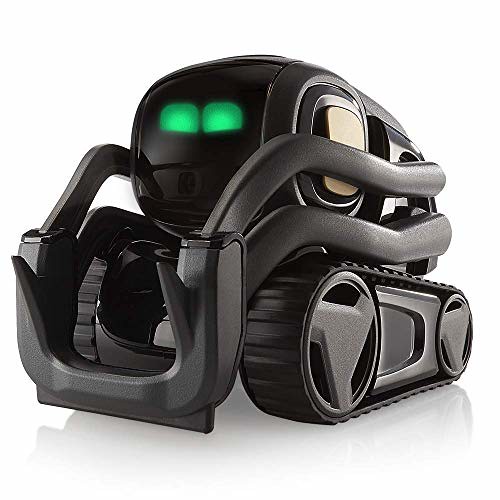
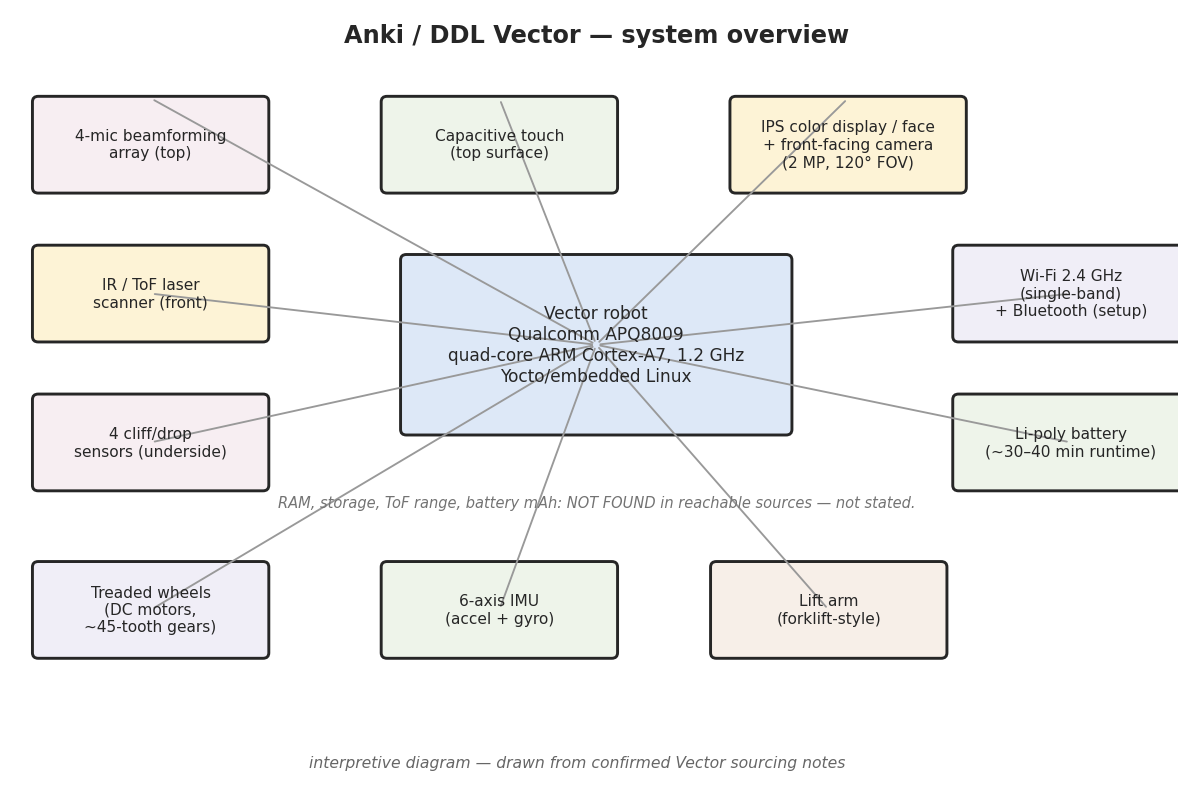
Physically Vector is a small tracked machine: two treaded wheels driven by DC motors, a forklift-style lift arm at the front, a high-resolution colour IPS display that serves as its expressive “face,” and a front-facing camera set into that face. It ships with a charging dock and a companion cube it can recognise and interact with (iFixit; wevolver; anki.bot). Its sensing is dense for its size — a four-microphone beamforming array, an infrared time-of-flight laser distance scanner, four cliff/drop sensors, a capacitive touch surface on top, and a six-axis IMU — all coordinated by an onboard Qualcomm Snapdragon running embedded Linux (wevolver; Kinvert; iFixit). Vol 3 opens that hardware up in detail.
1.2 Headline facts
Vector is a closed consumer product that was never accompanied by a public service manual, so much of what is known about its internals is community-reverse-engineered. The table below marks each row confirmed (stated by a reachable primary or authoritative source) or unverified (community-reported or single-secondary); items no reachable source pins down are left out rather than guessed.
Table 1 — Headline facts
| Attribute | Value | Confidence / Source |
|---|---|---|
| Name | Vector — Anki’s autonomous desktop companion | confirmed (Wikipedia) |
| Maker | Anki (2018), then Digital Dream Labs (acq. Dec 2019) | confirmed (Robot Report; PRNewswire) |
| Released | October 2018 (Oct 12 vs Oct 13 — sources conflict) | confirmed, date disputed (Wikipedia; iFixit) |
| Lineage | Successor to Cozmo (Anki, 2016) | confirmed (Wikipedia) |
| Wake phrase | ”Hey Vector” (English only) | confirmed (Wikipedia; ankicozmorobot) |
| Processor | Qualcomm Snapdragon APQ8009, quad-core ARM Cortex-A7, 1.2 GHz | confirmed, community-sourced (thedroidyouarelookingfor; wevolver; Kinvert) |
| OS | Yocto / embedded Linux | confirmed (thedroidyouarelookingfor; wevolver) |
| RAM / storage | Not stated in any reachable source | unknown — left unclaimed |
| Camera | 2 MP, 120° ultra-wide FOV (Vector 2.0) | confirmed (anki.bot; wevolver) |
| Display | High-resolution colour IPS “face” | confirmed (anki.bot); 184×96 per one teardown (unverified) |
| Microphones | Four-microphone beamforming array | confirmed (wevolver; anki.bot) |
| Distance | Infrared time-of-flight laser scanner (range not stated) | confirmed; range unknown (wevolver) |
| Other sensors | 4 cliff/drop sensors, capacitive touch, 6-axis IMU | confirmed (wevolver; iFixit) |
| Connectivity | Wi-Fi 2.4 GHz single-band; Bluetooth for setup | confirmed (wevolver; anki.bot) |
| Power | Li-poly battery, ~30–40 min runtime; returns to dock | confirmed; capacity unverified |
| Original “brain” | Cloud-dependent voice/NLP (“Hey Vector”) + Alexa | confirmed (Wikipedia; vector-cloud) |
| Cloud status | Dead to community mid-2023; officially shut Jan 2024 | confirmed (thedroidyouarelookingfor; iFixit) |
| Kept alive by | wire-pod (open local server), OSKR, community SDK/ROS 2 | confirmed (wire-pod; DDL; nilseuropa/vector_ros2) |
| Price (Vector 2.0) | ~$400 commonly cited | confirmed (CBS Pittsburgh) |
The frequently-cited dimensions and weight (about 3.9 × 2.4 × 2.7 in, ~159 g) do not appear in any source reachable for this dive and are therefore treated as unverified; the 543-page Vector Technical Reference Manual is the likely route to the exact hardware figures and is noted for a future hardware pass.
1.3 The revival idea
The single fact that defines Vector today is that the robot you can buy still works, but the company behind it does not. Anki shut down at the end of April 2019; Digital Dream Labs bought the Vector assets in December 2019, relaunched products in 2021, and then let the cloud servers go dark in 2023 — and in September 2024 the Pennsylvania Attorney General sued DDL over roughly 14,000 prepaid orders that were never filled (Wikipedia; Robot Report; CBS Pittsburgh). The corporate story, told in full in Vol 2, is a cautionary tale. The engineering story is the opposite: an enthusiast community treated the dead cloud as a removable part.
Because Vector’s firmware core is closed but its cloud/voice layer is fully replaceable, the robot can be pointed at a local server instead of a vendor’s data centre. wire-pod (Vol 6) is that server — free, open-source, and able to drive an unmodified retail Vector with swappable local speech-to-text and a choice of language models. For owners who want to go deeper, OSKR (Vol 5) permanently unlocks a robot to a developer build, and a community Python SDK and a ROS 2 wrapper (Vol 7) expose its sensors and motors to real autonomy code. The dead cloud is, in effect, the one component the community engineered around.
1.4 Where it sits in this hub
Vector is this hub’s first companion-robot deep dive — the modern, software-centric counterpart to the vintage hardware machines it joins. The nearest sibling in spirit is the consumer HERO Jr (covered in its own dive): both are closed, switch-on-and-go home robots aimed at non-programmers rather than kit-builders. But the contrast is the point. A HERO Jr is kept alive the way any 1984 machine is — by sourcing batteries and nursing hardware. A Vector is kept alive by software: its body is fine, and what had to be rebuilt was the service it phoned home to. Restoring a Vector means standing up a server, not rebuilding a circuit.
Table 2 — Where it sits in this hub
| HERO Jr (RT-1) | Vector | |
|---|---|---|
| Era | 1984 | 2018 |
| Made for | The living room, switch-on-and-go | The desk, switch-on-and-go |
| Brain | Onboard Motorola 6808 | Onboard Snapdragon + a remote cloud |
| What can fail | Hardware (batteries, motors) | The vendor’s cloud service |
| Kept alive by | Spares + restoration | An open local server (wire-pod) |
| Vendor today | Long defunct (Heathkit consumer) | Defunct twice (Anki → DDL) |
A fuller cross-robot matrix sits in _shared/comparison.md.
1.5 What the volumes cover
The volumes that follow open each layer of the machine and its revival. Vol 2 tells the Anki → Digital Dream Labs saga and why the revival matters; Vol 3 documents the hardware architecture and the sensor suite; Vol 4 covers the original cloud/voice stack and exactly what the shutdown killed; Vol 5 is OSKR and unlocking the robot to a developer build; Vol 6 is wire-pod, the local cloud replacement and the centerpiece of the dive; Vol 7 is the community Python SDK and the ROS 2 path; Vol 8 is acquiring a unit and getting it revival-ready; and Vol 9 is the cheatsheet — specs, repository URLs, and the quick-reference revival path.
Sources
- Wikipedia, “Anki (American company)” and the Vector material — corporate history, lineage, release, cloud dependence.
- The Robot Report, “Anki assets acquired by Digital Dream Labs” and “Inside the Anki shutdown” — the bankruptcy, the asset sale, and the December 2019 acquisition.
- PRNewswire, “Digital Dream Labs Acquires Anki” — the acquisition release.
- CBS News Pittsburgh, “PA Attorney General lawsuit: Digital Dream Labs” — the Sept 2024 action and the ~$400 Vector 2.0 figure.
- wevolver, “Vector 2.0 AI Robot Companion” specs; Kinvert, “What’s Inside Anki Vector”; iFixit, “Anki Vector” device page — hardware and sensor suite.
- anki.bot, “Meet Vector” — vendor-side product description (live as Digital Dream Labs).
- wiki.thedroidyouarelookingfor.info — community technical wiki: Snapdragon APQ8009, the Yocto OS, and the cloud-shutdown timeline.
- github.com/kercre123/wire-pod; github.com/digital-dream-labs; github.com/nilseuropa/vector_ros2 — the community revival stack referenced forward to Vols 5–7.
- Full gated fact base with confirmed/unverified markers and source reachability:
02-inputs/vector_sourcing_notes.md.
Comments (0)