Anki Vector 2 0 · Volume 2
The Anki → DDL Saga
2.1 Why this story matters
The Anki → Digital Dream Labs corporate arc is not incidental context for Vector — it is the reason the machine is interesting at all. A robot whose maker collapsed into bankruptcy, whose assets changed hands in a distressed auction, whose second owner let the critical cloud infrastructure go dark, and who then faced a state attorney general lawsuit over thousands of prepaid orders that were never filled should, by every ordinary reckoning, be landfill. Instead Vector remains a fully functional robot in 2026, kept alive by a community local server that replaces the cloud component the corporate chain failed to sustain.
The thesis of this volume is precise: the cloud that died is the one component the community engineered around. wire-pod (covered in Vol 6) is the direct replacement for the DDL/Anki voice stack — it runs on a commodity host, drives an unmodified retail robot, and makes the entire corporate saga irrelevant to the owner who installs it. To understand why that matters, the failure must be told in detail.
2.2 Founding: CMU, 2010
Anki was founded in San Francisco in 2010 by three Carnegie Mellon University robotics graduates: Boris Sofman, Mark Palatucci, and Hanns Tappeiner (Wikipedia; Failory). The founders came out of CMU’s Robotics Institute and the School of Computer Science — a lineage that shaped the company’s technical ambition throughout its life. The pitch was consumer robotics built on real autonomy research: products that used onboard probabilistic reasoning and computer vision rather than the track-and-sensor minimalism of the toy market.
CMU origin is not incidental. The same academic context that produced Carnegie Mellon’s autonomous vehicle programmes and the DARPA Grand Challenge alumni fed directly into Anki’s approach to localisation and motion control — visible in the optical-encoder lane tracking of Anki Drive and, eventually, in the real-time face recognition and navigation running on Vector’s Snapdragon core.
2.3 The product line: 2013 to 2018
Anki’s commercial history is a four-product arc, each entry moving further up the capability ladder:
Table 1 — capability ladder
| Product | Launch | Anki price | Notes |
|---|---|---|---|
| Anki Drive | Oct 23, 2013 | $149.99 | Slot-car-style racing; onboard localisation via road-marking optical codes; smartphone-controlled |
| OVERDRIVE | September 2015 | — | Second-generation racing platform; modular track |
| Cozmo | October 2016 | ~$180 | App-tethered desktop robot; forklift-style arm; expressive OLED face; early computer-vision games |
| Vector | October 2018 (Oct 12 or 13 — sources conflict) | — | Always-on, self-sufficient companion; wake-phrase voice; onboard Snapdragon; no smartphone tether |
Sources: Wikipedia (all four products); Failory (Cozmo and Anki Drive pricing).
Cozmo is the direct hardware predecessor to Vector and shares the forklift arm and tracked-tread form factor. The key architectural difference is dependency: Cozmo requires a paired smartphone running the Anki app to function, because the smartphone provides its processing. Vector carries its own Qualcomm Snapdragon, listens continuously for “Hey Vector,” and routes voice intent to the cloud for NLP — but it does not require a phone after setup (Wikipedia; ankicozmorobot). The Cozmo → Vector transition is the step from a puppet (phone as brain) to a self-sufficient machine (onboard brain plus remote cloud). It is precisely that architecture — capable hardware, replaceable cloud layer — that makes Vector revivable.
2.3.1 Funding
Anki raised approximately $182.5 million across five rounds from investors including Andreessen Horowitz (a16z), Index Ventures, Two Sigma, and JP Morgan (Wikipedia; Failory). The Series C (September 2014) was confirmed at $55 million. The Series D figure is a conflict in the sources: Wikipedia renders it as “$502.5M,” which is internally inconsistent with the stated $182.5M total, and is most likely a data error; Failory reports the Series D as approximately $52.5M, which reconciles with the $182.5M aggregate. The $52.5M Series D figure is used here as the more plausible reading and should be considered unverified exact; the $182.5M total is confirmed by two independent sources.
2.4 Silicon Valley Bank’s security interest: March 2018
On March 30, 2018 — seven months before Vector launched — Silicon Valley Bank recorded a security interest in Anki’s intellectual property (Robot Report; Failory). This is a material detail in the collapse narrative: when Anki failed in April 2019, SVB’s lien on the IP assets would need to be cleared before those assets could be transferred to a new owner. The December 2019 Digital Dream Labs acquisition price was presumably structured to settle or supersede that interest, though neither the price nor the SVB settlement terms were disclosed publicly.
2.5 The end of April 2019: shutdown
At the end of April 2019 Anki abruptly shut down (Wikipedia; Robot Report). Operations ceased in May 2019; approximately 200 employees were laid off (Wikipedia; Robot Report). The San Francisco office contents were subsequently auctioned on June 18–20, 2019 (Wikipedia; Robot Report).
The public explanation was funding. A last-minute funding and partnership attempt involving rumoured interest from Microsoft, Amazon, and Comcast did not materialise (Robot Report; Failory). These names appear in two sources but are not confirmed from a primary document — they are noted here as unverified and should be treated as reported background rather than established fact. What is established is the outcome: the money did not arrive, the payroll could not be met, and the company closed.
Vector had been on sale for six months when Anki shut down.
2.6 The asset auction and what it contained
The Anki IP estate that went to auction was substantial for a robotics startup:
- 45 issued utility patents and 73 design patents, plus pending applications
- Trademarks covering the Anki, Cozmo, Vector, and Overdrive brand names
- The anki.com domain
- Customer data covering 6.5 million or more customers and 19 million or more connected devices (Robot Report)
Notably, the estate came without liabilities: the acquirer assumed no Anki debts. The Silicon Valley Bank lien would have been addressed in the sale process; what transferred was clean IP, not a balance sheet. The purchase price was not disclosed; one report describes it as “a fraction of a penny on the dollar” relative to the capital invested, and another states simply that DDL “did not pay much” (Robot Report). Neither source gives a dollar figure.
2.7 Digital Dream Labs acquires the assets: December 2019
Digital Dream Labs (DDL) was founded in February 2015 and is led by CEO H. Jacob Hanchar (Robot Report; Wikipedia).
The acquisition closed in December 2019. There is a conflict on the exact date: TechReport places the announcement on December 26, 2019, while the PRNewswire press release announcing the acquisition carries a date of January 15, 2020. Both sources are cited by Robot Report and Wikipedia as placing the transaction in December 2019; the January date on the PRNewswire wire is likely a publication or distribution lag rather than the close date. The consensus is a December 2019 transaction; the exact day is disputed between the two records and is left as such here.
What DDL acquired: the patents, trademarks, domain, and customer base described above. What it did not acquire: Anki’s liabilities. The 6.5M+ customer / 19M+ device figure gave DDL an installed base to sell into immediately — an asset the acquisition price, whatever it was, clearly reflected.
2.8 The DDL era: relaunch and the “2.0” SKU (2021)
DDL relaunched the Vector and Cozmo product lines starting in 2021 (Wikipedia). The headline SKU relevant to this dive is Vector 2.0 — distinguished from the original (Anki-era) Vector primarily by an upgraded 2 MP, 120° ultra-wide camera (confirmed: anki.bot; wevolver; ankicozmorobot). Both generations share the Qualcomm Snapdragon APQ8009 platform and the Yocto/embedded Linux OS (thedroidyouarelookingfor; wevolver). Engineering differences beyond the camera — a redesigned battery compartment and “more reliable chassis” — are reported by community reviewers but have not been confirmed from a primary DDL source and should be treated as unverified.
Vector 2.0 carried a retail price commonly cited at approximately $400 (CBS Pittsburgh), a substantial step up from the Anki-era launch pricing. Community-aggregated colour-variant pricing (Vector Black $199.99 / Pink $219.99 / Blue $249.99 / Red $299.00; OSKR variants ~$250–$299.99 open-box) comes from a secondary review aggregator and is unverified — it may reflect earlier DDL pricing or promotional windows rather than the 2.0 standard retail. The ~$400 figure from CBS Pittsburgh (citing the AG lawsuit context) is the more contemporaneous and corroborated reference.
DDL also sold subscriptions required for full cloud functionality. Subscription prices rose approximately March 2022 (thedroidyouarelookingfor). A figure of ~$74.99/yr appears in secondary listings (unverified) and has not been confirmed from a primary DDL document. An Escape Pod one-time fee of $99 for the local voice server (DDL’s paid alternative to wire-pod) is similarly community-cited and unverified exact. The exact OSKR kit price was not found in any reachable source and is left unclaimed.
2.9 Cloud shutdown: mid-2023 to January 2024
The DDL cloud servers that handled Vector’s “Hey Vector” voice wake-phrase and NLP intent processing went offline. The timeline carries a two-part date:
- Dead to the community mid-2023 — the community wiki (wiki.thedroidyouarelookingfor.info) records the servers as going dark in mid-2023; this is when Vector units began failing to respond to voice commands in practice (thedroidyouarelookingfor; Wikipedia).
- Officially shut down by January 2024 — iFixit’s device page records the shutdown as complete and official by that date (iFixit).
These two dates are consistent: the servers degraded into practical death mid-2023 and the shutdown was formally acknowledged by January 2024. The precise mechanism — whether the servers were decommissioned all at once or gradually — is not documented in any reachable source. The date “July 2023” sometimes cited in informal recaps is not found in the sourced record and should not be asserted as the shutdown date.
2.9.1 What the cloud shutdown killed
The cloud handled the full voice intelligence pipeline. When “Hey Vector” is spoken, the four-microphone beamforming array captures the phrase and the robot’s onboard Snapdragon performs wake-word detection — that part runs locally (vector-cloud; chipper). But the subsequent speech-to-text transcription, natural language understanding, and knowledge-graph answer lookup all ran remotely on DDL’s servers. When those servers went dark, the end-to-end voice path broke. Vector retained its autonomous wander behaviour, face recognition, and physical reactions — the onboard inference survived — but the conversational intelligence that made it a “Hey Vector” assistant was gone (Wikipedia; vector-cloud).
This is the specific component that the community engineered around. The DDL open-source releases — vector-cloud (vic-cloud + vic-gateway, ARM binaries) and chipper (the voice backend, gRPC/TLS, MIT-licensed) — gave the community a documented interface to that layer, even if not a working replacement by themselves (chipper’s public release is a reference implementation with no built-in STT/NLU). Vol 4 documents the cloud architecture in full; Vol 6 documents wire-pod, which provides the working replacement.
2.10 Pennsylvania AG lawsuit: September 18, 2024
On September 18, 2024, Pennsylvania Attorney General Michelle Henry filed suit against Digital Dream Labs and CEO H. Jacob Hanchar over unfilled prepaid orders (CBS Pittsburgh). The complaint covers orders placed between November 2020 and January 2024 for products including Vector 2.0, Cozmo 2.0, and the Butter Robot, priced at $147 to $655 each (CBS Pittsburgh).
The scale of the alleged harm is substantial:
Table 2 — The scale of the alleged harm is substantial
| Claim element | Value |
|---|---|
| Unfulfilled prepaid orders | ~14,000 |
| Total customer loss | $4M+ (CBS Pittsburgh) / $2M+ (some headline summaries) — CONFLICT |
| Individual order range | $147–$655 |
| Legal claims | PA Unfair Trade Practices and Consumer Protection Law (UTPCPL); FTC Mail Order Rule |
| Penalties sought | $1,000–$3,000 per violation |
| Relief sought | Restitution, injunction |
The $4M+ vs $2M+ figures appear in different reports covering the same lawsuit and are a sourcing conflict; both values are cited here. CBS Pittsburgh, the most directly sourced record reachable for this dive, states $4M+. Some aggregated headlines state $2M+. Neither figure has been confirmed from the complaint document itself in any source reachable for this dive.
The outcome of the lawsuit is unknown as of the sourcing date for this dive (June 2026). No settlement, judgment, or dismissal was found in any reachable source. The anki.bot website remained live as of sourcing time, listing DDL as the operator and Vector 2.0 as a product (though reported as “sold out”), but the office is reported vacated (anki.bot; CBS Pittsburgh).
2.11 The “Anki is back” claim: UNVERIFIED
A single source — TechTimes, flagged in the sourcing notes — reports a September 2024 leadership change (Zack Anton replacing H. Jacob Hanchar as CEO, Hanchar moving to Chairman) and a 2026 “Anki is back” relaunch. This claim is treated as unverified and should not be stated as fact for the following reasons:
- It is single-sourced; no corroboration in any other reachable source.
- It is contradicted by contemporaneous evidence: the anki.bot site lists Vector 2.0 as “sold out,” the DDL office is reported vacated, and the September 2024 PA AG lawsuit describes a company that had failed to fulfil orders for over three years.
- The flagged TechTimes source was blocked (403) in the research environment, so the claim cannot be verified against the original text.
Readers who encounter “Anki is back” headlines should apply the same caution: the claim may reflect genuine new ownership activity, may be aspirational marketing, or may be inaccurate — the sourced record cannot resolve it. This volume does not treat the 2026 relaunch as established fact. The community wire-pod stack, documented in Vol 6, is independent of any vendor claim and functions regardless of whether any corporate revival is real or sustained.
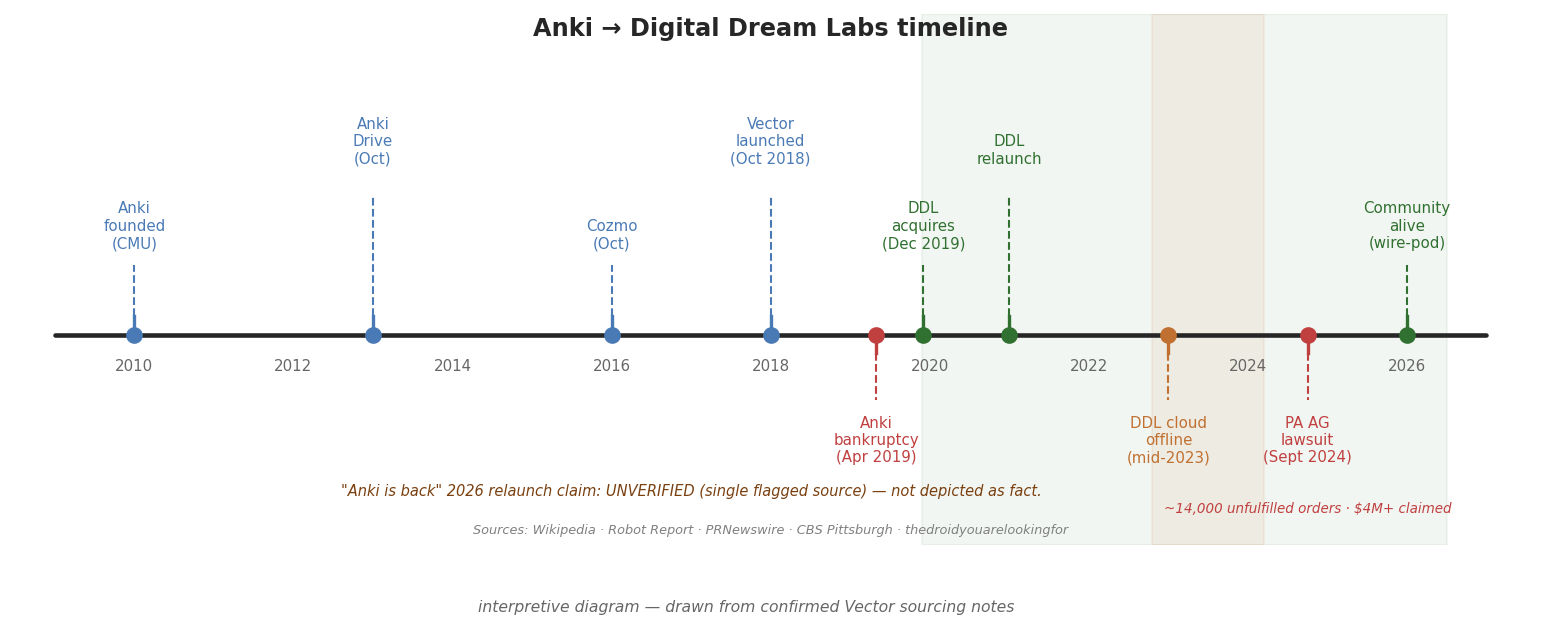
2.12 The timeline in summary
Table 3 — The timeline in summary
| Year / date | Event | Confidence |
|---|---|---|
| 2010 | Anki founded by Boris Sofman, Mark Palatucci, Hanns Tappeiner (CMU) | confirmed (Wikipedia; Failory) |
| Oct 23, 2013 | Anki Drive launched, $149.99 | confirmed (Wikipedia) |
| Sep 2014 | Series C, $55M (a16z lead) | confirmed (Wikipedia; Failory) |
| Feb 2015 | Digital Dream Labs founded (CEO H. Jacob Hanchar) | confirmed (Robot Report) |
| Sep 2015 | OVERDRIVE launched | confirmed (Wikipedia) |
| Oct 2016 | Cozmo launched, ~$180 | confirmed (Wikipedia) |
| Mar 30, 2018 | SVB security interest in Anki IP | confirmed (Robot Report; Failory) |
| Oct 2018 | Vector launched (Oct 12 or Oct 13 — date disputed) | confirmed; day disputed (Wikipedia; iFixit) |
| End Apr 2019 | Anki shuts down; ~200 laid off | confirmed (Wikipedia; Robot Report) |
| Jun 18–20, 2019 | SF office contents auctioned | confirmed (Wikipedia; Robot Report) |
| Dec 2019 | DDL acquires Anki IP assets (Dec 26, 2019 per TechReport; Jan 15, 2020 per PRNewswire — dates conflict) | confirmed; exact date disputed |
| 2021 | DDL relaunches Vector and Cozmo product lines | confirmed (Wikipedia) |
| ~Mar 2022 | DDL raises subscription prices | confirmed (thedroidyouarelookingfor) |
| Mid-2023 | DDL cloud dead to the community in practice | confirmed (thedroidyouarelookingfor; Wikipedia) |
| By Jan 2024 | DDL cloud officially shut down | confirmed (iFixit) |
| Sep 18, 2024 | PA AG Michelle Henry sues DDL + Hanchar over ~14,000 unfilled orders, $4M+ (conflict: some sources $2M+) | confirmed (CBS Pittsburgh) |
| 2026 | ”Anki is back” relaunch claim | unverified — single source, contradicted; do not assert |
2.13 The corporate arc as an engineering argument
The saga above is not merely cautionary; it is structurally important to the rest of this dive. Each corporate failure removes a layer of vendor dependency from the equation and validates a community engineering decision:
- Anki’s bankruptcy validated the community’s interest in understanding the hardware at the component level — a dead manufacturer cannot issue firmware updates or provide support.
- DDL’s acquisition and the OSKR release gave the community a documented path to bootloader-level access on a converted “Dev” robot (Vol 5).
- The cloud shutdown was the critical forcing function: it turned a theoretical architecture question (“could Vector be pointed at a local server?”) into a practical necessity. The community had already been working on wire-pod; the shutdown made it the only path to a fully functional robot (Vol 6).
- The 2024 lawsuit confirms that DDL is, at minimum, unable to fulfil orders and has effectively vacated its operational commitments — the community stack cannot depend on any vendor action.
The dead cloud is exactly the component wire-pod replaces. The complete corporate failure is exactly the scenario the open stack was built to survive. This is why the revival story is the spine of the dive — not nostalgia, but engineering that works in the absence of a vendor.
Sources
- Wikipedia, “Anki (American company)” — founding, CMU founders, product line (Anki Drive, OVERDRIVE, Cozmo, Vector), funding rounds, shutdown, DDL acquisition.
- The Robot Report, “Anki assets acquired by Digital Dream Labs” and “Inside the Anki shutdown: who owns the IP, the assets auction, and the failed partnership” — the SVB lien (March 2018), the April 2019 shutdown, the June 2019 auction, the asset contents, the December 2019 DDL acquisition price characterisation, and the no-liabilities term.
- PRNewswire, “Digital Dream Labs Acquires Anki…” (press release, dated Jan 15, 2020) — the acquisition announcement; date is the sourcing conflict against TechReport.
- Failory, “Anki Cemetery” — founding year, CMU founders, funding rounds including the Series D reconciliation (~$52.5M vs Wikipedia’s internally inconsistent “$502.5M”), the failed partnership rumours, the SVB lien.
- CBS News Pittsburgh, “PA Attorney General lawsuit: Digital Dream Labs” — the September 18, 2024 PA AG action, $4M+ total, ~14,000 orders, $147–$655 per unit, the ~$400 Vector 2.0 price.
- wiki.thedroidyouarelookingfor.info — community technical wiki: cloud shutdown timeline (mid-2023 in practice), subscription price increase (~March 2022), the OSKR state, and the community recommendation of wire-pod.
- iFixit, “Anki Vector” device page — cloud officially shut by January 2024.
- anki.bot, “Meet Vector” and the DDL storefront — Vector 2.0 listed but “sold out,” © 2026 DDL; office reportedly vacated.
- ankicozmorobot.com, “Vector Robot” — Cozmo vs Vector architectural contrast, wake phrase and English-only operation, 2.0 camera upgrade.
- github.com/digital-dream-labs/vector-cloud and /chipper — the open-sourced cloud reference stack; confirms what the cloud handled (STT → NLU → knowledge graph) and what the community received to replace it.
- Full gated fact base with confirmed/unverified markers and source reachability:
02-inputs/vector_sourcing_notes.md.
Comments (0)