Anki Cozmo · Volume 1
Overview — The Robot That Did Not Need the Cloud
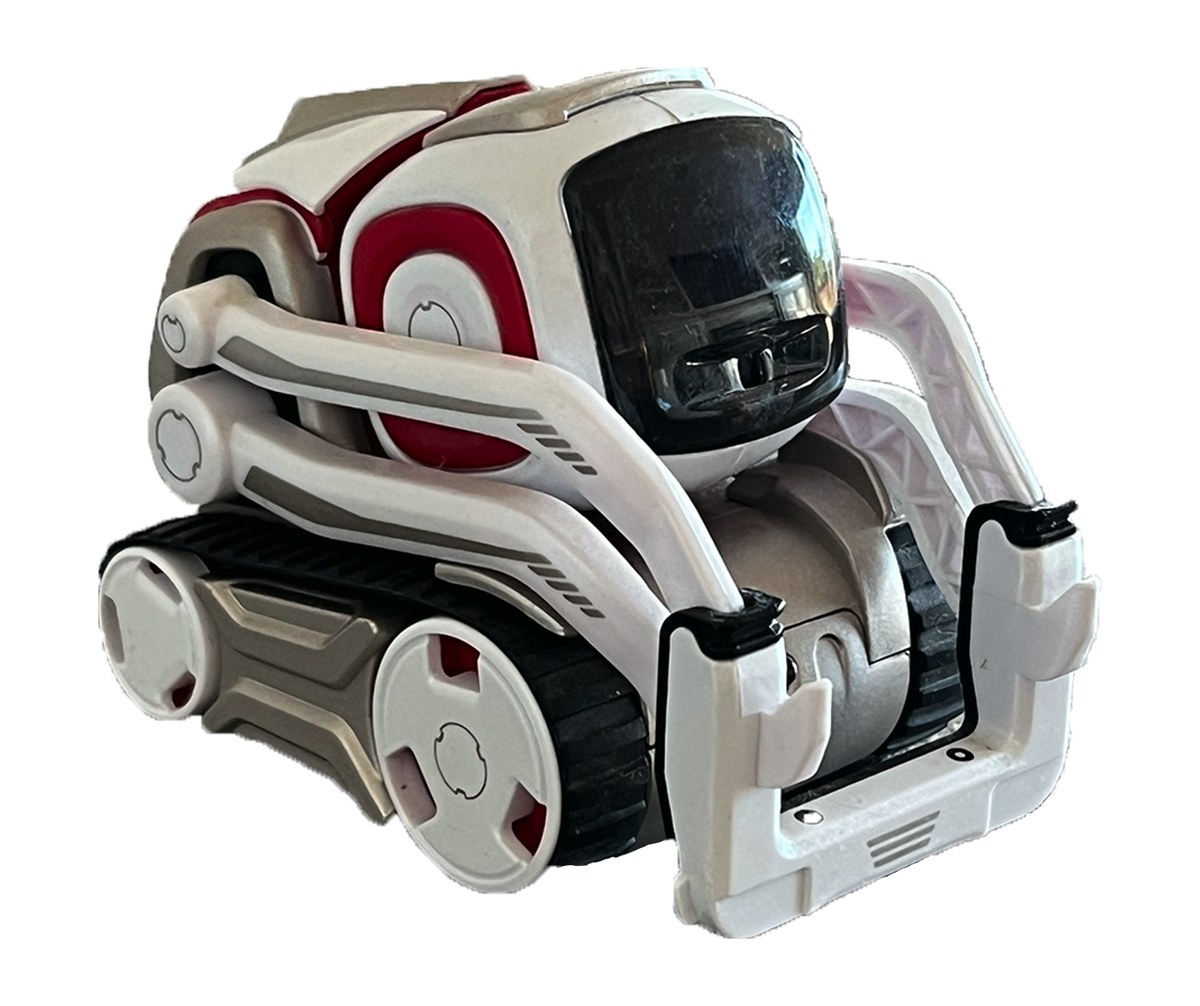
1.1 What it is
Cozmo is a palm-sized desktop companion robot released by Anki on 16 October 2016 at USD 179.99. It runs on two rubber treads, carries a forklift-style lift arm at the front, and shows an animated pair of eyes on a small display that functions as its face. Three sensor-equipped Power Cubes ship in the box; the robot recognises them, pushes them, stacks them, and plays games with them. It arrives fully assembled. There is nothing to build and nothing to solder.
What makes Cozmo worth a volume series is not the toy. It is the architecture underneath the toy, and what that architecture turned out to be worth.
Cozmo does almost none of its own thinking. Face recognition, pet detection, expression estimation, path planning, the animation system and the emotion engine that gives the robot its personality all run on a smartphone or tablet app, not on the robot. The app is referred to in the protocol documentation as the engine. The robot is, in the strict sense, a peripheral: it broadcasts its own Wi-Fi network, the phone joins it, and the two exchange UDP packets many times a second for as long as the session lasts.
That design decision was made in 2016 for cost reasons — offloading vision to a device the customer already owned meant the robot did not need an applications processor. It had an unintended consequence that matters more than the original motivation. When Anki collapsed in 2019, and again when Digital Dream Labs let its servers lapse years later, Cozmo kept working, because nothing it needs in order to play was ever hosted by the company.
1.2 The contrast that defines it
This hub already documents Cozmo’s successor. Anki’s Vector, released in 2018, put a Qualcomm Snapdragon inside the robot, added a four-microphone array, and answered to the spoken phrase “Hey Vector.” It was the more capable machine in every obvious respect — and it was the one that broke. Vector’s speech recognition and its knowledge-graph answers ran in Anki’s, and later Digital Dream Labs’, cloud. When that cloud went dark, a retail Vector lost its voice until the community built wire-pod, an open local server, to stand in for the vendor’s data centre.
Cozmo needed no such rescue. The comparison is the cleanest illustration in this collection of a principle that has nothing to do with robots:
Table 1 — collection of a principle that has nothing to do with robots
| Cozmo (2016) | Vector (2018) | |
|---|---|---|
| Where the intelligence runs | on the owner’s phone | partly on the robot, partly in a vendor cloud |
| Voice input | none fitted | four-microphone array, wake phrase |
| What the shutdown killed | nothing required for play | speech recognition and spoken answers |
| What was needed to revive it | nothing | an open-source replacement server |
| Failure mode of the design | the app must remain installable | the vendor must remain solvent |
Neither design is simply better. Cozmo’s dependency did not disappear; it moved. A robot tethered to a phone app is hostage to app stores, operating-system version requirements and the continued existence of a build that will run on current hardware. That is a slower and more forgiving kind of decay than a server being switched off, but it is decay all the same. Vol 6 examines how much of it has already happened.
1.3 Headline facts
Anki published no service manual for Cozmo, and Digital Dream Labs published none
after it. Everything below is drawn either from the vendor’s own materials, from
published teardowns, or from the reverse-engineered protocol documentation maintained
by the pycozmo project. Each row is marked confirmed where a reachable primary or
authoritative source states it, or unverified where it rests on a single secondary
source. Figures that no reachable source establishes are left out rather than
estimated.
Table 2 — Headline facts
| Attribute | Value | Confidence |
|---|---|---|
| Released | 16 October 2016, United States | confirmed |
| Launch price | USD 179.99 | confirmed |
| Maker | Anki, then Digital Dream Labs from December 2019 | confirmed |
| Successor | Vector, October 2018 | confirmed |
| Main microcontroller | NXP Kinetis K02, 100 MHz ARM Cortex-M4 | confirmed, teardown |
| Wi-Fi | Espressif ESP8266EX; the robot is the access point | confirmed |
| Bluetooth | Nordic nRF51822, used for the Power Cubes | confirmed |
| Camera | 320 x 240 greyscale delivered by firmware | confirmed |
| Camera sensor | reportedly 640 x 480, not exposed by firmware | unverified |
| Field of view | approximately 60 degrees | confirmed, per-unit calibrated |
| Display | 128 x 64, in-plane-switching LCD panel | confirmed, teardown |
| Motors | two drive motors, head tilt, lift arm | confirmed |
| Encoders | magnetic, on the motor shafts, two lobes each | confirmed, teardown |
| Voice input | none — no microphone array fitted | confirmed |
| Accessories | three BLE Power Cubes, charging platform | confirmed |
| Battery life | quoted at around 45 minutes | unverified |
| Mass and dimensions | not established — see below | not found |
| Units sold | ”hundreds of thousands” by August 2018 | confirmed, vendor claim |
1.3.1 On the size and weight figures
Cozmo’s mass and dimensions are widely quoted and, as far as this dive could establish, wrongly quoted. Retail listings give figures such as 2.5 by 2.5 by 4.25 inches and weights approaching three pounds; both plainly describe the packaged product, not the robot, since a machine of that footprint could not weigh three pounds. A figure of roughly 363 grams circulates in secondary robot surveys, including the note that seeded this subproject, but no reachable primary source confirms it.
Rather than repeat any of them, this dive treats Cozmo’s mass and dimensions as not established and says so wherever the question arises. An owner with the robot and a kitchen scale can settle it in a minute; that measurement is left as an open item in Vol 8.
1.4 Hardware revisions
Four hardware versions are documented by the community, distinguished chiefly by the power button — a detail that tracks regional certification rather than capability.
Table 3 — Hardware revisions
| Version | Period | Distinguishing feature |
|---|---|---|
| 4 | Autumn 2016 | no button |
| 5 | Autumn 2017 | off button, European certification |
| 6 | Autumn 2018 | off button, Japanese certification |
| 7 | Autumn 2019 | on/off button |
The practical consequence is small but real: the backpack button is reported by
pycozmo as supported on version 1.5 hardware and newer, so the oldest units answer a
slightly smaller command set. A buyer has no way to determine the version from a
typical second-hand listing photograph.
1.5 What the volumes cover
Vol 2 follows Anki from its Carnegie Mellon founding through the 2019 shutdown, the Digital Dream Labs acquisition, the long-delayed “Cozmo 2.0”, and the 2024 action brought by the Pennsylvania Attorney General — the corporate story that Cozmo survived. Vol 3 opens the machine up: the microcontroller, the two radios, the drive train, the camera and the cubes. Vol 4 is the centre of the dive, documenting the robot-and-engine split in detail, including the network protocol that joins them. Vol 5 covers the three ways to program a Cozmo and what each one depends on. Vol 6 addresses the question an owner actually asks — does it still work, and what is likely to break first. Vol 7 surveys the community and the open-source record, which is smaller and quieter than Vector’s and worth being honest about. Vol 8 is the cheatsheet.
Sources
- Wikipedia, “Cozmo” — release date, price, Code Lab, sales claims, the Anki shutdown and the Digital Dream Labs acquisition.
- microcontrollertips.com, “Cozmo Robot, a distant relative of Vector: Teardown” — the Kinetis K02, ESP8266EX, nRF51822, motor and encoder detail.
- iFixit, “Anki Cozmo” device page — display resolution, sensor list, motor count.
pycozmodocumentation (pycozmo.readthedocs.io) — the protocol, the engine-and-robot relationship, hardware versions, and the supported-feature lists.- touretzkyds/cozmopedia wiki, “camera” — camera resolution, colour handling and field of view.
- Anki and Digital Dream Labs product and support pages, live at anki.bot.
Comments (0)