Anki Cozmo · Volume 2
Anki, Digital Dream Labs, and the Company Cozmo Outlived
2.1 A robotics company that sold toys
Anki was founded in 2010 by three graduates of the Carnegie Mellon Robotics Institute — Boris Sofman, Mark Palatucci and Hanns Tappeiner — and based in San Francisco. Its premise was that the hard parts of robotics research, chiefly localisation and real-time control, had become cheap enough to put into consumer products, and that the way to fund that work was to sell the results as entertainment rather than as research platforms.
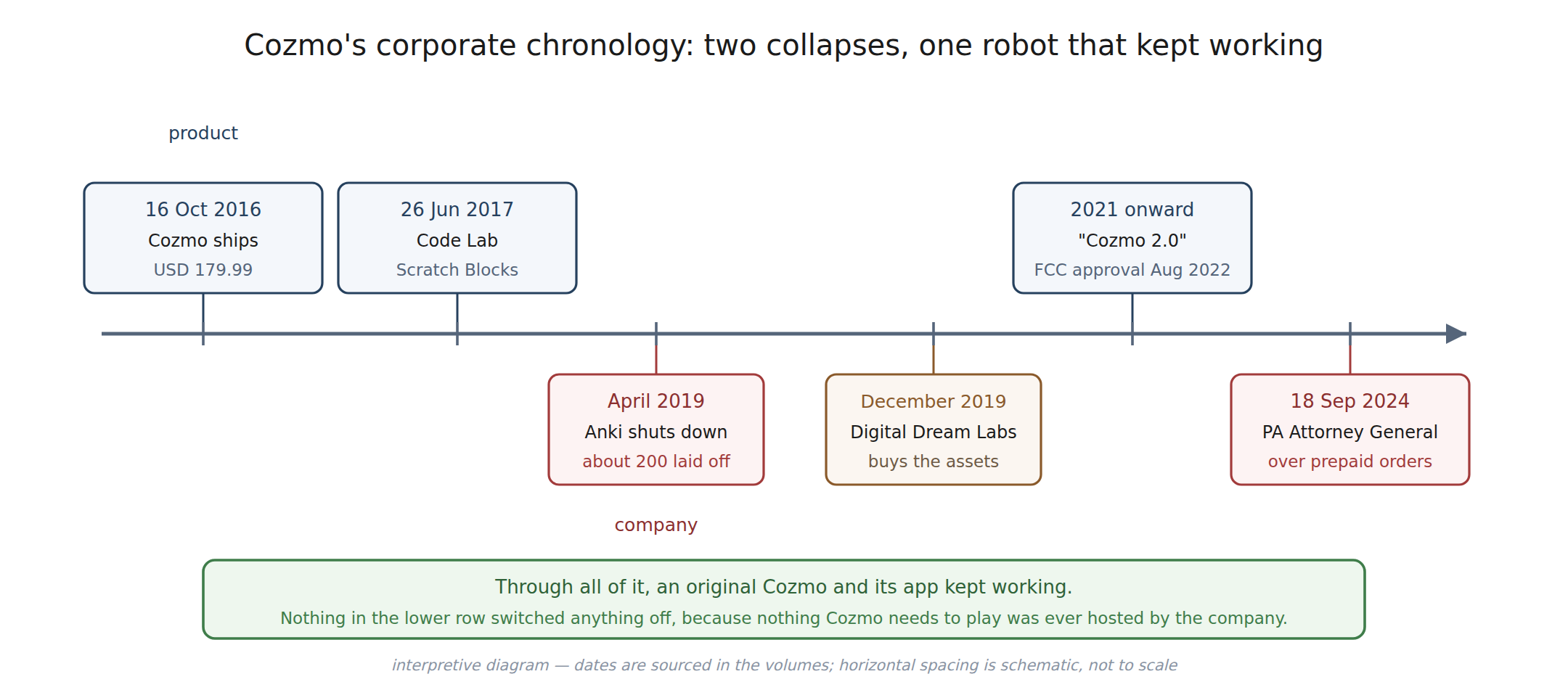
The product line followed that logic. Anki Drive, a set of self-driving toy cars that raced on a printed mat, launched in October 2013 at USD 149.99. Overdrive succeeded it in 2015 with reconfigurable track. Cozmo arrived in October 2016, and Vector in October 2018. Across five funding rounds the company raised approximately USD 182.5 million from investors including Andreessen Horowitz, Index Ventures and Two Sigma.
Cozmo was, commercially, the high point. Anki claimed “hundreds of thousands” of units sold by August 2018 and described it as the best-selling toy on Amazon in the United States, the United Kingdom and France that month. A robot with a genuine character animation pipeline — Anki hired animators out of the film industry to build its expressive repertoire — had found a mass audience.
2.2 The collapse
It was not enough. In April 2019 Anki shut down after failing to close a new funding round, laying off roughly two hundred employees. Reporting at the time described a late-stage deal that did not materialise; the specific counterparty has been the subject of persistent rumour and is not treated as established here. Silicon Valley Bank had held a security interest in Anki’s intellectual property since March 2018, which shaped what happened to the assets afterwards.
The contents of the San Francisco office were auctioned in June 2019. For owners, the immediate question was whether the robots on their desks would continue to function.
For Cozmo owners the answer was yes, and the reason is the subject of Vol 4: the app on the owner’s phone was the engine, and the app was already installed. For Vector owners the answer was more complicated and eventually became no, until the community intervened. The two robots shared a corporate fate and did not share a technical one.
2.3 Digital Dream Labs
In December 2019, Digital Dream Labs — a Pittsburgh educational-technology company founded in February 2015 and led by H. Jacob Hanchar — acquired Anki’s robotics and artificial-intelligence assets. Sources differ slightly on the date of record: one account gives an announcement of 26 December 2019, while the company’s own press release is dated 15 January 2020. December 2019 is the consensus close.
What changed hands was substantial on paper: 45 issued utility patents and 73 design
patents plus pending applications, the Anki, Cozmo, Vector and Overdrive trademarks,
the anki.com domain, and customer data covering a reported 6.5 million customers and
19 million connected devices. No liabilities were assumed. The purchase price was not
disclosed; the buyer characterised it publicly as a small fraction of the assets’
original cost.
Digital Dream Labs began relaunching products in 2021.
2.4 “Cozmo 2.0”
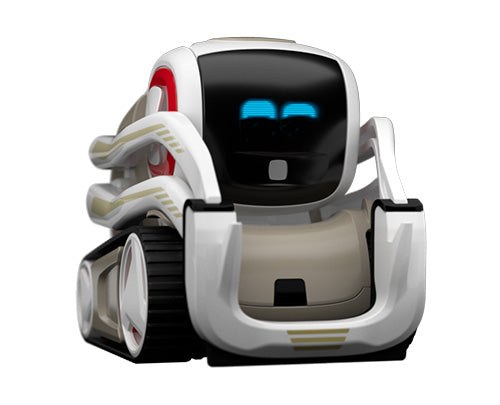
A revised Cozmo was announced for pre-order on 23 November 2020 at USD 197, with delivery estimated for May 2021. The advertised hardware changes over the original were:
- a 2 megapixel camera, replacing the original sensor, for better face and pet recognition
- a full-colour display in place of the original monochrome panel
- more than 30 per cent additional battery runtime
- four proximity and cliff sensors rather than one
- a capacitive touch sensor on the backpack
- interchangeable parts shared with Vector accessories
The delivery estimate was not met, and the gap between announcement and availability became the defining feature of the product. The company’s own manufacturing updates record the sequence: camera calibration problems resolved in February 2022; a COVID-19 lockdown closing the Chinese factory in March 2022; the factory reopening on 31 March 2022; FCC compliance testing completed on 28 July 2022 and approval granted on 2 August 2022; and development units still in production for internal testing as of November 2022. That is roughly two years from a May 2021 delivery promise to units that had not yet reached customers.
At the time of writing the Digital Dream Labs storefront lists Cozmo 2.0 at USD 399.99 and marks it as unavailable.
2.4.1 A caveat worth recording
At least one long-running commentator on these robots questioned publicly whether Cozmo 2.0’s internals were genuinely new, speculating that Cozmo and Vector hardware might have converged onto a shared design distinguished mainly by firmware. This dive records that as speculation, not finding. No teardown of a shipped Cozmo 2.0 was located during this research, and without one the question cannot be settled. The advertised specification list above is the vendor’s claim; it has not been independently verified here.
2.5 The lawsuit
On 18 September 2024, the Attorney General of Pennsylvania filed suit against Digital Dream Labs and Hanchar over prepaid orders that were never fulfilled. The complaint concerned roughly 14,000 orders placed between November 2020 and January 2024, at individual prices between USD 147 and USD 655. Headline figures for the total vary between “more than two million dollars” and “more than four million dollars” depending on the account. The products named included Vector 2.0, Cozmo 2.0 and a “Butter Robot” tie-in. The claims were brought under Pennsylvania’s Unfair Trade Practices and Consumer Protection Law and the federal Mail Order Rule, seeking restitution, civil penalties and an injunction.
The outcome is not established. No settlement, judgment or dismissal was located during this research. Anyone relying on the status of that action should check it directly rather than trusting this paragraph, which reflects only what was reachable at the time of writing.
2.6 What this means for a Cozmo today
The corporate record above is bleak, and it is worth being precise about which parts of it actually reach the robot on a desk.
It does not affect play. The original Cozmo’s core functionality never depended on a company server. Vol 4 sets out why in detail. No event in this volume switched anything off for an existing owner.
It does affect buying. There is no functioning retail channel for a new Cozmo. Purchases from the Digital Dream Labs storefront carry the history described above, and the second-hand market is the realistic route. Vol 6 covers acquisition in detail.
It does affect support. There is no vendor to repair a robot, honour a warranty, supply a spare tread, or publish a firmware fix. Treads and cubes are the parts most likely to be wanted, and the supply of both is whatever remains in circulation.
It does affect the app, eventually. The app is the one component that a company
must actively maintain for the robot to keep working, because mobile operating systems
move and unmaintained builds eventually stop installing. This is the real long-term
risk to a Cozmo, and it is a slow one rather than a switch. It is also precisely the
risk that the pycozmo project exists to hedge against, which is why Vol 5 treats an
apparently dormant piece of software as more important than its commit history
suggests.
2.7 Cross-reference
The Vector dive in this hub covers the same corporate timeline from the other side,
including the cloud shutdown and the community wire-pod server that replaced it. The
two volumes deliberately overlap only where the companies’ histories are shared; the
technical consequences diverge completely and are not repeated between them.
Sources
- Wikipedia, “Anki (American company)” and “Cozmo” — founding, funding, product line, shutdown, acquisition and relaunch.
- The Robot Report, “Anki assets acquired by Digital Dream Labs” and its reporting on the shutdown — the asset schedule, patent counts, customer figures, and the Silicon Valley Bank security interest.
- PRNewswire, “Digital Dream Labs Acquires Anki” — the acquisition release, dated 15 January 2020.
- Digital Dream Labs knowledge base, “State of Manufacturing: Cozmo 2.0” — the manufacturing chronology, FCC dates and COVID-19 delays.
- anki.bot product listing for Cozmo 2.0 — the advertised hardware changes, the USD 399.99 price and the unavailable status.
- personalrobots.biz, “Cozmo 2.0 announced .. but what is under the hood?” — the November 2020 pre-order price and the recorded speculation about shared internals.
- CBS News Pittsburgh — the 18 September 2024 Pennsylvania Attorney General action.
Comments (0)