Anki Cozmo · Volume 7
The Community and the Open-Source Record
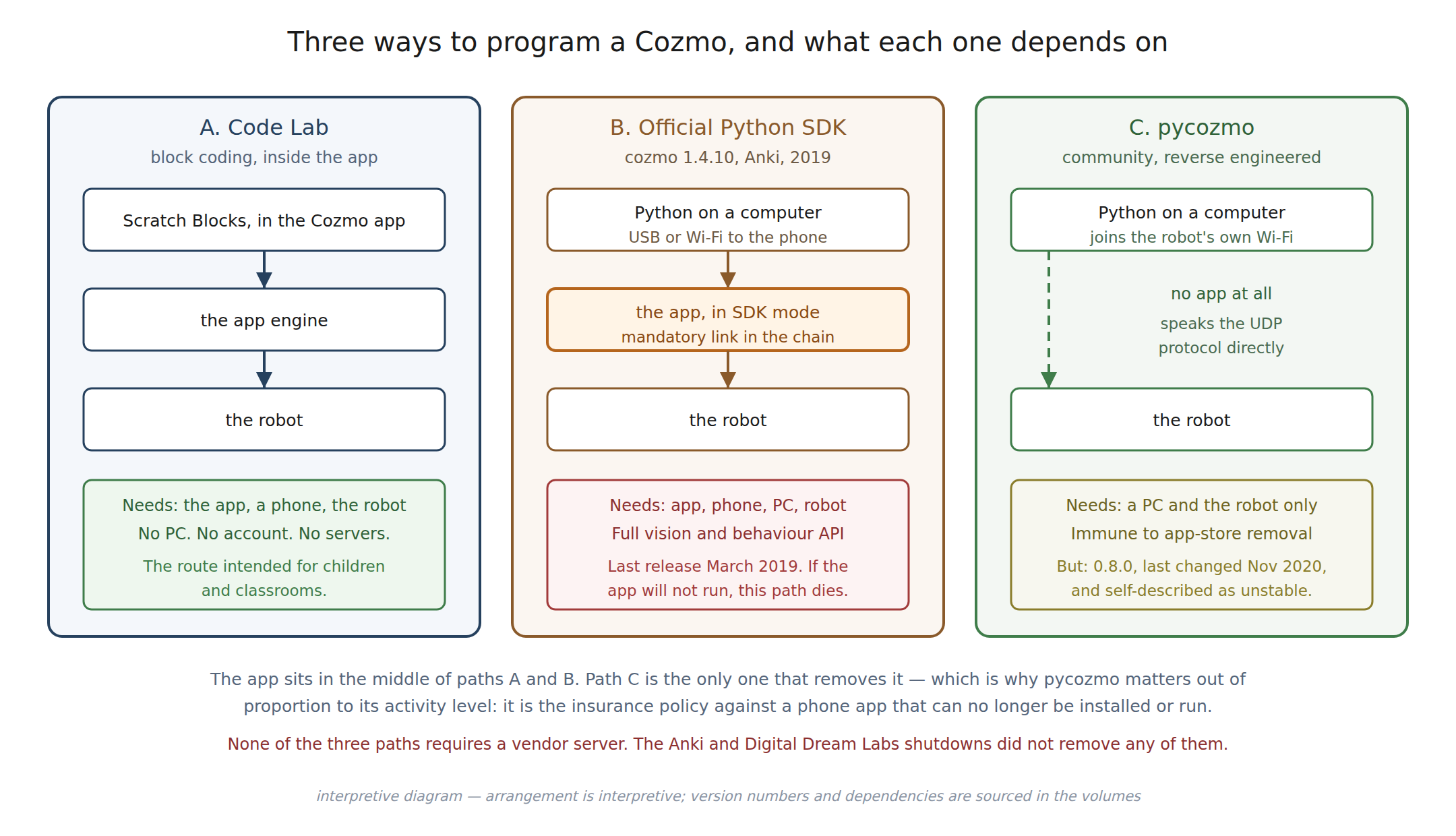
7.1 A quieter room than Vector’s
The Vector dive in this hub documents an unusually energetic community: a free open-source server replacing a dead cloud, a maintained fork chain of the Python SDK, a ROS 2 wrapper, a bootloader unlock programme and an active technical wiki. It is one of the better examples in consumer electronics of users refusing to let a product die.
Cozmo’s community is smaller, quieter and less urgent, and the reason is the whole argument of this dive: nothing forced it into being. Vector owners woke up to a robot that had stopped answering them. Cozmo owners did not. A community rallies around a crisis, and Cozmo never had one.
That is a good outcome for owners and a thin one for anyone hoping to find an active project to join.
7.2 The record, stated plainly
Table 1 — The record, stated plainly
| Project | Role | Licence | Latest | Last activity | Stars |
|---|---|---|---|---|---|
anki/cozmo-python-sdk | official SDK, needs the app | not a standard identifier | 1.4.10 | Nov 2022 | ~725 |
zayfod/pycozmo | independent SDK, no app | MIT | 0.8.0 | Nov 2020 | ~229 |
Neither is under active development. The official SDK’s last release predates its
company’s collapse. pycozmo’s last commit was in November 2020.
There is no Cozmo equivalent of wire-pod, and there does not need to be. wire-pod
exists to replace a dead server; Cozmo has no server to replace. The absence of that
project in the Cozmo world is a sign of health, not neglect — a point worth making
explicitly, because a naive comparison of the two communities reads the wrong lesson
from it.
7.3 What the community actually produced
The protocol documentation is the real achievement. The most valuable community
artefact is not a piece of software but a specification: pycozmo’s documentation of
Cozmo’s wire protocol — the access point naming, the addressing, the UDP port, the
frame format, the reliability scheme, the ping behaviour, the hardware version table.
That work is what makes Cozmo a documented machine rather than a sealed one, and it is
what will still be useful in twenty years when every piece of software mentioned in
this dive has stopped running.
A protocol specification does not rot. An implementation of it can always be rewritten.
Academic and teaching material. A cozmopedia wiki maintained under the
touretzkyds organisation documents the robot’s camera characteristics and other
behaviour in more technical detail than the vendor ever published, and was among the
more useful sources for Vol 3. Cozmo saw genuine use in computer-science teaching,
supported by the Code Lab and Scratch Blocks route described in Vol 5.
Support channels. pycozmo directs users to GitHub issues and to a
#development-cozmo channel on a Digital Dream Labs community Discord server. The
current state of that server was not established during this research.
An unreachable wiki. A community wiki at ankibots.wiki covering Anki’s robots is
referenced in several places, including the note that seeded this subproject. It
returned server errors on every attempt during this research and could not be consulted.
It is recorded here as existing but unverified — it may well hold material that
would improve this dive.
7.4 Openness, honestly rated
It is worth being precise about how open Cozmo actually is, because the scaffolding note for this subproject described it as “relatively open” and that phrase does a lot of work.
What is open. An independent, MIT-licensed implementation of the robot’s protocol exists. The protocol itself is documented publicly. The official SDK’s source is published.
What is not open. The robot’s firmware is closed and was never published. The mobile app is closed, and it is the app — not the robot — that contains the personality engine, the animation system and the vision stack. The official SDK’s licence is not a recognised open-source identifier. No hardware design files, schematics or CAD were ever released.
So: Cozmo is a closed robot with an openly documented protocol. That is a meaningfully better position than a closed robot with an undocumented one, and a meaningfully worse position than a genuinely open platform. For comparison within this hub, the Petoi machines publish their firmware under the MIT licence and their mechanical files alongside it; Reachy Mini publishes hardware, software and simulation together. Cozmo is not in that category and should not be described as though it were.
7.5 What would actually help
Should anyone wish to contribute, the useful work is reasonably clear from the state of the record:
- Port
pycozmoto current Python. Its stated support stops at 3.9 and its dependencies are of that era. This is ordinary, unglamorous, entirely tractable work and it is the single highest-value thing anyone could do for this robot. - Advance the off-board functions. The personality engine, animation system and vision pipeline are listed as work in progress. Completing any of them moves Cozmo from “a robot you can drive” toward “a robot that behaves like Cozmo” without an app.
- Archive the app. The app is the fragile component. Its preservation is the thing most likely to matter in a decade, and it is the thing nobody is doing.
- Publish a Cozmo 2.0 teardown. Vol 2 records unresolved speculation about whether the 2.0 hardware is genuinely distinct. One teardown would settle it.
- Measure the robot. Its mass and dimensions are, absurdly, not established anywhere. See Vol 3.
7.6 Assessment
Cozmo’s community did the important thing — it wrote down how the machine works — and then, reasonably, dispersed, because the robot kept working and nothing demanded more. The result is a platform that is well documented, legally clean at the protocol layer, and essentially unmaintained.
For an owner, that is fine. For someone hoping to buy into an active ecosystem, it is not what Vector’s community offers, and the difference should be understood before rather than after purchase.
Sources
zayfod/pycozmorepository, PyPI listing and documentation — licence, version history, last activity, the protocol specification, the supported and work-in-progress feature lists, and the support channels.anki/cozmo-python-sdkrepository metadata — release history, last activity, star count and licence status.- touretzkyds/cozmopedia wiki — community technical documentation, used as a source in Vol 3.
- Digital Dream Labs support article, “Cozmo SDK Information” — the official position on the SDK and Code Lab.
ankibots.wiki— referenced but unreachable throughout this research; recorded as unverified.- The Anki Vector dive in this hub — for the community comparison drawn above.
Comments (0)