Reachy Mini · Volume 1
Overview — Open by Design, With One Asterisk
1.1 What it is
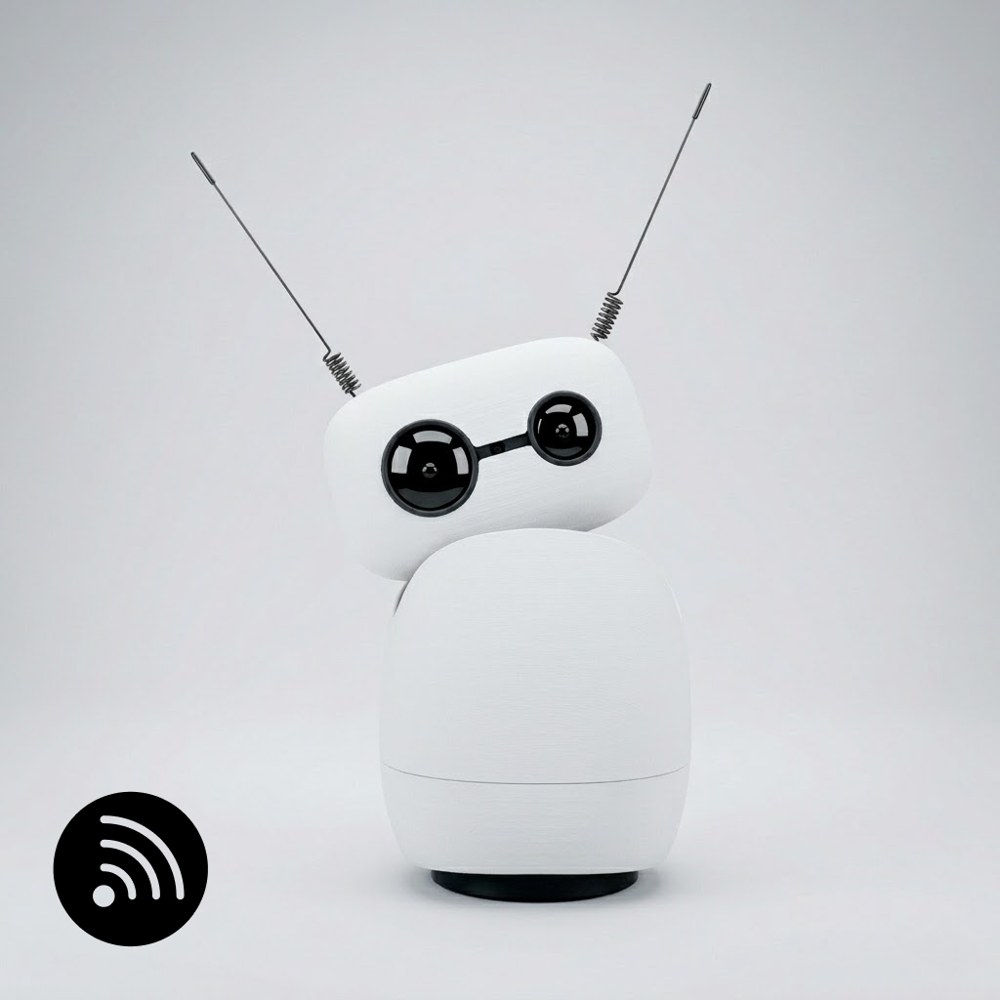
Reachy Mini is a desktop companion robot from Pollen Robotics, a French company acquired by Hugging Face in April 2025. It was announced on 9 July 2025. It stands about 28 cm tall, weighs roughly 1.5 kg, and consists of an expressive head on a rotating body, with two motorised antennas.
It has no arms, no gripper and no wheels. It does not travel. Everything it expresses, it expresses through where it points its head, how it moves getting there, and what its antennas do — which is a narrower design than it first appears and, as Vol 3 argues, a deliberate one.
Two variants ship. Reachy Mini Lite is tethered to a computer by USB-C and has no battery. Reachy Mini Wireless carries a Raspberry Pi Compute Module and a battery, and stands alone. Both arrive as kits, taking two to three hours to assemble, with tools and a guide included and no soldering or 3D printing required.
1.2 Why it is in this hub
This collection documents two companion robots from Anki — Cozmo and Vector — whose manufacturer went bankrupt, whose successor company went dormant, and whose owners discovered in the worst possible way where their robots’ dependencies lived. Reachy Mini is the deliberate counterpoint: a desktop companion designed open from the first day, by a company whose entire business model is publishing things.
The comparison is the reason to read this dive alongside those two.
Table 1 — Why it is in this hub
| Cozmo (2016) | Vector (2018) | Reachy Mini (2025) | |
|---|---|---|---|
| Intelligence runs | on the owner’s phone | robot plus vendor cloud | on the robot or the owner’s computer |
| Firmware | closed, never published | closed, never published | published |
| SDK | app-dependent | community rebuild | official, active |
| Simulation | none | none | MuJoCo, published |
| Voice | none fitted | cloud, later dead | local capture, integrations are the owner’s choice |
| Survives vendor failure | yes, by accident | only via community rescue | by design — but see the licence note below |
Where Cozmo survived its vendor through an architectural accident, and Vector needed an open-source rescue, Reachy Mini is built so that the question should not arise. Whether it fully succeeds is the subject of the asterisk below.
1.3 Headline facts
Table 2 — Headline facts
| Attribute | Value | Confidence |
|---|---|---|
| Announced | 9 July 2025 | confirmed |
| Makers | Pollen Robotics, acquired by Hugging Face April 2025 | confirmed |
| Height | 28 cm / 11 in; 23 cm in sleep mode | confirmed |
| Width | 16 cm / 6.3 in | confirmed |
| Mass | 1.5 kg / 3.3 lb | confirmed |
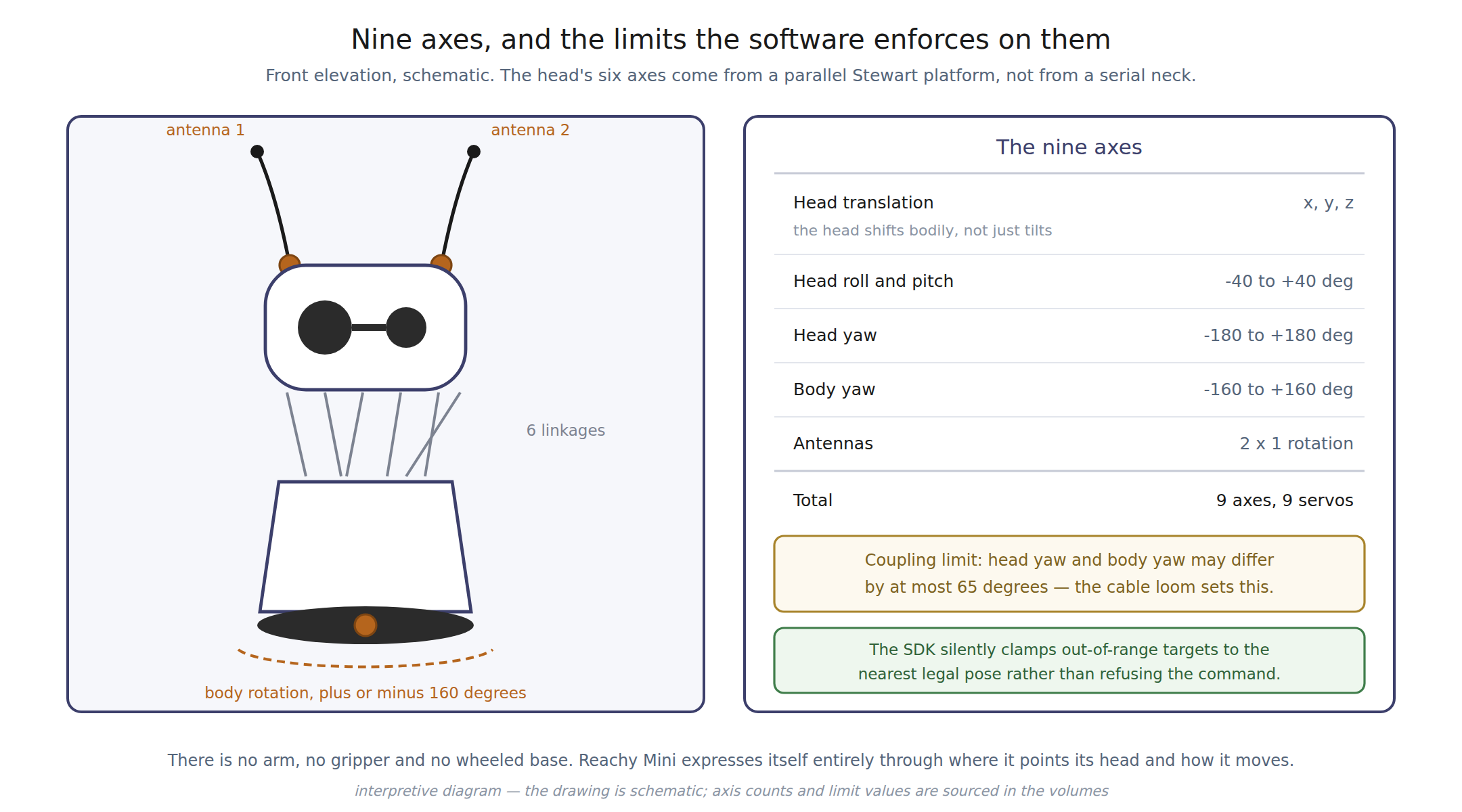
| Degrees of freedom | 9 — 6 head, 1 body, 2 antennas | confirmed |
| Servos | 9 | confirmed |
| Head mechanism | parallel Stewart platform, 6 linkages | confirmed |
| Camera | wide-angle; Raspberry Pi Camera v3 class, Sony IMX708 | confirmed / part unverified |
| Microphones | 4, PDM MEMS digital | confirmed |
| Speaker | 5 W | confirmed |
| Wireless compute | Raspberry Pi CM4, 4 GB RAM, 16 GB storage | confirmed |
| Wireless battery | LiFePO4, 6.4 V 2000 mAh, 12.8 Wh | confirmed, single source |
| IMU | Wireless variant only | confirmed |
| Lite connection | USB-C to a host computer | confirmed |
| Form | assembly kit, 2 to 3 hours | confirmed |
| Lead time | up to 90 days, often sooner | confirmed |
| Software licence | Apache-2.0 | confirmed |
| Hardware licence | CC BY-SA-NC | confirmed |
1.4 The asterisk: “fully open” is not quite right
The note that scaffolded this subproject described Reachy Mini as “fully open — hardware, software, firmware, and a MuJoCo sim all open-source.” The software half of that is correct and then some. The hardware half needs correcting, and the correction matters.
The SDK repository states its licensing as Apache-2.0 for software, and Creative Commons BY-SA-NC for the hardware design files.
NC means non-commercial. A licence with a non-commercial restriction is not an open-source licence by the Open Source Initiative’s definition, and the design files are therefore not open-source hardware by the Open Source Hardware Association’s definition either. Both definitions require permitting commercial use.
What this means in practice:
- An owner may study, modify, repair and reproduce the hardware for themselves.
- Derivatives must be shared alike under the same terms.
- Nobody may manufacture and sell Reachy Mini hardware or a derivative of it.
That last restriction is commercially sensible — it prevents a contract manufacturer undercutting Pollen using Pollen’s own files — and it is a real limitation that the phrase “fully open” conceals. The software genuinely is open. The hardware is published and shared, but not free.
By contrast, the Petoi machines documented in this hub publish their firmware under the MIT licence, which carries no such restriction. On the specific axis of licence permissiveness, Petoi is the more open platform, even though Reachy Mini publishes more material overall.
This dive uses “open by design” rather than “fully open”, and states the licence split wherever openness is discussed.
1.5 The price question
Reachy Mini’s price has moved, and the sources disagree in a way that is worth documenting rather than resolving to a single number.
Table 3 — The price question
| Source | Lite | Wireless |
|---|---|---|
| Announcement coverage, July 2025 | USD 299 | USD 449 |
| Hugging Face announcement page, as read for this dive | USD 399 | USD 499 |
| Pollen Robotics store, as read for this dive | EUR 350 | EUR 435 |
| Secondary report, June 2026 | a further USD 20 increase | a further USD 20 increase |
The most likely explanation is straightforward: the robot launched at the lower pair, the prices rose, and the announcement page was edited in place to reflect current pricing rather than preserved as a historical record. That is a normal thing for a vendor to do and an awkward thing for anyone citing the page as a primary source, since it now disagrees with every contemporaneous report of its own announcement.
Early coverage of the acquisition also quoted a Hugging Face estimate of USD 250 to 300 depending on tariffs, which is below even the announced price.
Treat every figure above as a snapshot. Check the store before buying.
1.6 The Raspberry Pi confusion, resolved
The scaffolding note flagged a conflict between sources claiming “Raspberry Pi 5”, “Raspberry Pi 4” and “CM4”. This dive resolves it.
The Wireless variant carries a Raspberry Pi Compute Module 4, specifically a part identified as CM4104016 — 4 GB RAM, 16 GB storage, with wireless. “Raspberry Pi 4” and “CM4” are therefore the same part described at different levels of precision, not a disagreement. The Hugging Face page says “Raspberry Pi 4”; the repository says “Raspberry Pi CM4”; both are right.
Claims of a Raspberry Pi 5 are incorrect and appear only in secondary marketing material.
1.7 Minor dimensional conflict
One independent spec sheet gives the height as 30 cm against the vendor’s 28 cm, and adds a length of 20 cm and a width of 15.5 cm against the vendor’s 16 cm width. The differences are small and most likely reflect whether the antennas or a packing envelope are included. The vendor’s figures are used throughout this dive; the discrepancy is noted rather than resolved.
1.8 What the volumes cover
Vol 2 covers Pollen Robotics, the Hugging Face acquisition, and what “open by design” means when the parent company’s business is publishing models. Vol 3 is the hardware: the Stewart-platform head, the two variants, and what is actually in the three boxes. Vol 4 is the software architecture — the daemon, the SDK, the safety limits and the simulator. Vol 5 covers the app ecosystem and AI integration, which is the genuinely novel part of this machine. Vol 6 is acquisition, an honest assessment and the cheatsheet.
Sources
- huggingface.co/blog/reachy-mini — the announcement of 9 July 2025, dimensions, mass, degrees of freedom, camera, microphones, speaker, compute, kit form, lead time and current listed prices.
github.com/pollen-robotics/reachy_mini— the Apache-2.0 and CC BY-SA-NC licence split, the CM4 identification, the variant descriptions and the assembly time.- store.pollen-robotics.com, Reachy Mini Lite and Wireless listings — euro prices, specifications, kit contents and lead time.
- robotsguide.com, “Reachy Mini” — the independent spec sheet, including the CM4104016 part identification, the camera and microphone detail, the LiFePO4 battery, the materials list, and the conflicting 30 cm height.
- TechCrunch and related coverage, April 2025 — the Hugging Face acquisition of Pollen Robotics and the early price estimate.
- automate.org and other July 2025 coverage — the USD 299 and USD 449 announcement prices.
Comments (0)