Reachy Mini · Volume 2
Pollen Robotics, Hugging Face, and What Open by Design Means
2.1 Before the Mini
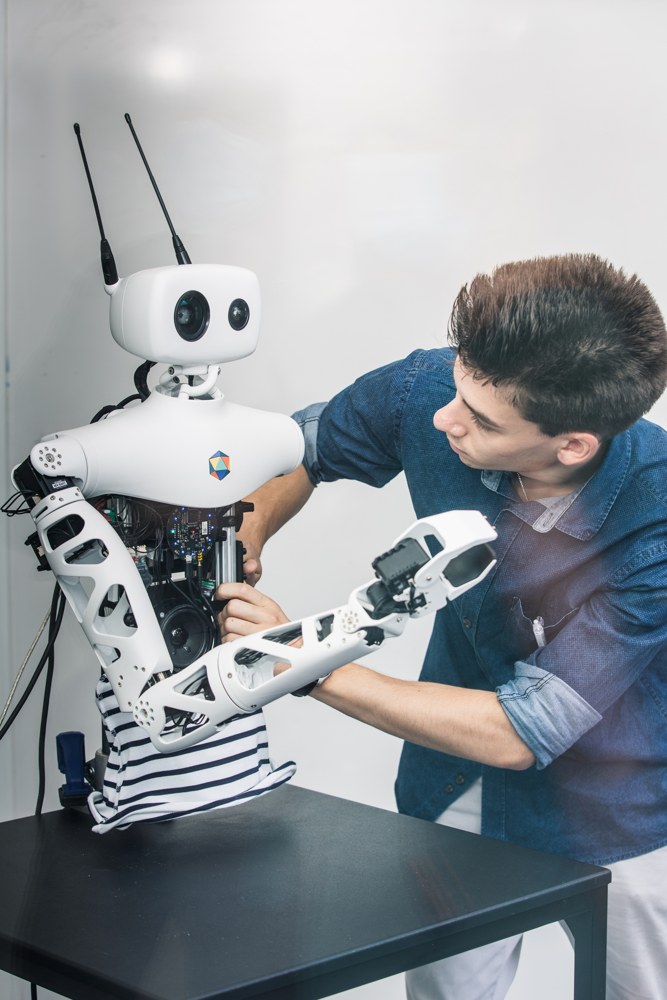
Pollen Robotics is a French robotics company based in Bordeaux, and Reachy Mini is not its first robot. The Reachy platform preceded it: a full-size humanoid torso with two articulated arms, an expressive head with camera eyes, and the same sprung antennas that survive on the Mini as its most recognisable feature.
That lineage matters for two reasons. First, the antennas and the head-led expressive vocabulary are not a toy designer’s flourish invented for a desktop product — they are carried down from a research platform where the question of how a robot signals attention and intent to a human was the actual subject of study. Second, Pollen had already committed to publishing its designs before Reachy Mini existed. The openness is inherited, not adopted for marketing.
The full-size Reachy is documented here only as ancestry. It is a different machine at a different price in a different category, and nothing in this dive should be read as applying to it.
2.2 The Hugging Face acquisition
In April 2025, Hugging Face acquired Pollen Robotics for an undisclosed sum. Reachy Mini was announced roughly three months later, on 9 July 2025.
Hugging Face is not a robotics company. It operates the dominant public repository for machine-learning models and datasets, and its business is built on hosting and distributing other people’s published work. Its stated intention on acquiring Pollen was to open-source the robots’ hardware and software so that, in its own framing, anyone could assemble, rebuild and understand how they work.
That combination — a company whose entire commercial position rests on being the place where open work is published, buying a robotics company that already published its designs — is what makes Reachy Mini structurally different from the Anki machines documented elsewhere in this hub.
2.3 Why the parent company’s business model is the interesting fact
It is worth being precise about the argument here, because “the vendor is committed to openness” is a claim every vendor makes and almost none can be held to.
Anki’s business was selling robots. Its cloud services, its closed firmware and its proprietary app were all defensible on that basis: they protected the product. When the company failed, everything it had kept closed became inaccessible, because the reason it was closed was to stop other people having it.
Hugging Face’s business is being the place where things are published. A robot whose design files, firmware and SDK live on its own hub, whose apps are distributed as ordinary Hugging Face Spaces, and whose models plug into its existing ecosystem is not a product protected by secrecy — it is a demonstration of the platform. The openness is not a concession the company makes despite its interests. It is the point.
This does not make Hugging Face immortal or benevolent, and nothing here should be read as a prediction about its future. It makes the failure mode different. If Anki had survived, Vector’s cloud would still have been closed. If Hugging Face were to disappear tomorrow, the SDK is Apache-2.0 and already cloned, the design files are published, the simulator runs without hardware, and the daemon serves a local HTTP API that owes nothing to any server.
That is the specific, checkable sense in which this robot is built to survive its vendor, and the Cozmo and Vector dives in this hub are the control group for it.
2.4 What is actually published
Table 1 — What is actually published
| Component | Published | Licence |
|---|---|---|
| Python SDK | yes | Apache-2.0 |
| JavaScript SDK | yes | Apache-2.0 |
| Daemon and firmware | yes | Apache-2.0 |
| MuJoCo simulation | yes | Apache-2.0 |
| Example applications | yes | Apache-2.0 |
| Hardware assembly guides | yes | — |
| Hardware design files | yes | CC BY-SA-NC |
The repository is active to a degree that is unusual for consumer hardware: roughly 2,900 commits, 1,500 stars, and commits landing on the day this research was conducted. Ninety-odd open issues and fifty-odd open pull requests indicate a project being worked on rather than a code drop.
Compare the Cozmo dive’s equivalent table, where the official SDK’s last release predates its company’s bankruptcy and the community alternative has been dormant since 2020.
2.5 The non-commercial clause, revisited
Vol 1 established that the hardware files carry a non-commercial restriction and that this disqualifies them as open-source hardware under the standard definitions. The question worth asking here is whether it undermines the durability argument above.
It does not, for an owner. Every action an owner needs — reading the design, printing a replacement part, modifying the mechanism, repairing it in ten years — is permitted. The restriction bites only on selling hardware built from the files.
It does bite on one scenario. If Pollen and Hugging Face both vanished and nobody could legally manufacture replacement parts commercially, an owner could print their own but could not buy them from a third party who had tooled up. That is a narrower risk than a dead cloud, and it is a real one.
The honest summary is that the software is as durable as software gets, and the hardware is well documented but encumbered. Stating it that way is more useful than either “fully open” or a complaint.
2.6 A note on comparison within this hub
Three positions on openness are now documented in this collection, and they do not rank on a single axis:
- Anki Cozmo and Vector — closed firmware, closed app, nothing published. Survival depended on architecture in one case and community effort in the other.
- Petoi Bittle and Nybble — firmware under MIT, no restrictions, mechanical files published, one proprietary app that does not matter. The most permissively licensed.
- Reachy Mini — the most material published by a wide margin, including a simulator and an active SDK, with a non-commercial clause on the hardware.
A reader wanting maximum licence freedom should note that Petoi’s MIT terms are more permissive than Reachy Mini’s. A reader wanting the most complete published stack, the most active development and the ability to develop before the hardware arrives should note that Reachy Mini is not close to being matched here.
Sources
- TechCrunch, “Hugging Face buys a humanoid robotics startup”, April 2025, and related coverage — the acquisition, its timing, and the stated open-source intention.
- huggingface.co/blog/reachy-mini — the 9 July 2025 announcement and the platform framing.
github.com/pollen-robotics/reachy_mini— the published components, the Apache-2.0 and CC BY-SA-NC licence split, and repository activity metrics.- robotsguide.com entries for Reachy and Reachy Mini — the Pollen Robotics lineage and the Bordeaux origin.
- pollen-robotics.com — company positioning and the full-size Reachy platform.
- Open Source Initiative and Open Source Hardware Association definitions — for the standard against which the non-commercial clause is assessed.
- The Anki Cozmo, Anki Vector and Petoi dives in this hub — for the comparisons drawn.
Comments (0)