Reachy Mini · Volume 6
Acquisition, Honest Assessment and Cheatsheet
6.1 Buying one
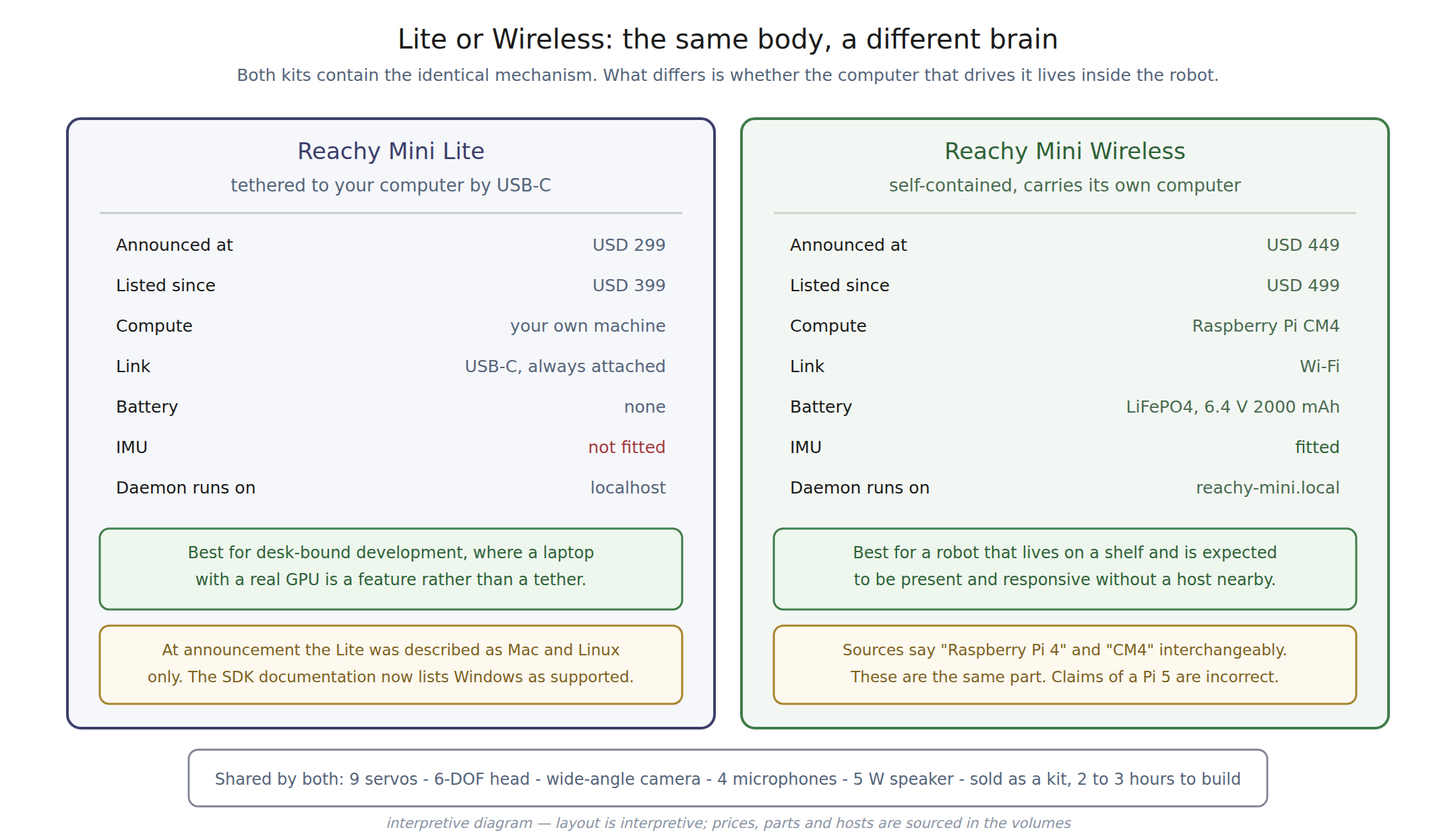
Reachy Mini is sold directly by Pollen Robotics and through the Hugging Face route, as a kit, in two variants. Unlike every other robot documented in this hub’s companion-robot thread, it is currently in production and available new — no second-hand market is required.
Table 1 — Buying one
| Lite | Wireless | |
|---|---|---|
| Announced price | USD 299 | USD 449 |
| Listed price, as read | USD 399 | USD 499 |
| Store price, as read | EUR 350 | EUR 435 |
| Lead time | up to 90 days, often sooner | up to 90 days, often sooner |
Every price above is a snapshot. They have already moved once, a further increase was reported in June 2026, and the announcement page appears to have been edited in place rather than preserved — so it now disagrees with contemporaneous reports of its own launch. Check the store.
6.1.1 Which variant
Lite if the robot will live beside a computer that is on anyway, and the purpose is writing code. It is USD 100 cheaper and a laptop’s compute is an asset rather than a tether. It has no IMU and no battery.
Wireless if the robot is meant to be present — on a shelf, responsive, not plugged into anything. The battery, the Wi-Fi and the IMU are what make it a thing in a room rather than a peripheral.
The mechanism is identical. Nothing about the expressiveness differs.
6.1.2 Before ordering
- Confirm the current price, which moves.
- Confirm the lead time, quoted as up to 90 days.
- For Lite, confirm host OS support — Windows was added after announcement, so the documentation is ahead of older coverage.
- Budget two to three hours for assembly. Tools and a guide are included; no soldering and no 3D printer are needed.
- Note that the IMU is Wireless-only, which is the least obvious difference.
- Consider starting in simulation during the lead time — uniquely among the robots in this hub, the wait is usable.
6.2 Honest assessment
6.2.1 What is genuinely strong
The published stack is the most complete in this hub, by a wide margin. SDK, daemon, firmware, simulator, examples, assembly guides and hardware design files, with roughly 2,900 commits and activity on the day this research was conducted. Nothing else documented here is close.
The simulator changes the purchase. A 90-day lead time is normally dead time. Here it is development time, and the hardware arrives as a deployment target.
The architecture is right for what it is. A local HTTP daemon that any client can reach, with heavy inference free to run elsewhere, is the correct shape for a robot whose job is to be a body for models. It is also inspectable in a way Cozmo’s undocumented UDP protocol was not until a volunteer reverse-engineered it.
The Stewart platform earns its complexity. Head translation — leaning, not just tilting — is a real expressive capability that a serial neck cannot produce.
Reusing Hugging Face Spaces for distribution gave a niche robot a real software ecosystem at almost no cost.
6.2.2 What is overstated
“Fully open” is wrong. The software is Apache-2.0. The hardware design files are CC BY-SA-NC, and a non-commercial clause disqualifies them as open-source hardware under the standard definitions. Owners may study, modify and repair freely; nobody may manufacture and sell. On licence permissiveness alone, the Petoi machines in this hub are more open — their firmware is MIT with no restrictions.
The app store is a vendor dependency, and it is the only one in this dive. Vol 5 sets out why it is a far smaller exposure than Vector’s dead cloud — applications are git repositories and the robot works offline — but it is not zero, and the rest of this dive’s durability argument should be read with it in view.
Prices and specifications have drifted, and the primary announcement page was edited rather than versioned. That is ordinary vendor behaviour and a genuine nuisance for anyone citing it.
6.2.3 What is not established
- Long-term reliability. This is a 2025 product. No multi-year service record exists, for the servos, the Stewart linkages or the battery.
- Spare-parts availability and pricing were not established.
- The size and activity of the application catalogue were not surveyed.
- Curation policy for published applications.
- Battery cycle life beyond the LiFePO4 chemistry and 12.8 Wh capacity.
- Height — one independent sheet says 30 cm against the vendor’s 28 cm.
6.2.4 Who it is for
A good fit for someone who wants to put machine-learning models into a physical object, who values being able to read the whole stack, and who is comfortable assembling a kit and writing Python.
A poor fit for someone wanting a finished companion in the Cozmo or Vector sense. Reachy Mini has no personality engine, no emotional model and no built-in character. It has a superb expressive mechanism and an SDK — the character is the owner’s to write. That is the opposite trade from the Anki machines, which shipped a personality and no access to it.
A poor fit for anyone needing manipulation or mobility. There are no arms and no wheels, by design.
6.2.5 The verdict
As an engineering artefact and as an answer to the question this hub keeps asking — what happens to the robot when the vendor goes away — Reachy Mini is the strongest design documented in the companion-robot thread. It is what Vector should have been.
The asterisk is that “open by design” is not the same as “fully open”, and the honest version is more useful than the marketing one: the software is as free as software gets; the hardware is published but encumbered; and the app store is somebody else’s service.
6.3 Cheatsheet
Distilled from Vols 1 to 6. C = stated by a vendor or repository source, U = single secondary source, NF = not established.
6.3.1 At a glance
Table 2 — At a glance
| Attribute | Value | Conf. |
|---|---|---|
| Announced | 9 July 2025 | C |
| Makers | Pollen Robotics, acquired by Hugging Face April 2025 | C |
| Height / width / mass | 28 cm (23 cm asleep) / 16 cm / 1.5 kg | C |
| Alternative height figure | 30 cm | U |
| Degrees of freedom | 9 — 6 head, 1 body, 2 antennas | C |
| Head mechanism | parallel Stewart platform, 6 linkages | C |
| Camera | wide-angle, Pi Camera v3 class, Sony IMX708 | C / part U |
| Microphones | 4, PDM MEMS, 16 kHz | C |
| Speaker | 5 W into 4 ohms | C |
| IMU | Wireless only | C |
| Wireless compute | Raspberry Pi CM4, 4 GB / 16 GB | C |
| Wireless battery | LiFePO4, 6.4 V 2000 mAh, 12.8 Wh | U |
| Assembly | kit, 3 boxes, 2 to 3 hours, no soldering | C |
| Lead time | up to 90 days | C |
| Software licence | Apache-2.0 | C |
| Hardware licence | CC BY-SA-NC — not open-source hardware | C |
Raspberry Pi note: “Raspberry Pi 4” and “CM4” are the same part. Claims of a Pi 5 are incorrect.
6.3.2 Motion limits
Table 3 — Motion limits
| Axis | Range |
|---|---|
| Head pitch and roll | -40 to +40 deg |
| Head yaw | -180 to +180 deg |
| Body yaw | -160 to +160 deg |
| Head-to-body yaw difference | max 65 deg — set by the cable loom |
The SDK clamps out-of-range targets rather than refusing them.
6.3.3 Software
Table 4 — Software
| Item | Value |
|---|---|
| Package | reachy-mini on PyPI |
| Version | 1.10.0, 25 Aug 2026; 1.11.0rc1, 11 Sep 2026 |
| Python | 3.11+ per PyPI; docs say 3.10–3.12, recommend 3.12 |
| Repository | pollen-robotics/reachy_mini, Apache-2.0 |
| Daemon | REST + WebSocket on port 8000 |
| Host | localhost (Lite) / reachy-mini.local (Wireless) |
| Simulator | MuJoCo, reachy-mini[mujoco] |
| Also | JavaScript SDK, same daemon and API |
Install with uv pip install "reachy-mini". Git LFS required. Linux additionally
needs GStreamer and udev rules for USB vendors 1a86 and 38fb.
6.3.4 API essentials
with ReachyMini() as mini:
    mini.goto_target(head=..., antennas=..., body_yaw=..., duration=2.0, method="minjerk")
    frame = mini.media.get_frame()          # (h, w, 3) uint8
    doa, speech = mini.media.get_DoA()      # 0 rad left, pi rad right
    mini.start_head_tracking()
Interpolation: linear, minjerk (default), ease_in_out, cartoon.
Motors: enable_motors(), disable_motors(), enable_gravity_compensation().
Media backends: default, local, webrtc, no_media. WebRTC remote clients are
Linux-only at present.
6.3.5 Apps
Published as Hugging Face Spaces; installed in one click from the robot’s dashboard.
Write one by calling logic from a run method, packaging it, and publishing the Space.
More than 15 behaviours ship pre-loaded. Integrates with LeRobot.
6.3.6 Open items
Long-term reliability; spare-parts availability; application catalogue size and curation; battery cycle life; the 28 cm versus 30 cm height discrepancy; current pricing.
6.3.7 Hub contrast, one row
Table 5 — Hub contrast, one row
| Reachy Mini | Anki Vector | |
|---|---|---|
| Remote computation | whatever the owner points it at | a single vendor endpoint that died |
Fuller cross-robot matrix: _shared/comparison.md.
6.4 Figure slots for the unit documented here
Sources
This cheatsheet introduces no new claims; every row traces to Vols 1 to 5 and through
them to the sources cited there. Principal anchors: huggingface.co/blog/reachy-mini;
the huggingface.co/docs/reachy_mini installation, core-concepts, Python SDK and apps
pages; github.com/pollen-robotics/reachy_mini; pypi.org/project/reachy-mini;
store.pollen-robotics.com; robotsguide.com; and April 2025 acquisition coverage.
Comments (0)