RoboDog · Volume 3
The Landscape: What's Out There
The quadruped robotics market in 2026 divides cleanly into two worlds: a commercial tier where turnkey machines sell from roughly US $300 to US $75,000, and an open-source DIY tier where a builder armed with a 3D printer, a few hundred dollars in servos, and a Raspberry Pi can produce a walking twelve-degree-of-freedom robot over a weekend. Between these poles lies almost every variation imaginable in actuator technology, computing architecture, weatherproofing, payload, and software openness. This volume surveys the most relevant machines in each world — scored against the five axes that matter for an original build program — then consolidates the findings into comparison tables and extracts the lessons each platform offers to a three-tier build ladder aimed at full autonomous all-weather property patrol.
3.1 How This Survey Evaluates Each Platform
Five axes frame every entry in this survey. Understanding the axes before reading the platform profiles makes the comparison tables below immediately useful.
Capability captures what the machine can physically do: locomotion agility (speed, slope angle, obstacle height), payload, weather protection, and on-board sensing. A robot capable of navigating a 45-degree mud slope in driving rain scores very differently from one that handles a flat living-room floor.
Price is assessed at the point of purchase as of the access dates noted in each citation. This market moves fast: Unitree alone has revised the Go2 line three times since the platform launched in mid-2023, and Chinese FOB prices can run 10–20 % below US/EU distributor prices. [1] Where a confirmed discrepancy between sources exists, this volume reports the range and notes the likely cause.
Documentation quality distinguishes a project a first-time builder can complete alone from one that requires deep expertise just to understand the bill of materials. A commercial vendor’s SDK reference is not the same as a community readthedocs site with build logs, nor is either equivalent to a peer-reviewed ICRA paper with full hardware and software release.
Community affects the practical effort of debugging, sourcing substitute parts, and extending the base platform. A Discord server with ten thousand members answering servo-calibration questions has real value. A GitHub repository with a single maintainer who last committed three years ago does not.
What it teaches the build ladder is the lens unique to this survey. Rather than ranking platforms in the abstract, this volume asks what each one reveals about actuator selection, structural approach, compute architecture, weatherproofing strategy, and gait software — each of which feeds directly into a three-tier build ladder whose third tier must patrol outdoors autonomously in all weather.
3.2 Commercial Platforms
3.2.1 Unitree Go2 Family (2023–present)
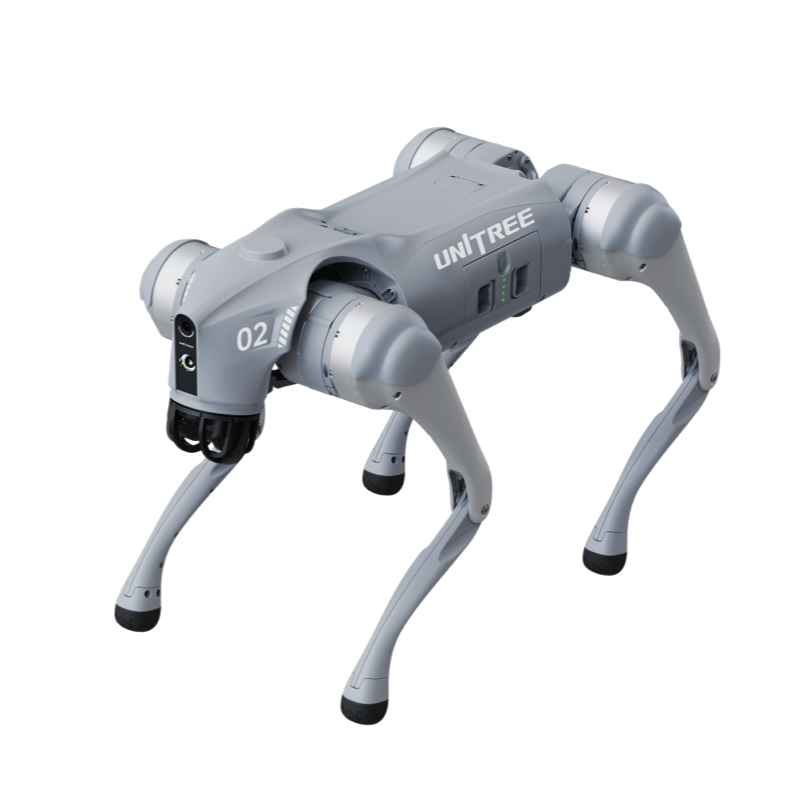
Shenzhen-based Unitree Robotics launched the Go2 platform in mid-2023 and has since iterated it into four publicly sold tiers plus enterprise variants. The platform has become the most widely discussed affordable commercial quadruped among hobbyists and researchers, in large part because the entry price was the first to break through the US $2,000 barrier at commercial scale. [2]
Go2 Air. The entry tier starts at approximately US $1,600 (multiple US distributors, as of April 2026). [1][2] Weight is roughly 15 kg with battery installed. [3] The standard 8,000 mAh / 28.8 V battery delivers approximately one to two hours of runtime depending on activity. Top speed is 2.5 m/s, maximum slope is 30°, and the robot can step over obstacles up to 150 mm (5.9 in). [3] The onboard sensor is a Unitree 4D LiDAR L2 with 360°×96° hemispherical sweep. [3] Connectivity is app-based only; no ROS access, no SDK, no external compute port at this tier. Payload is approximately 7 kg. [3]
Go2 Pro. At approximately US $2,800 (Unitree official shop; multiple distributors, March 2026), [1][2] the Pro adds limited Python and C++ SDK access, raises top speed to 3.5 m/s, and increases obstacle clearance to 160 mm. [4] Peak joint torque is rated at approximately 45 N·m. [4] Payload climbs to approximately 8–10 kg. [4] The sensor suite is the same 4D LiDAR L2 plus depth cameras.
Go2 Edu (Standard and Plus). The Edu tier introduces the NVIDIA Jetson Orin compute module — Orin Nano (40 TOPS) in the Standard, Orin NX (100 TOPS) in the Plus — along with a full open SDK (Python, C++, ROS 2), a Unitree 4D LiDAR L1 (360°×90°, 50 mm minimum detection distance), five fish-eye stereo depth cameras, an Intel RealSense D435i, and four foot-end force sensors. [5][6] Pricing for the Edu tier shows a marked discrepancy across sources: one 2026 price guide lists the Standard at US $3,790 and the Plus at US $5,490, [2] while retail-order product pages from robostore.com and STEMfinity list full Edu configurations with LiDAR and sensor suites at US $13,205–$15,637.50. [5][6] The lower figures likely represent a bare-platform body without the complete sensor integration package; the higher figures represent the fully equipped research-ready build. Buyers should confirm sensor inclusion and software subscription terms at point of purchase. The Edu Plus adds a 15,000 mAh battery and docking station, extending runtime to two to four hours. [5]
Go2 Enterprise. A managed-services tier priced around US $8,900 that includes cloud fleet software and a support contract rather than a different hardware configuration. [2]
Unitree B2. The B2 is a separate, heavier industrial platform distinct from the Go2 family, cited here because it marks the top of Unitree’s quadruped range. At approximately US $30,000 from US distributors (some FOB China sources give lower figures), [1][7] the B2 weighs 60 kg, carries a 40 kg moving payload (120 kg static), sustains 6.0 m/s — the fastest of any production quadruped in 2025 — and carries IP67 weatherproofing. [7] Battery capacity is 45 Ah (2,250 Wh), yielding more than four hours of runtime and a 20 km unloaded range. [7] It is the machine on the commercial spectrum most similar in intent to the third-tier build target for this program.
3.2.2 Boston Dynamics Spot
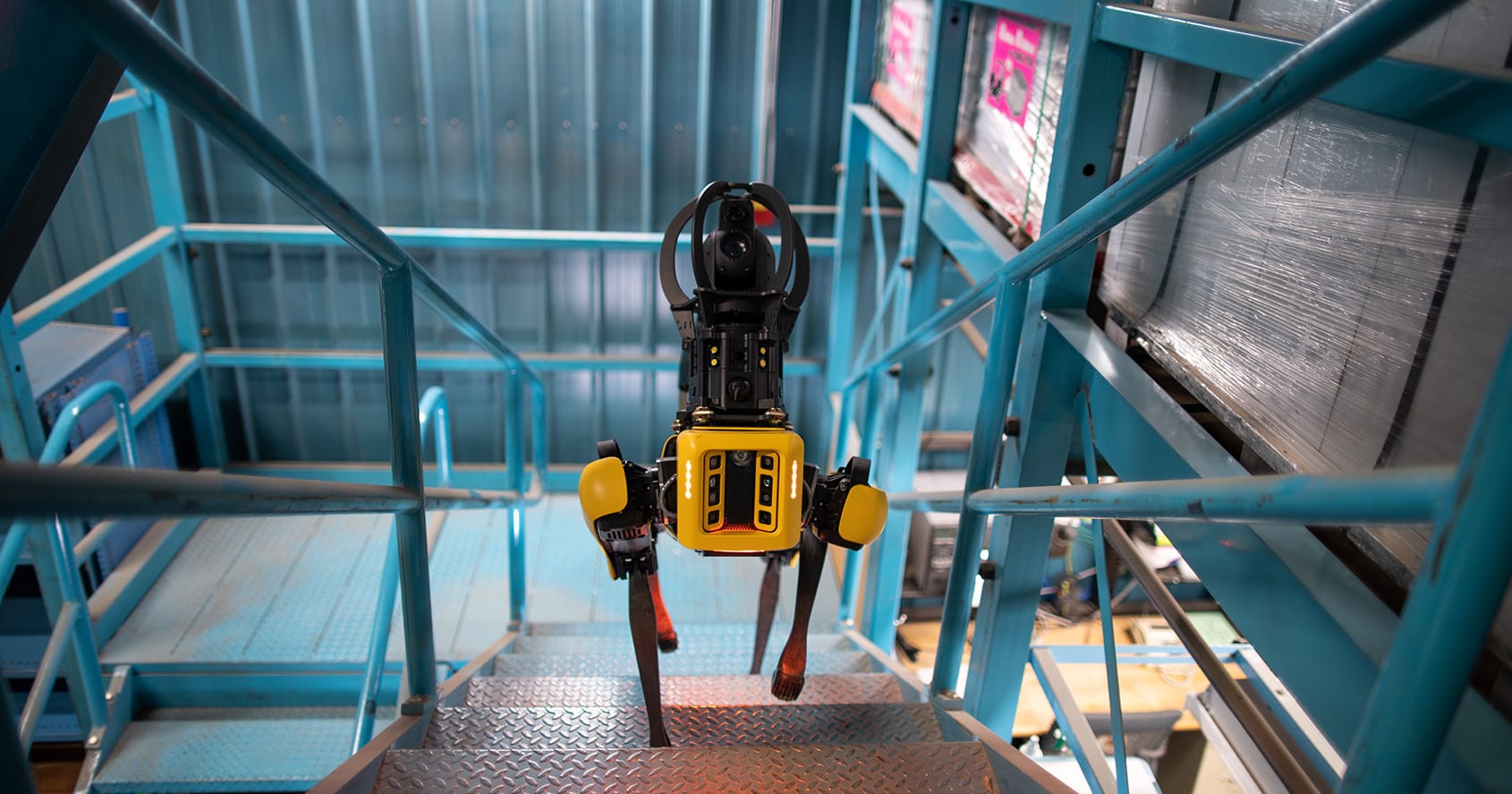
Boston Dynamics released Spot for general commercial sale in June 2020. The Explorer Kit base price is consistently cited at US $74,500–$75,000 across the sources checked for this volume: standardbots.com lists $75,000 as of January 2026, while IEEE Spectrum and futurobots.com cite $74,500. [8][9][10] The base kit includes the robot, two hot-swappable battery packs, a rugged tablet controller, charger, and transport case.
At this price, Spot delivers: 32.7 kg body weight; 14 kg payload; 90 minutes per charge; 1.6 m/s top speed; IP54 dust and water resistance; -20 °C to +55 °C operating range; and 360-degree perception through a combination of stereo cameras, depth sensors, and optional LiDAR. [8][9] The optional Spot Arm (a 7-degree-of-freedom manipulator with 11 kg payload) adds approximately US $65,000, bringing total hardware to roughly US $140,000. [8] Annual software subscriptions for the Orbit and Scout fleet management systems add US $15,000–$25,000 per year. [8] Full industrial deployments commonly exceed US $195,000.
Boston Dynamics publishes the Spot SDK as open source on GitHub (Python), making it freely available for academic and commercial use. However, the hardware is emphatically not open: Boston Dynamics restricts sales to commercial, industrial, and accredited academic buyers and performs screening before accepting orders. More than 1,500 units have been deployed across oil platforms, construction sites, mining operations, and public safety agencies globally. [8]
Spot’s primary relevance to this program is as the commercial benchmark against which every other quadruped is compared. Its IP54 rating, -20 °C cold-weather operation, and long-term industrial deployment record define the capability envelope the third-tier build aspires to approach.
3.2.3 DEEP Robotics: Lite3 and X30
DEEP Robotics is a Hangzhou-based company whose product line occupies a middle tier between Unitree and Boston Dynamics in both price and performance. The two models most relevant to this survey sit at opposite ends of that range.
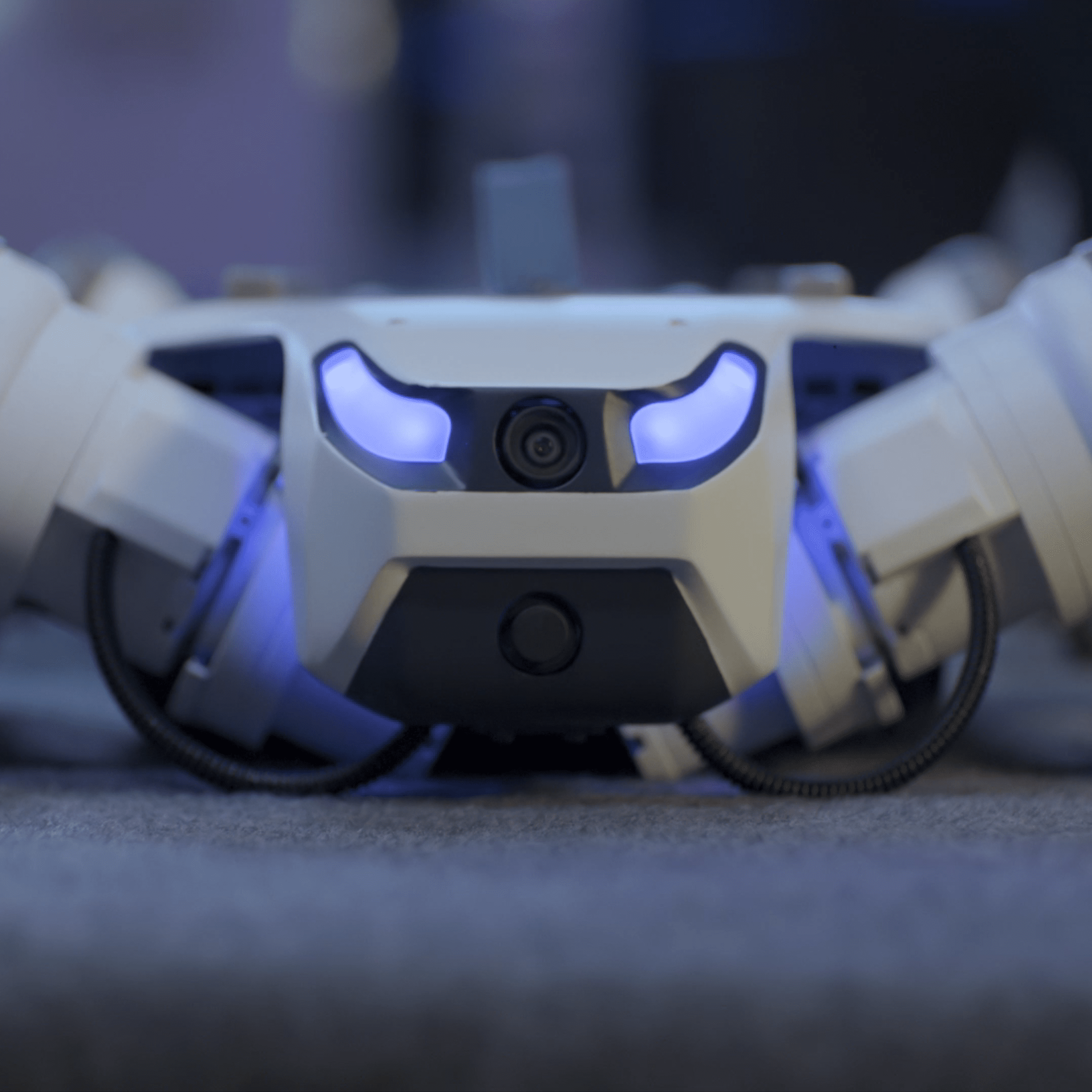
Lite3. The Lite3 Basic starts at US $2,890 on the official deeprobotics.us online shop (promotional pricing at US $2,745.50 during a June 2026 sale). [11][12] Four variants are offered: Basic, Venture, Pro, and LiDAR; the LiDAR model rises to approximately US $5,400. [11] Body weight is 12–13.5 kg depending on variant; payload is 5–7.5 kg distributed across the back deck. [13] Standing dimensions are 610×370×445–496 mm. Runtime is 1.5–2 hours and range reaches up to 5 km on a charge. Unladen top speed is 5 m/s. [13]
The Lite3 SDK is notable for its simulation breadth: DEEP Robotics provides URDF and MJCF model files validated for NVIDIA Isaac Sim, Gazebo Classic, Gazebo Sim (Ignition), MuJoCo, and PyBullet, in addition to ROS 1 and ROS 2 runtime interfaces. [13] The LiDAR model integrates an industrial-grade IMU with a depth camera system for autonomous obstacle avoidance and 3D scanning. [13]
X30. The X30 Pro variant is priced at approximately US $85,000 from US distributors (Robots International, June 2026), with a second distributor corroborating approximately US $82,000 (Robots Asia, CNY 591,615 at June 2026 exchange rates). [14][33] The base X30 configuration is available on a request-for-quote basis only and carries no publicly listed price. The X30 weighs 56 kg, carries ≥30 kg payload, achieves ≥4 m/s, sustains IP67 weatherproofing through a -20 °C to +55 °C range, clears 200 mm obstacles, and navigates slopes up to 45°. [14] Range exceeds 10 km on a charge. [14]
3.2.4 Petoi Bittle (and Nybble)
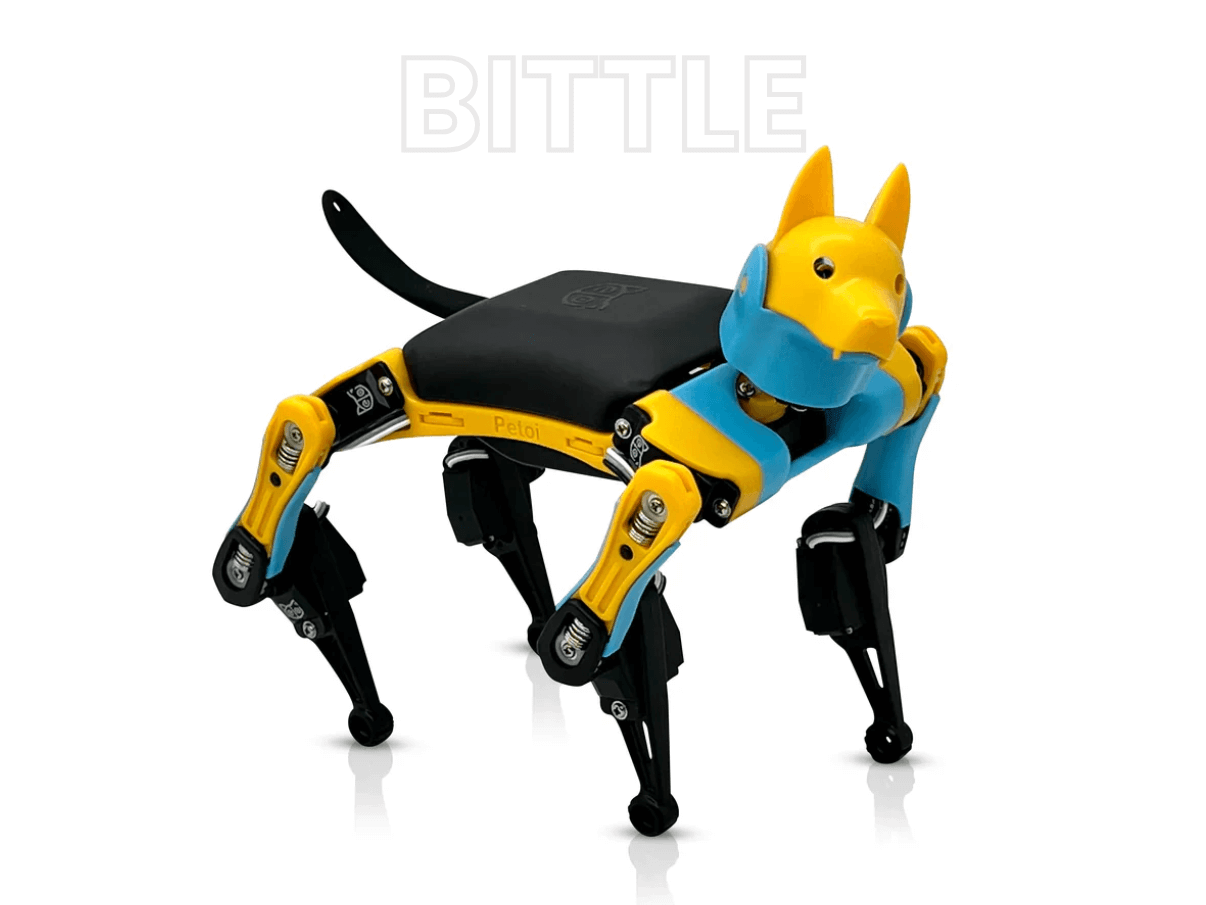
The Petoi Bittle is a desktop-scale open-source quadruped that sells for US $289 (sale price from US $299) or US $299 for the voice-controlled Bittle X variant (petoi.com, as of 2025). [15][16] The companion Nybble (a robot cat) is similarly priced at US $299.
Bittle has nine degrees of freedom and uses hobby servo actuators controlled by Petoi’s NyBoard (an Arduino-based controller). Body length is approximately 20 cm; weight is approximately 250 g. Programming is supported through a Scratch-like block environment, C++, and Python, with optional expansion via Raspberry Pi modules for computer vision and ROS integration. The firmware (OpenCat) is fully open source on GitHub under MIT license.
Bittle’s relevance to this survey is educational rather than operational. It will not patrol a property in rain; its servos lack the torque, its frame lacks weatherproofing, and its battery lasts minutes rather than hours. However, Bittle teaches inverse kinematics, gait sequencing, servo calibration, and the NyBoard’s sensor fusion approach in a form factor cheap enough to crash, rebuild, and iterate. Tom’s Hardware’s 2025 review describes it accurately as “more than a pet toy — a robotics primer.” [16] A builder who has spent two evenings with a Bittle understands the physical constraints of servo-based quadrupeds at a level that no textbook reproduces.
3.2.5 MangDang Mini Pupper 2
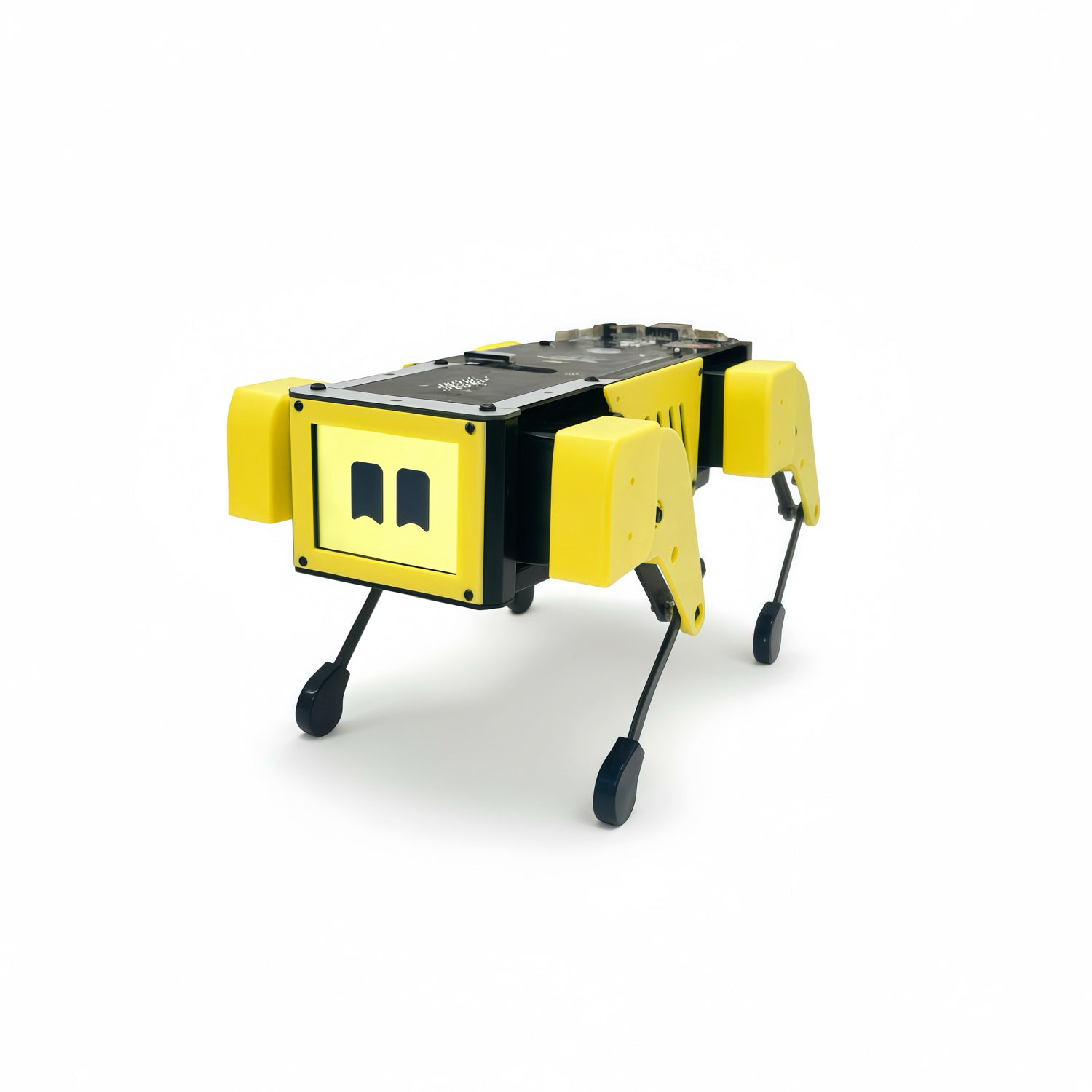
MangDang’s Mini Pupper 2 occupies a distinctive niche: a ROS2-native, MIT-licensed, Raspberry Pi-powered quadruped small enough to carry in one hand, priced within the reach of individual hobbyists and university lab budgets. As of 2024–2025, pricing ranges from US $429–$499 for self-assembly kits and US $549 for the standard assembled unit, rising to US $529–$649 for the Pro variant. [17][18][19]
Key specifications: 450 g total weight; 210×110×140 mm (CM4 version) or 165 mm tall (Pi 4 version); 12 DOF via three servos per leg, each leg managed by a dedicated microcontroller; 1,000 mAh battery; 30–50 minutes runtime; 200 g payload. [20][21] The standard version provides position servo feedback; the Pro version adds velocity and torque feedback per servo — a hardware distinction that enables torque-based control loops unavailable in the standard model. [21] The Pro variant integrates an OAK-D-Lite stereo depth camera for depth perception and visual processing.
Compute is Raspberry Pi 4 (or CM4) plus an ESP32 MCU. The 320×240 LCD display, built-in microphone, and speaker enable interaction and debugging without a separate monitor. Software is MIT-licensed and ROS2-native; the project GitHub (mangdangroboticsclub/QuadrupedRobot) provides full build documentation.
Mini Pupper 2 is the most direct commercial analog to a Tier-1 FDM builder’s goal: a small, affordable, fully programmable, ROS2-integrated quadruped. The gap between Mini Pupper 2 and the program’s Tier-3 all-weather patrol target is enormous in every dimension (weight, payload, weatherproofing, range, autonomy), but the software stack and control architecture translate directly upward.
3.3 Open-Source DIY Builds
3.3.1 Stanford Pupper (v3) and Stanford Doggo
Stanford’s robotics ecosystem has produced two distinct open-source quadruped lineages, both released under the MIT license and both notable for their documentation quality.
Stanford Doggo (2019) was designed as a quasi-direct-drive (QDD) research platform and presented at IEEE ICRA 2019. [22][23] QDD actuation uses a single-stage low-ratio (≤10:1) gearbox directly coupled to a high-torque-density brushless motor. The result is mechanically simple, thermally efficient, highly backdrivable (meaning external forces can push the joint), and dynamically capable. The Doggo has eight degrees of freedom (two per leg) and a BOM cost under US $3,000, assembled using only hand tools. [22] Its vertical jumping agility exceeded the previous best-performing robot by 22 % at publication. [22] The GitHub repository (Nate711/StanfordDoggoProject) remains a reference implementation for QDD quadruped design. Community size is modest (the academic-origin project is well-documented but has a narrower maker following than SpotMicro), but the documentation quality is excellent: a full IEEE paper, open CAD, and software.
Stanford Pupper v3 (2024) extends the Pupper lineage (v1 and v2 cost US $600–$1,000 in parts) to approximately US $2,000 for a self-sourced build. [24][25] The v3 is Raspberry Pi-based with a screen, articulated ears, built-in microphone, and speaker — designed as much for human interaction as for locomotion research. It integrates the OpenAI Realtime API and visual language models (VLMs), using cameras and proprioceptive sensing for conversational and visual tasks. [24] Actuators are quasi-direct drive (low-ratio geared brushless, following the Doggo lineage). License is MIT; documentation lives on a maintained readthedocs site (pupper-v3-documentation.readthedocs.io) and the stanfordroboticsclub GitHub. Pre-built kits are available from vendors like OzRobotics for approximately US $2,500+. [26]
The Stanford lineage’s primary lesson is actuator philosophy: QDD actuation costs more than hobby servos but delivers backdrivability, torque control, and impact compliance that hobby servos cannot approximate. Every dynamic gait — trotting, bounding, jumping — becomes significantly more tractable with QDD or equivalent low-impedance actuation.
3.3.2 James Bruton’s OpenDog (V1–V3)
James Bruton (XRobots) began the OpenDog project in 2018, documenting it through a thirty-plus-episode YouTube series and accompanying GitHub releases (github.com/XRobots). [27][28] The project is the most detailed public record of a single builder constructing a full-size (Spot-scale) quadruped from scratch, iterating through fundamentally different actuator architectures across versions.
V1 (2018–2019) used ODrive open-source brushless motor controllers paired with brushless DC outrunner motors driving ball screws via belt transmissions. [27] Ball screws are non-backdrivable: an external force cannot push the joint back. This makes the machine stiff and precise but unable to absorb impact dynamically. Total build cost was estimated at approximately US $2,000, with the ODrive units and motors accounting for the majority. [27] The chassis was largely 3D-printed on FDM hardware.
V2 replaced the non-backdrivable ball screws with backdrivable brushless motors and added an IMU for balance sensing. [27][28] This substantially improved compliance and dynamic response, at the cost of some positional stiffness.
V3 adopted 3D-printed cycloidal drives — compact, high-reduction-ratio gearboxes that Bruton developed over several months of iteration. [29] Cycloidal drives are partially backdrivable (more so than ball screws, less so than QDD) and can be fabricated on any FDM printer, making them the most accessible route to moderate gear reduction without purchasing commercial gearboxes. Component cost for V3 is estimated at US $2,000–$3,000 depending on motor controller choices; the brushless motors and ODrive units remain the primary cost drivers, as in V1. [29]
All versions are MIT-licensed with full CAD and code on GitHub. Documentation quality is high by DIY standards (video series plus written build notes at xrobots.tech) but less formal than the Stanford papers. The community is large: XRobots has approximately one million YouTube subscribers, and the OpenDog videos have been viewed millions of times collectively. [27]
3.3.3 SpotMicro and SpotMicroAI
SpotMicro is a Spot-shaped desktop quadruped originally designed for 3D printing and assembled around twelve hobby servos. It has no single canonical author; the design evolved through a community of contributors coordinated at spotmicro.org, with the SpotMicroAI fork (readthedocs: spotmicroai.readthedocs.io) being the most widely documented branch. [30][31]
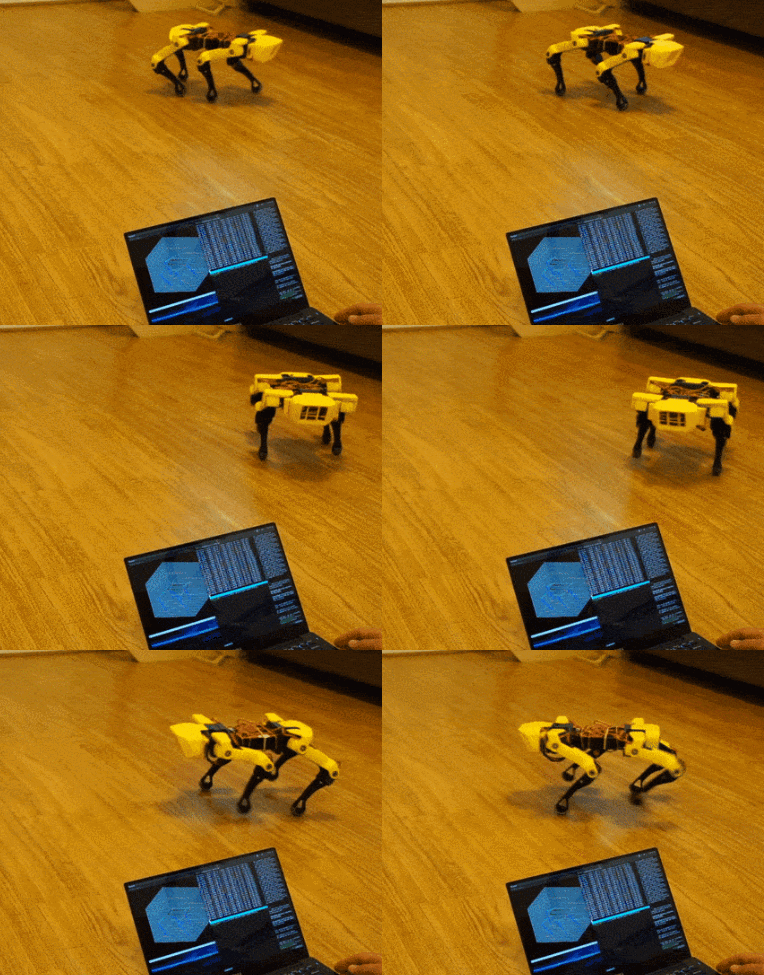
The standard SpotMicro uses twelve MG996R hobby servos (approximately US $3–$5 each), a PCA9685 PWM controller board, an MPU6050 IMU, and a Raspberry Pi. [31] An upgraded variant substitutes CLS6336HV servos at approximately US $25 each, raising servo cost from roughly US $40–$60 to approximately US $300 but significantly improving torque and feedback. Compute variants include Jetson Nano (SpotMicroJetson fork). Total BOM is approximately US $300–$600 depending on servo choice, Raspberry Pi version, and print material — making SpotMicro the lowest entry-cost functional quadruped in this survey. [30][31] This estimated range is community-derived, not from a single authoritative BOM document.
Licenses vary across the many community forks (MIT and GPL variants predominate). Documentation quality is moderate and fragmented: the readthedocs site is useful but not comprehensive, and key build knowledge lives in forum threads rather than structured guides. The community is large and active — multiple Discord servers, spotmicro.org forums, dozens of GitHub repositories. [30]
SpotMicro’s lesson is that a recognizable quadruped gait is achievable at very low cost if control quality is sacrificed. Hobby servos have no torque feedback, poor positional resolution at load, and limited torque bandwidth. A SpotMicro walks; it does not trot dynamically, absorb impacts, or operate outdoors reliably. The gap between SpotMicro and a patrol-capable outdoor machine is not incremental — it is architectural.
3.3.4 OpenQuadruped and Related Projects
Several additional open-source projects merit mention for their algorithmic or structural contributions, even if their maker communities are smaller.
OpenQuadruped (adham-elarabawy/open-quadruped) is a 3D-printed twelve-DOF robot distinguished by its Bezier-curve gait generation approach, which produces smoother body trajectories than simple linear interpolation. [32] A custom PCB handles the twelve servo outputs, and a ROS + Gazebo simulation pipeline accompanies the hardware. License is MIT. Community is modest (hundreds of GitHub stars); documentation is adequate for a builder with prior ROS experience but would be challenging without it. Parts cost is estimated at US $300–$500, comparable to a SpotMicro build, as the design uses similarly classed hobby servos, a Raspberry Pi, and 3D-printed structural components. [32]
OpenDog Mini (James Bruton) is a smaller, lower-cost variant of the OpenDog project intended to make the backdrivable brushless motor approach more accessible. Unlike the main OpenDog platforms, the Mini uses smaller motors and a proportionally reduced chassis, bringing the build cost closer to the SpotMicro range while retaining better actuator quality. [27]
Dingo (Robotic Systems Lab / ETH Zürich) is a research quadruped whose code draws from Stanford Pupper and Notspot repositories. It is primarily an academic platform rather than a maker project, but the Notspot software (a community-maintained Spot-emulating gait library for Raspberry Pi) has been adopted by multiple community builds and is worth tracking for its locomotion control quality.
3.4 Comparison Tables
3.4.1 Commercial Platforms
Table 1 — Commercial Platforms
| Platform | Price (USD, 2026) | Weight | Payload | Runtime | Speed | Protection | SDK / Openness |
|---|---|---|---|---|---|---|---|
| Unitree Go2 Air | ~$1,600 [1][2] | 15 kg [3] | ~7 kg | 1–2 h | 2.5 m/s | None rated | App only |
| Unitree Go2 Pro | ~$2,800 [1][2] | 15 kg [4] | ~8–10 kg | 1–2 h | 3.5 m/s | None rated | Python/C++ SDK |
| Unitree Go2 Edu | $3,790–$15,637 [2][5][6] | 15 kg | ~8–10 kg | 2–4 h (15 Ah) [5] | 3.5 m/s | None rated | Full ROS2 + SDK |
| Unitree B2 | ~$30,000 [1][7] | 60 kg [7] | 40 kg | 4+ h | 6.0 m/s | IP67 | SDK |
| Boston Dynamics Spot | $74,500–$75,000 [8][9] | 32.7 kg [8] | 14 kg | 90 min | 1.6 m/s | IP54 | Open Spot SDK |
| DEEP Robotics Lite3 | $2,890–$5,400 [11][12] | 12–13.5 kg [13] | 5–7.5 kg | 1.5–2 h | 5 m/s | None rated | ROS1/ROS2 + SDK |
| DEEP Robotics X30 | ~$85,000 (Pro); quote-only (base) [14][33] | 56 kg [14] | ≥30 kg | 2.5–4 h | ≥4 m/s | IP67 | SDK |
| Petoi Bittle | $289–$299 [15][16] | ~250 g [16] | Minimal | 30–60 min | ~0.4 m/s | None | Open (MIT) |
| MangDang Mini Pupper 2 | $429–$649 [17][18][19] | 450 g [20] | 200 g | 30–50 min | ~0.5 m/s | None | MIT + ROS2 |
Prices are US distributor prices at the dates cited. FOB China factory prices are typically 10–20 % lower. [1] “None rated” indicates no published IP or NEMA ingress-protection rating.
3.4.2 Open-Source DIY Builds
Table 2 — Open-Source DIY Builds
| Platform | Est. BOM Cost | Actuator Type | DOF | License | Docs Quality | Community Size | Key Challenge |
|---|---|---|---|---|---|---|---|
| Stanford Doggo | <$3,000 [22] | Quasi-direct drive BLDC | 8 | MIT | High (IEEE paper + GitHub) | Small (academic) | QDD parts sourcing |
| Stanford Pupper v3 | ~$2,000 [24][25] | Quasi-direct drive BLDC | 12 | MIT | High (readthedocs + GitHub) | Medium | AI integration complexity |
| OpenDog V1 | ~$2,000 [27] | ODrive + BLDC → ball screw | 12 | MIT | High (30+ video series) | Large (YouTube) | Non-backdrivability |
| OpenDog V3 | ~$2,000–$3,000 est. [29] | 3D-printed cycloidal drives | 12 | MIT | High (video + GitHub) | Large (YouTube) | Cycloidal print precision |
| SpotMicro | ~$300–$600 est. [30][31] | 12× hobby servos | 12 | MIT/GPL (varies) | Moderate (scattered) | Very large (forums + Discord) | Servo torque / control quality |
| Mini Pupper 2 (open ed.) | ~$430–$500 est. [17][18] | 12× custom PWM servos | 12 | MIT | High (GitHub + readthedocs) | Large | Limited runtime (30–50 min) |
| OpenQuadruped | ~$300–$500 est. [32] | 12× hobby servos | 12 | MIT | Moderate (GitHub) | Small | Smaller community |
BOM costs marked “est.” are community-derived estimates; no single canonical BOM document was found. All prices as of sources cited (2019–2025).
3.5 What Each Teaches the Build Ladder
The three-tier build ladder this program follows runs from FDM hobby (Tier 1, the SpotMicro / Bittle / Mini Pupper 2 zone) through mid machined (Tier 2, CNC-cut aluminum or carbon fiber structural members, higher-quality servo or quasi-direct-drive actuators) to a full-CNC all-weather autonomous finale (Tier 3, sealed, weatherproof, proprioceptive, capable of sustained outdoor patrol). Each platform surveyed above casts a specific shadow on that ladder.
3.5.1 Lessons from Commercial Platforms
The Unitree Go2 family establishes what mass production can achieve at each price point. The Air at US $1,600 demonstrates that a robot with real terrain capability (150 mm obstacles, 30° slopes, 4D LiDAR) can be built at modest cost when manufactured at scale. The Edu tier’s NVIDIA Orin integration shows that on-board ML inference is no longer reserved for enterprise-tier machines. The pricing discrepancy between configuration levels (bare body vs. full-sensor package) is a practical reminder that headline specs require scrutiny: the camera suite and LiDAR that make the Edu genuinely useful for autonomous operation add $10,000+ to the base body price.
Boston Dynamics Spot defines the commercial ceiling in terms of deployment maturity, software ecosystem, and all-weather reliability. Its IP54 rating, -20 °C cold-weather specification, and multi-year track record in industrial environments show that a properly engineered quadruped can survive environments hostile to consumer electronics. The Spot SDK’s open availability means software written against Spot’s API can be studied and adapted even without a Spot unit. However, Spot’s speed ceiling (1.6 m/s) and 90-minute runtime are notable weaknesses relative to the patrol mission; the Unitree B2 and DEEP X30 both exceed Spot on these axes.
The DEEP Robotics Lite3 is the most instructive commercial platform for Tier-2 build planning. It occupies the same price range as the Go2 Pro/Edu but emphasizes simulation fidelity (five physics environments with validated URDF/MJCF models) over consumer UX, making it explicitly aimed at researchers who will be writing and testing controllers before deploying on hardware. A Tier-2 build should aspire to the same workflow: develop and validate in simulation, then flash to hardware.
Petoi Bittle and Mini Pupper 2 together define Tier 1. A Bittle build teaches servo calibration, IK basics, and gait sequencing in under a weekend. A Mini Pupper 2 extends that into full ROS2 integration with a real sensor (OAK-D-Lite). Neither is a serious patrol candidate, but both are concrete, cheap, and fast to iterate — precisely the properties needed to establish builder competence before committing to a Tier-2 or Tier-3 material budget.
3.5.2 Lessons from Open-Source Builds
The Stanford QDD lineage (Doggo + Pupper v1–v3) makes the strongest technical case in this survey for quasi-direct drive as the correct actuator paradigm for a dynamic outdoor quadruped. Backdrivability (the ability of external forces to push a joint without overloading the drivetrain) is not optional for outdoor use: rocks, curbs, and uneven terrain will apply unpredictable lateral loads, and a non-backdrivable drivetrain either breaks or falls over. QDD motors cost more than hobby servos — as a rough order-of-magnitude comparison derived from the whole-robot BOM figures surveyed above, a QDD-equipped leg runs approximately US $100–$300 in parts versus US $5–$25 for a hobby-servo leg — but the capability gap is proportionally larger. The Tier-2 build should use actuators in the QDD or cycloidal-drive class.
James Bruton’s OpenDog series provides the best documented record of what it takes to build a full-size quadruped as a solo builder. The V1-to-V3 actuator evolution — ball screw (stiff, non-backdrivable) → backdrivable brushless → cycloidal drive — is a compressed map of the design space. V3’s printed cycloidal drives are the most reproducible of the three, making them the most practical route for a builder without machine-shop access. The key lesson from OpenDog is that actuator and structural design are inseparable: the frame must be designed around the actuator’s load path from the start; retrofitting a better actuator into a frame designed for a different one is harder than starting fresh.
SpotMicro teaches what hobby servos cannot do. At US $300–$600 all-in, a SpotMicro builder learns assembly, wiring, servo mapping, and basic gait control. The machine walks. But the absence of torque feedback, the positional slop under load, and the roughly 0.9 N·m (≈9 kg·cm) rated stall torque of MG996R servos [31] make any dynamic or outdoor application impractical. SpotMicro is a useful negative example: a Tier-1 build that uses better servos (Dynamixel AX or MX series, or equivalents) from the start avoids the ceiling that basic hobby-servo designs hit immediately.
Mini Pupper 2’s ROS2 integration and MIT licensing make it the most directly reusable software reference for this program. The gait controller, servo driver, and ROS2 node architecture are all open, all documented, and all written for a 12-DOF quadruped. Adapting Mini Pupper 2’s software stack to a larger, more capable Tier-2 body is a credible path that avoids writing low-level locomotion code from scratch.
The synthesis across all platforms is consistent: the actuator choice is the pivotal early decision. Commercial platforms that work outdoors (Spot, B2, X30) all use proprietary but clearly QDD-inspired or harmonic-drive actuators. Open-source platforms that achieve dynamic gaits (Doggo, Pupper) use QDD. Open-source platforms that use hobby servos (SpotMicro, Bittle) walk indoors on flat surfaces. A build that aspires to autonomous outdoor patrol must begin with actuators in the QDD or high-quality gear-reduced brushless class, regardless of what tier it occupies.
Sources
- GrabaRobot — “Unitree Robot Price: Complete Guide to Every Unitree Model in 2026” (accessed 2026-06-18) — https://www.grabarobot.com/blog/unitree-robot-price/
- Robotics Center AI — “Robot Dog Price Guide 2026: Every Model Compared” (accessed 2026-06-18) — https://www.roboticscenter.ai/blog/robot-dog-price-guide
- Robots International — “Unitree Go2 Air: Specs, LiDAR, Uses & Price” (accessed 2026-06-18) — https://www.robotsinternational.com/Unitree-Go2-Air-Quadruped.htm
- Unitree Robotics — Go2 official specification page; Go2 Pro peak joint torque listed as approximately 45 N·m (accessed 2026-06-19) — https://www.unitree.com/go2/
- RoboStore — “Unitree Go2 EDU AI Quadruped Robot Dog” product page with Orin and sensor specs (accessed 2026-06-18) — https://robostore.com/products/go2-edu-40-tops-computing-quadruped-robot-dog
- STEMfinity — “Unitree Go2 EDU AI Quadruped Robot Dog” listing at $15,637.50 (accessed 2026-06-18) — https://stemfinity.com/products/unitree-go2-edu-ai-quadruped-robot-dog
- RoboStore — “Unitree B2 Industrial Quadruped Robotic Dog” specs (accessed 2026-06-18) — https://robostore.com/products/unitree-b2-industrial-quadruped-robotic-dog
- Standard Bots — “How much does the Boston Dynamics Spot robot cost in 2026?” (accessed 2026-06-18) — https://standardbots.com/blog/spot-robot
- IEEE Spectrum — “Boston Dynamics’ Robot Dog Price and Availability” (accessed 2026-06-18) — https://spectrum.ieee.org/boston-dynamics-spot-robot-dog-now-available
- FutureRobots — “Boston Dynamics Spot: Why Companies Pay $74,500 for This Robot Dog” (accessed 2026-06-18) — https://www.futurobots.com/boston-dynamics-spot-robot-dog-industrial-review/
- DEEP Robotics — Official Lite3 product page and online shop (accessed 2026-06-18) — https://shop.deeprobotics.us/collections/lite
- AwesomeRobots — “Deep Robotics Lite3 from $2,890” (accessed 2026-06-18) — https://www.awesomerobots.xyz/robots/deep-robotics-lite3
- Robotics 24/7 — “DEEP Robotics Launches Lite3 Quadruped Robot With Front Flipping Mobility” (accessed 2026-06-18) — https://www.robotics247.com/article/deep_robotics_launches_lite3_quadruped_robot_front_flipping_mobility
- Robots International — DEEP Robotics X30 Pro listed at US $85,000; base X30 available on quote-only basis (accessed 2026-06-19) — https://www.robotsinternational.com/Deep-Robotics.htm
- Petoi — Official Bittle product page with pricing (accessed 2026-06-18) — https://www.petoi.com/products/petoi-bittle-robot-dog
- Tom’s Hardware — “Petoi Bittle Robot Dog Review” (accessed 2026-06-18) — https://www.tomshardware.com/reviews/petoi-bittle-opensource-robotic-dog-ai-stem-learning
- MangDang — Mini Pupper 2 product page with pricing (accessed 2026-06-18) — https://mangdang.store/products/mp2
- RobotShop — “Mini Pupper 2 Pre-assembled Kit” listing (accessed 2026-06-18) — https://www.robotshop.com/products/mangdang-mini-pupper-2-pre-assembled-kit-open-source-ros-robot-dog-kit
- Amazon — Mini Pupper 2 listing (accessed 2026-06-18) — https://www.amazon.com/MangDang-Quadruped-Educational-Open-Source-Pre-Assembled/dp/B0CNCRNSQY
- CNX Software — “Mini Pupper 2 — Raspberry Pi 4 / CM4 robot dog adds ESP32, ROS2 support, servo feedback” (accessed 2026-06-18) — https://www.cnx-software.com/2022/10/19/mini-pupper-2-raspberry-pi-4-cm4-robot-dog-esp32-ros2-servo-feedback/
- New Atlas — “Mini Pupper 2 makes a bid to be your new hackable robo-dog pal” (accessed 2026-06-18) — https://newatlas.com/robotics/mangdang-mini-pupper-2/
- IEEE ICRA 2019 — Kau & Schultz, “Stanford Doggo: An Open-Source, Quasi-Direct-Drive Quadruped” (accessed 2026-06-18) — https://ieeexplore.ieee.org/document/8794436/
- arXiv — Stanford Doggo paper preprint (accessed 2026-06-18) — https://arxiv.org/abs/1905.04254
- Stanford Pupper v3 documentation — Official readthedocs site with ~$2,000 BOM reference (accessed 2026-06-18) — https://pupper-v3-documentation.readthedocs.io/
- Robots That Exist — “Pupper v3 - Real Robot Build Info” (accessed 2026-06-18) — https://robotsthatexist.com/robots/pupper-v3
- OzRobotics — “Stanford Pupper Quadruped Open-Source Educational AI Robot - Complete Kit” (accessed 2026-06-18) — https://ozrobotics.com/shop/stanford-pupper-quadruped-open-source-educational-ai-robot-complete-kit/
- Robohub — “James Bruton focus series #1: openDog, Mini Robot Dog & openDog V2” (accessed 2026-06-18) — https://robohub.org/james-bruton-focus-series-1-opendog-mini-robot-dog-opendog-v2/
- Hackaday — “[James Bruton] Is Making A Dog: OpenDog Project” (accessed 2026-06-18) — https://hackaday.com/2018/06/11/james-bruton-is-making-a-dog-opendog-project/
- 3D Printing Industry — “James Bruton begins work on V3 of his open-source 3D printed robotic dog” (accessed 2026-06-18) — https://3dprintingindustry.com/news/james-bruton-begins-work-on-v3-of-his-open-source-3d-printed-robotic-dog-196644/
- SpotMicroAI documentation — readthedocs BOM and community info (accessed 2026-06-18) — https://spotmicroai.readthedocs.io/en/latest/gettingStarted/
- Technology×2 — “RESEARCH: SpotMicroAI, Low cost and Easily built Quadruped Robot” (accessed 2026-06-18) — https://www.technologyx2.com/proj_robot_quadruped/2020/6/14/research-spotmicroai-low-cost-and-easily-built-quadruped-robot
- GitHub — adham-elarabawy/open-quadruped OpenQuadruped repository (accessed 2026-06-18) — https://github.com/adham-elarabawy/open-quadruped
- Robots Asia — DEEP Robotics X30 Pro listed at CNY 591,615 (approximately US $82,000 at June 2026 exchange rates); base X30 available on quote basis (accessed 2026-06-19) — https://www.robotsasia.com/Deep-Robotics.htm
Comments (0)