RoboDog · Volume 6
Build 2: The Mid Machined Tier
Build 1 taught the essentials: how servo torque translates to walking torque, why a shared-compute architecture stumbles above 4 Hz gait, and what a robot that cannot handle a step edge feels like in the hand. Build 2 is the first machine in this program that can actually trot — not shuffle quasi-statically, but produce a dynamic, spring-loaded diagonal gait that recovers from terrain disturbances. The price of that capability is a step-change in cost and build complexity. Twelve quasi-direct-drive brushless actuators replace twelve hobby servos. A machined aluminum and PETG-CF composite frame replaces the all-FDM shell. A Jetson Orin NX replaces the Raspberry Pi 5. The bill of materials rises from approximately US $540 to approximately US $8,776. Every dollar of that increase is traceable to a specific Build-1 lesson that could not be resolved within the FDM hobby tier. This volume documents what was changed, why, how the core subsystems were specified, and what Tier 2 still cannot do — because that remaining gap defines the Tier-3 design brief.
6.1 Goal and What This Build Adds
Build 2’s design objective is a twelve-degree-of-freedom quadruped standing at Labrador-shoulder height (approximately 450–500 mm hip height) capable of a stable dynamic trot on outdoor hardscape, controlled via a Bluetooth gamepad with assisted ROS 2 autonomy for obstacle-free waypoint navigation. The frame mass budget is 10 kg all-up — well below the Spot (32 kg) and Go2 (15 kg) but substantially heavier than Build 1’s 1.5 kg desktop frame. That mass increase forces the actuator upgrade: the DS3218MG servos that pass Build 1’s torque check at SF = 2.4 cannot meet the static load requirement for a 10 kg frame at any reasonable safety factor.
The specific capability additions that separate Tier 2 from Tier 1:
Dynamic gait. Quasi-direct-drive actuation provides the backdrivability — the ability of the joint to be pushed back by an external force without damaging the drivetrain — that is the necessary condition for trotting, bounding, and impact-absorbing locomotion. Hobby servos, whether DS3218MG or LX-16A, are not backdrivable; their multi-stage plastic or metal gearboxes lock the joint when undriven, and an impact load is transmitted directly to the gear teeth. QDD actuators with 6:1 to 9:1 gear ratios reflect substantially less inertia to the output shaft and permit the control loop to implement virtual spring-damper compliance at each joint.
Proprioceptive torque sensing. The AK-series integrated actuators use field-oriented control (FOC) motor drivers that regulate phase current and can report estimated torque in real time over CAN bus. Build 1 had no torque feedback at any joint; the controller estimated stance from kinematics alone. Build 2 can sense ground contact directly — which leg is in stance, what load it is carrying, when a foot slips — enabling the gait state estimator to produce a significantly better body-state estimate.
Assisted autonomy. The Jetson Orin NX 16GB provides 100 TOPS of AI inference capability on-board, enabling the robot to run an object-detection model (YOLOv8 or Ultralytics YOLO11 on the OAK-D Pro’s VPU), estimate traversable space from the depth camera, and execute a Nav2 behavior-tree navigation plan. This is assisted autonomy — not unsupervised patrol, but supervised route-following with onboard obstacle detection that does not require the operator to manually steer around every table leg.
Light weather resistance. All electronics are housed in an IP5X-rated enclosure mounted on the back spine. The AK80-9 V3.0 actuators are rated to −20 °C to 50 °C with sealed motor windings. Structural leg members are PETG-CF, which resists moisture and UV better than PLA-CF. Tier 2 is not rated for sustained rain or submersion — that is Tier 3 — but it can operate in light drizzle or morning dew on grass without expecting an immediate failure.
Build 2 is also explicitly not the final patrol dog. It cannot navigate over rough terrain without mapping support, cannot survive a drenching rain, cannot run a twenty-four-hour patrol shift, and cannot make autonomous security decisions. Those capabilities belong to Tier 3. Build 2’s job is to validate that the owner can build, tune, and operate a dynamically competent QDD quadruped — the hardest single engineering problem in the build ladder — before committing to the Tier-3 BOM.
6.2 Actuators
6.2.1 QDD Actuator Lineup: CubeMars AK80-9 V3.0
The CubeMars AK80-9 V3.0 KV100 is the selected primary actuator for Build 2. It integrates a 48 V brushless DC motor, a 9:1 single-stage planetary gearbox, a 16-bit magnetic encoder, and a field-oriented control driver board into a single 490 g sealed housing measuring Ø98×38.5 mm. [1] Published specifications from the CubeMars product page (accessed June 2026) list peak torque at 22 N·m, rated continuous torque at 9 N·m, and rated no-load speed at 570 rpm on a 48 V supply. [1] Rated phase current is 12 A; peak current is 28 A; phase-to-phase resistance is 160 mΩ. [1] Operating temperature spans −20 °C to 50 °C. The control interface is CAN bus (MIT protocol and Servo mode supported); the driver board handles FOC commutation internally without requiring a separate controller on the BOM. [1]
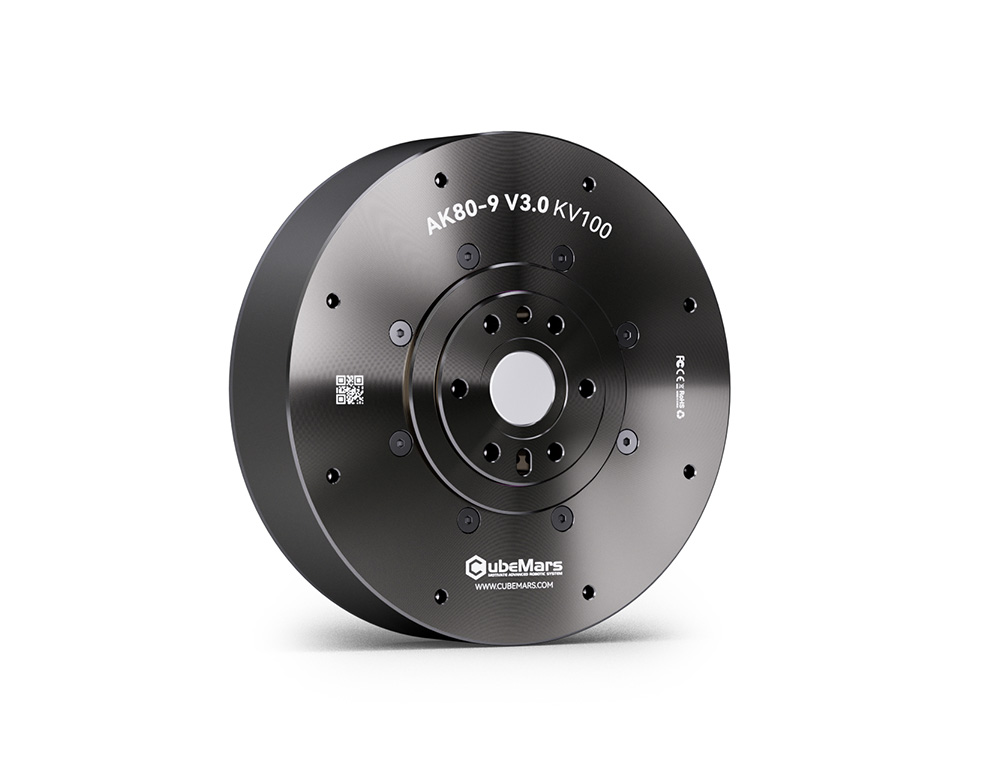
Pricing shows a consistent band across US-accessible channels as of June 2026: the CubeMars product detail page lists US $479.90, [1] and the Foxtech US distributor lists the same unit at US $479.00–$579.90 (InStock at time of access). [2] The store.cubemars.com online store listed the unit at US $579.90 in June 2025 (sold out then, as documented in Volume 4). [3] The spread between channels is real and buyers should confirm price at point of purchase; the BOM in this volume uses US $479.90 per unit (product page figure) as the baseline. At 12 units for a complete 3-DOF, 4-leg set, the actuator subtotal is US $479.90 × 12 = US $5,759 (rounded to nearest dollar).
CubeMars is a product brand under T-Motor (Sanrui Intelligent); the AK80-9 was originally introduced as the T-Motor AK80-9 and drew its design lineage from the MIT Mini-Cheetah actuator. The Alibaba direct-import price for T-Motor–branded AK80-9 units from the same period ranges US $449.90–$549.90 per unit, [4] but warranty coverage and driver firmware support are less predictable from gray-market import channels. The CubeMars-branded V3.0 through US-accessible distributors is the appropriate procurement path.
For the three hip-abduction/adduction (HAA) joints in builds where shoulder-abduction load is lower, the CubeMars AK60-6 V3.0 KV80 is a lighter and less expensive alternative: 380 g, 9 N·m peak (3 N·m rated), 6:1 reduction, US $229.90 per unit. [5] Substituting the AK60-6 for the three HAA joints per leg (12 joints × ⅓ = 4 HAA joints) saves approximately US $1,000 at the cost of reduced HAA torque headroom. The torque sanity-check below uses the full-AK80-9 configuration as the baseline.
6.2.2 Torque Sanity-Check: First-Order Static Estimate for Build 2
The methodology matches Build 1’s calculation in Volume 5 for direct comparison. This is a first-order static estimate only; it does not model dynamic impact loads, thermal derating, or joint friction losses. Its purpose is to establish whether the AK80-9’s rated torque class is appropriate for a 10 kg frame at this geometry — a necessary, not sufficient, verification.
Assumptions:
- Robot total mass: M = 10 kg. This accounts for the 12× AK80-9 actuators at 490 g each (5.88 kg), a machined aluminum and PETG-CF frame (approximately 2 kg), the Jetson Orin NX and carrier board (approximately 0.3 kg), the 12S LiPo pack (approximately 2.8 kg), and sensors plus wiring (approximately 0.7 kg remainder). The 10 kg figure is consistent with Volume 4’s Tier-2 power budget estimate of 8–10 kg. [6]
- Gravitational acceleration: g = 9.81 m/s²
- Stance legs during diagonal trot: N = 2 (two diagonally opposite legs bear the full body weight at any instant in a trot gait)
- Worst-case knee lever arm: L = 0.15 m (150 mm lower leg / tibia from knee joint to foot contact; slightly longer than Build 1’s 120 mm to reflect the larger Labrador-scale frame geometry; worst case occurs when the tibia is approximately horizontal, maximizing the moment arm)
- Safety factor: SF = 2 (same as Volume 5 methodology for consistent comparison across build tiers)
Calculation:
Per-stance-leg vertical force: F_v = Mg/N = (10 × 9.81) / 2 = 49.05 N
Static knee joint torque: τ_static = F_v × L = 49.05 × 0.15 = 7.36 N·m
Required peak torque at SF = 2: τ_required = 7.36 × 2 = 14.72 N·m
Results vs. AK80-9 V3.0:
Table 1 — Results vs. AK80-9 V3.0:
| Metric | AK80-9 V3.0 value [1] | Comparison to τ_static = 7.36 N·m | Comparison to τ_required (SF=2) = 14.72 N·m |
|---|---|---|---|
| Peak torque | 22 N·m | 3.0× static margin | Passes (22 / 14.72 = 1.49×) |
| Rated continuous torque | 9 N·m | 1.22× static margin | Below SF=2 (9 / 14.72 = 0.61×) |
The AK80-9 passes at peak torque with 3.0× static margin, which is adequate for the brief stance-phase loading in a trot gait where each leg is in contact for approximately half the gait cycle. The rated continuous torque of 9 N·m is below the 14.72 N·m SF=2 target, but this does not disqualify the actuator: in a trot gait, the knee joint does not sustain its worst-case static load continuously — it applies peak torque for the duration of the stance phase and then unloads. The thermal constraint (rated current of 12 A) is met at the average draw, not the peak stance draw. This is precisely the design principle behind QDD actuators: size by peak rather than continuous torque for the brief, energetic stance-phase events. The MIT Mini-Cheetah (9 kg body mass, 17 N·m peak actuators) operated successfully in this same regime, [7] and community experience with QDD platforms of this torque class — including the documented mjbots Quad A1 at approximately 10 kg, which has demonstrated sustained trot gaits [18] — suggests that actuators in this peak-torque class can sustain trot operation without thermal failures under normal duty cycles.
As with Volume 5, this calculation uses datasheet values under ideal conditions. Dynamic loads during impact events, thermal derating at elevated ambient temperature, and gearbox efficiency losses (efficiency is not fully 100%) will all reduce effective output below the rated figures. These effects reinforce rather than undercut the choice of 22 N·m peak — the 3.0× peak margin provides the headroom that dynamic events consume.
6.2.3 Build-Your-Own QDD Option: BLDC Motor plus Planetary Gearbox
An alternative to integrated AK-series modules is assembling a QDD joint from discrete components: a naked high-torque-density outrunner brushless motor, a single-stage planetary gearbox, a separate FOC controller, and an absolute encoder. This is the approach taken by the MIT Mini-Cheetah’s actuator design and by the mjbots Quad A1 open-source platform.
A representative DIY QDD joint using this approach would comprise a T-Motor U8 II KV100 motor (US $309.99 [29]), a 6:1 or 9:1 single-stage planetary reduction unit (approximately US $60–$120 depending on supplier and backlash specification, est.), a moteus r4.11 controller (US $94 [8]), and an AMS AS5048A 14-bit absolute encoder IC (approximately US $8 [30]). Total per-joint cost: approximately US $470–$530, compared to US $479.90 for an integrated AK80-9.
At the T-Motor U8 II KV100’s retail price of US $309.99, the component-build path offers no meaningful cost advantage over the integrated AK80-9. The argument for the DIY path is mechanical-design flexibility and component-level control — the builder specifies every sub-component and can swap gearbox ratio, motor KV, or encoder independently — not cost reduction. A naked brushless motor still requires mechanical design of the joint housing, bearing selection and press-fitting, encoder alignment, and wiring harness routing through the joint. The integrated AK80-9 ships as a drop-in module with mounting holes, a CAN connector, and a calibrated encoder. For a builder whose goal is validated dynamic locomotion rather than motor-controller design, the integrated path reduces the number of failure modes that compete for debugging time. Build 2 specifies the integrated AK80-9 path; the DIY path is noted here as a component-flexibility option for builders with mechanical design experience who want to specify each sub-component independently.
6.2.4 Motor Controllers: moteus r4.11 and ODrive S1
For builders following the DIY QDD path, two open-source FOC controllers are the community standard.
The mjbots moteus r4.11 is the reference controller for QDD-class legged robotics. At US $94 per unit, it delivers 900 W peak electrical power on a 10–44 V (10S LiPo maximum) rail at up to 100 A peak phase current, operates a 15–30 kHz control loop on a 170 MHz STM32G4, and communicates at 5 Mbps CAN-FD. [8] Weight is 14.2 g. The controller is the hardware used in the mjbots Quad A1 open-source quadruped, is fully open-source (Apache 2.0 firmware and hardware), and integrates with micro-ROS through a documented CAN-FD hardware interface. [8]
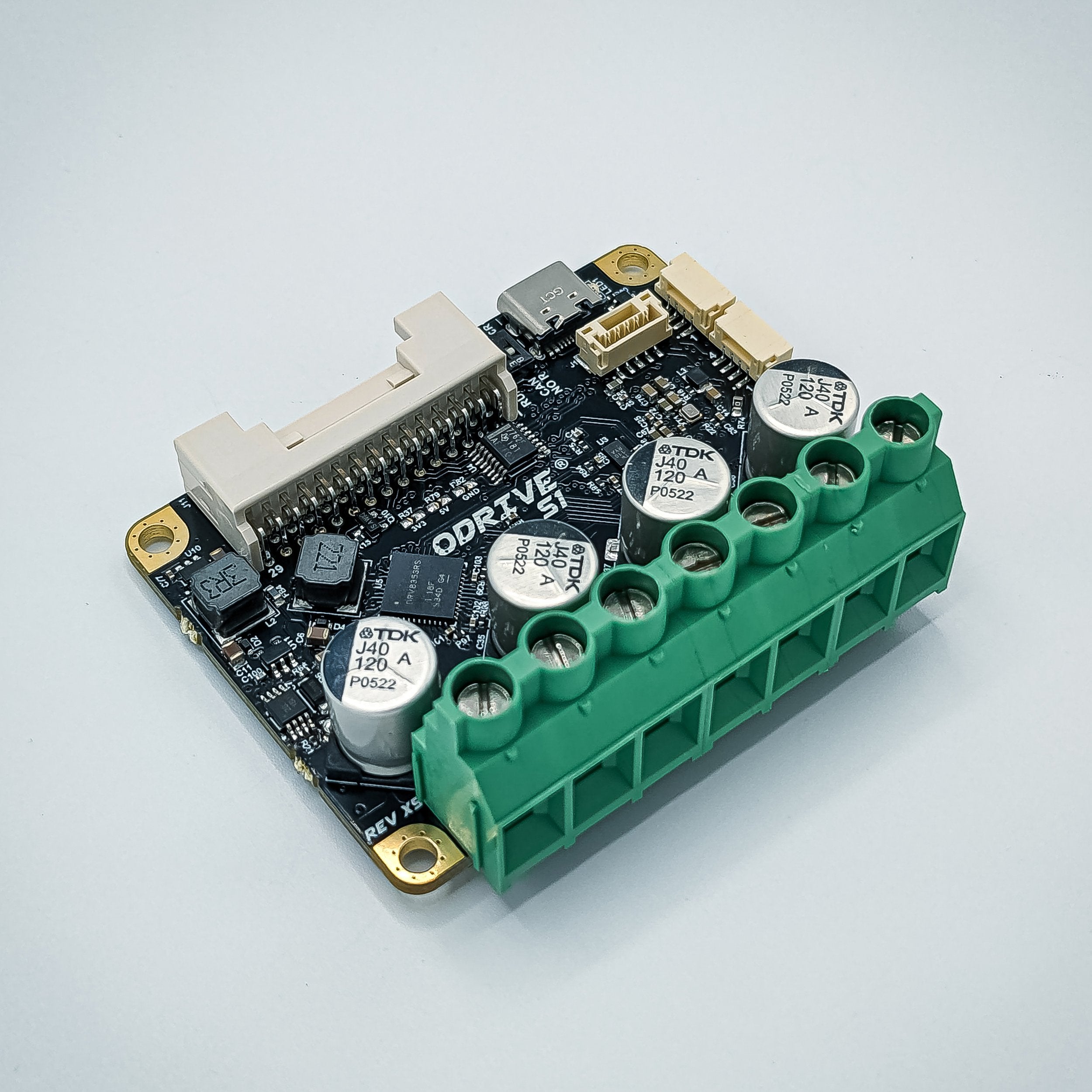
The ODrive S1 operates on 12–48 V at up to 40 A continuous and is preferred by builders who need the widest encoder-type compatibility (the onboard MA702 plus quadrature, Hall, SPI, and RS-485 offboard interfaces) or who want USB and UART alongside CAN for development flexibility. [9] US price is US $149 per unit. [9] The ODrive S1 has a larger board footprint (66×50 mm) and slightly higher per-unit cost than the moteus, but its broader encoder support and mature documentation make it the recommended starting controller for first-time QDD builds. For a 12-joint set using the DIY QDD path, 12 ODrive S1 units cost US $1,788; 12 moteus r4.11 units cost US $1,128.
Builders using integrated AK80-9 actuators do not add motor controllers to the BOM — the driver electronics are included in the actuator module price.
6.3 Frame
6.3.1 Mixed Printed and Machined Architecture
Build 1’s all-FDM approach is appropriate for the loads that hobby servos generate. Build 2’s QDD actuators produce 22 N·m peak at each joint; a FDM PLA-CF shoulder bracket at the hip-to-body junction would require unreasonably thick cross-sections to survive that loading, and would still be vulnerable to the combination of elevated ambient temperature (PLA-CF glass transition ≈ 55–60 °C) and UV exposure in outdoor use. [10]
Build 2 uses a mixed approach: structurally critical interfaces are machined 6061-T6 aluminum; non-critical link members and covers are PETG-CF printed. The specific allocation:
Machined in 6061-T6 aluminum (owner’s CNC mill):
- Shoulder side plates and hip pivot brackets — highest actuator moment transfer; 3 mm minimum wall thickness per the Volume 4 structural guideline for a 22 N·m joint [6]
- Spine structural rails — two 20×30 mm extruded rectangular tube segments forming the body backbone, drilled and tapped for electronics payload mounting
- Knee pivot blocks — small but high-stress, benefit from aluminum’s 276 MPa yield strength versus approximately 33 MPa (cross-layer, worst case for FDM-printed PETG-CF in tension) [31]
3D-printed in PETG-CF:
- Upper leg (femur) and lower leg (tibia) link members — primarily axial / bending loads from body weight; PETG-CF’s impact absorption reduces component destruction in tip-over events [10]
- Electronics enclosure cover, wiring strain-relief clips, foot pads
The choice of PETG-CF for the printed members (rather than PLA-CF as in Build 1) reflects outdoor operating conditions: PETG-CF resists moisture ingress and UV exposure better than PLA-CF and absorbs energy before fracture rather than splitting cleanly. [10] Its heat deflection temperature (approximately 80 °C) also eliminates the risk of solar-induced deformation that PLA-CF would introduce in a machine deployed on concrete in summer sun. [10]
6.3.2 Leg Design and Wiring Routing
Each of the four legs implements three degrees of freedom: hip abduction/adduction (HAA) at the shoulder pivot, hip flexion/extension (HFE) at the upper-leg–body junction, and knee flexion/extension (KFE) at the femur–tibia hinge. The kinematic parameters — hip height, femur length, tibia length — are sized to produce a target shoulder height of approximately 460 mm with a standing knee angle of approximately 140°, matching a medium Labrador’s proportions and placing the feet approximately 200 mm below the hip pivot in normal stance.
One of Build 1’s lessons was that servo wiring fatigue-fails within hundreds of cycles if routed externally across a flexing joint. Build 2 routes all actuator power and CAN signal cables through hollow leg link members — the machined aluminum links and printed PETG-CF tubes both have central bores sized for a 4-conductor shielded cable bundle. The CAN bus runs in a daisy-chain topology from the compute module’s CAN-FD interface, passing through each actuator’s upstream and downstream connectors, with per-actuator node IDs assigned during initial commissioning.
Sealed ABEC-5 bearings (2RS designation) press-fit into the aluminum pivot blocks at every rotating joint. Sealed bearings prevent rain and dust ingress at the joint interfaces, which is the primary light-weather-resistance feature at the mechanical level. Joint fasteners are M4 stainless steel bolts with Nylock locking nuts at every structural connection, and Loctite 243 (blue) thread-locker on all through-bolts where Nylock nuts do not fit.
6.4 Compute
Build 1’s Raspberry Pi 5 provides adequate CPU compute for ROS 2 and a gait controller but cannot run neural-network inference at useful frame rates — the VideoCore VII GPU does not support CUDA. Build 2 replaces it with the Jetson Orin NX 16GB module and a third-party compact carrier board.
6.4.1 Jetson Orin NX 16GB
The Jetson Orin NX 16GB delivers 100 TOPS of AI inference in standard configuration, rising to 157 TOPS in Super Mode under JetPack 6.2 (higher clock frequencies, same hardware), at a configurable power draw of 10–25 W. [11] Its GPU is NVIDIA Ampere architecture (8 GB module: 70 TOPS; 16 GB module: 100 TOPS standard). [11] The ARM Cortex-A78AE CPU runs at up to 8 cores, enabling simultaneous ROS 2 gait control and Nav2 navigation on the same SOM without a separate co-processor for locomotion. CAN, SPI, I2C, and UART interfaces are available through the module’s carrier-board connector, enabling direct wiring to the actuator CAN bus without a USB-to-CAN adapter in the final build (though a USB-CAN adapter is included in the BOM for initial bring-up convenience).
The Orin NX 16GB is available from US-accessible distributors at approximately US $969–$1,100 as of June 2026, depending on the reseller (Firefly SoM: US $969; [12] DigiKey Seeed listing: approximately US $999 at bulk quantity; [13] ThinkRobotics India: approximately US $1,100 equivalent). [14] The BOM in this volume uses US $999 as the estimated module price; buyers should confirm current pricing at point of purchase.
A compact carrier board — the Waveshare JETSON-ORIN-IO-BASE-B — adds dual Ethernet (2.5G + 1G), dual M.2 Key M slots for NVMe SSD and secondary storage, an M.2 Key E slot for a wireless card, seven USB ports, and two CSI camera connectors in a robotics-friendly form factor, at US $99.99. [15]
For builders who want to minimize compute cost, the Jetson Orin Nano 8GB Super developer kit (US $249 from SparkFun and other authorized distributors) includes an Orin Nano 8GB module and a reference carrier board that accepts all Orin Nano and Orin NX modules. [16] The Orin Nano 8GB delivers 67 TOPS — sufficient to run a YOLO object-detection model at useful frame rates and handle Nav2 path planning simultaneously, though with less headroom for additional inference workloads than the Orin NX. For a Tier-2 build focused on assisted autonomy rather than a full multi-model inference stack, the Orin Nano path reduces the compute subtotal from US $1,099 (NX module + carrier) to US $249 (dev kit, carrier included), saving US $850. The BOM in this volume specifies the Orin NX 16GB for consistency with Volume 4’s tier recommendation; the Orin Nano is noted as a cost-reducing alternative.
6.4.2 Real-Time Motor Control MCU
A fundamental lesson from Build 1 is that ROS 2 running on a shared Linux kernel cannot produce the deterministic sub-millisecond timing that a 10–15 kHz joint control loop requires. Build 2 separates the real-time control layer onto a dedicated microcontroller: an STM32G4-based Nucleo development board (STM32G474RE class, 170 MHz, CAN-FD peripheral) running micro-ROS. [17] The micro-ROS layer subscribes to joint torque and position commands published by the CHAMP gait controller node running on the Orin NX, executes the CAN-FD protocol to the twelve AK-series actuators at 10–15 kHz, and publishes joint state and estimated torque back to the ROS 2 network. This is the same compute architecture used by the mjbots Quad A1 (a moteus-based dedicated MCU per bus) and aligns with the Mini Pupper 2’s per-leg ESP32 co-processor pattern. [18]
6.5 Autonomy
Build 2 targets assisted autonomy — a level of software capability that sits above pure teleoperation (Build 1) but well below the fully supervised, route-aware patrol that Tier 3 will implement.
6.5.1 ROS 2 and CHAMP
The locomotion controller is CHAMP (github.com/chvmp/champ), the same MIT Cheetah I hierarchical gait framework used in Build 1. [19] On a QDD-actuated platform, CHAMP’s foot trajectory planner can operate at 4–8 Hz gait frequency with torque-mode impedance control at each joint — the key difference from Build 1’s PWM servo interface. The framework accepts velocity commands from Nav2 or from a gamepad teleop node and translates them to joint position or torque targets through the configured URDF kinematics. CHAMP is BSD-3-licensed and actively maintained as of June 2026. [19]
6.5.2 Nav2 for Obstacle Avoidance and Waypoint Navigation
Navigation 2 (Nav2) is the ROS 2 navigation stack that provides behavior-tree-based path planning, costmap-based obstacle marking, and plugin architecture for local and global planners. [20] On the Orin NX, Nav2 can run simultaneously with the CHAMP gait controller and an object-detection model; the Orin NX’s 8-core ARM Cortex-A78AE provides sufficient CPU headroom to maintain approximately 10 Hz navigation updates in standard Nav2 costmap configurations (est.).
The depth stream from the OAK-D Pro populates a 3D costmap via the depth_image_proc and nav2_costmap_2d packages. The RPLIDAR S2’s 2D scan fills the 2D occupancy layer. Together, they provide the obstacle representation that Nav2’s DWB local planner uses to curve around detected obstacles. Waypoint following — navigating a set of GPS or map coordinates in sequence — is provided by the nav2_waypoint_follower action server. For Build 2’s assisted-autonomy goal, this means the operator specifies a patrol route as a list of waypoints; the robot follows the route autonomously, stopping when an obstacle is detected and either waiting or re-routing within Nav2’s planner budget.
6.5.3 Vision Detection
The Luxonis OAK-D Pro integrates an Intel Myriad X Vision Processing Unit (4 TOPS) directly on the camera board. [21] This VPU can run a YOLOv8-Nano or Ultralytics YOLO11 model compiled to OpenVINO format without loading the Orin NX GPU — an important separation of concerns that keeps the vision inference pipeline latency-independent of the navigation stack. At 30 fps depth and 30 fps RGB, the detection pipeline can identify person-sized objects at up to 8–10 m range at the OAK-D Pro’s usable stereo depth window.
Object-detection output from the OAK-D Pro is published as ROS 2 Detection2DArray messages that Nav2’s costmap layers can consume as virtual obstacles, or that a separate alert node can forward to a home automation or notification service over the WiFi link.
6.5.4 Honest Limits of Tier-2 Autonomy
Build 2’s assisted autonomy is a step toward, not a realization of, the patrol mission. The robot can follow a waypoint route, avoid obstacles in its path, and report detected objects to a monitoring client. It cannot reliably navigate across rough grass, cannot make independent security decisions (what constitutes a threat versus a tree branch), cannot return to base autonomously after a battery-low event without GPS waypoint integration, and cannot maintain a patrol schedule across multiple days without operator supervision. Those capabilities belong to the Tier-3 build. Documenting this gap explicitly is the purpose of this section — it defines exactly what remains to be engineered.
6.6 Sensors
Build 2 replaces every sensor from Build 1 with an upgraded unit matched to outdoor, dynamic-gait operating conditions.
6.6.1 Depth Camera: Luxonis OAK-D Pro
The OAK-D Pro (US $429 [21]) replaces the Raspberry Pi Camera Module 3 used in Build 1. It provides stereo depth at a 70 cm–12 m range with a 75° depth FOV, an integrated Intel Myriad X VPU (4 TOPS) for onboard neural inference, an IR dot projector for improved depth accuracy on textureless surfaces, and an IR LED for operation in darkness. [21][22] The extended 12 m depth range is a significant improvement over the Intel RealSense D435i’s approximately 3 m maximum — for outdoor path planning at walking speed (approximately 0.5–1.0 m/s), 12 m of look-ahead provides several seconds of obstacle reaction time. [21]
The OAK-D Pro’s onboard VPU running object detection means that Build 2’s primary detection pipeline does not consume Orin NX GPU cycles, leaving that compute headroom available for simultaneous Nav2 costmap updates and any additional inference tasks. ROS 2 DepthAI drivers (depthai-ros2) are actively maintained by Luxonis and support the OAK-D Pro natively. [22]
6.6.2 2D LiDAR: Slamtec RPLIDAR S2
The RPLIDAR S2 provides a 360° 2D scan at up to 32,000 samples per second, 0.1125° angular resolution, and a 30 m maximum range. [23] Its direct time-of-flight (dToF) measurement technology enables reliable operation in up to 80 klux outdoor sunlight — a significant constraint on older triangulation-based LiDAR models that wash out in bright conditions. [23] IP65 weatherproofing makes the S2 suitable for the light-weather operation that Build 2’s enclosure targets. US retail price from RobotShop as of June 2026 is US $417.90. [24]
The RPLIDAR S2 provides 2D obstacle mapping in a horizontal plane. It does not provide height data and cannot detect obstacles below its scan plane (curbs, roots, step edges lower than approximately 100 mm) or overhead obstructions. Three-dimensional LiDAR coverage — the Livox Mid-360 at US $749 with IP67 and 70 m range — is a Tier-3 addition that resolves this vertical blindness but would add cost and weight to a Tier-2 machine that does not yet need it for flat hardscape patrol. [25]
6.6.3 IMU: Bosch BMI088
The MPU-6050 used in Build 1 is adequate for a desktop-speed indoor robot but exhibits elevated gyroscope bias drift and susceptibility to vibration-induced noise at the higher motor currents and vibration levels that QDD actuators introduce. Build 2 replaces it with the Bosch BMI088, a 6-axis IMU in a 3×4.5×0.95 mm LGA package specifically characterized for high-vibration robotics and drone environments, with a maximum gyroscope bias drift of 2°/hour and acceleration range of ±3 g to ±24 g. [26] The Grove breakout board from Seeed Studio provides I2C or SPI connectivity on a convenient connector board at US $28.15. [27]
The BMI088’s vibration-rejection characteristics arise from an anti-phase sensor design that cancels common-mode vibration while retaining differential motion signals. [26] In a QDD quadruped that applies 22 N·m impulses to the frame at each footstrike, this noise immunity directly improves the quality of the state estimator’s body-velocity and attitude estimates.
6.7 Power
6.7.1 Battery: 12S LiPo at 44.4 V
Build 1’s 3S LiPo (11.1 V, 2,200 mAh) was chosen for compatibility with the DS3218MG servo’s 4.8–6.8 V operating range after UBEC step-down. Build 2’s AK80-9 actuators are rated at 48 V and operate most efficiently near their design voltage; running them at lower voltage reduces both top speed and available torque. The battery chemistry steps up to a 12S lithium polymer pack at 44.4 V nominal (50.4 V fully charged).
The Tattu 44.4 V 12S1P 10,000 mAh 30C LiPo pack (US $467.62 as of June 2026 [28]) provides 444 Wh of stored energy. Its 30C continuous discharge rate (300 A continuous, 600 A burst) is far beyond what a 12-joint QDD system will demand — the pack is oversized on C-rating for safety margin, not for peak current. At the Tier-2 estimated system draw of approximately 180–340 W, the 444 Wh pack yields approximately 78–148 minutes of operating time at 85% depth of discharge. Actual runtime depends heavily on gait aggressiveness, terrain, and autonomy workload; 90–120 minutes of active patrol is a conservative planning estimate.
Note: at 444 Wh this pack exceeds the 300 Wh threshold above which lithium battery packs are subject to IATA/ICAO dangerous goods restrictions for air freight. Ground shipment within the US is unrestricted; buyers should plan accordingly for international shipment.
6.7.2 Power Rail Architecture
Three power rails derive from the 44.4 V main bus:
44.4 V traction rail — feeds the twelve AK80-9 actuators directly through a fused power distribution board. At rated current (12 A per actuator), the worst-case combined draw is 144 A at 44.4 V = 6.4 kW, a figure that is only approached during simultaneous stall at all joints. At trot, the instantaneous current during a loaded stance phase is roughly 3–5 A per active joint — approximately 50–80 A (2.2–3.6 kW) across the legs simultaneously in stance. This stance-phase peak is the figure that sizes the traction-rail wiring, fusing, and connectors; it is not the time-averaged system draw. Averaged over the full gait cycle — only about half the joints bear load at any instant, swing-phase current is low, and QDD actuators recover energy on unloading — the mean electrical draw is far lower, on the order of the 180–340 W Tier-2 planning budget from Vol 4 [6] used for the runtime estimate in the Battery section above.
12 V compute rail — steps the 44.4 V traction rail down via a high-efficiency (>92%) synchronous buck converter. The Orin NX 16GB at 25 W peak, RPLIDAR S2 at 4.4 W, OAK-D Pro at 7.5 W, and USB peripherals bring the 12 V rail load to approximately 40–50 W.
5 V logic rail — derived from the 12 V compute rail via a compact linear or switching regulator. Powers the STM32G4 MCU, IMU, USB-CAN adapter, and LED status indicators.
Power-rail sequencing — a lesson from Build 1 — is handled by a MOSFET soft-start relay on the traction rail, controlled by a GPIO on the STM32G4 that enables actuator power only after the micro-ROS node confirms the gait controller is ready. This prevents the inrush current of twelve actuators powering up simultaneously from causing a voltage sag on the compute rail during the Orin NX’s Linux boot sequence.
6.8 Light Weather Resistance
Build 2 achieves light weather resistance — protection from drizzle, morning dew, splashed water, and high humidity — without the full IP67 or IP69K sealing that Tier 3 will require.
Actuator weatherproofing. The AK80-9 V3.0 motor windings are enclosed in the machined aluminum housing with a sealed front face, providing protection from splashed water and humidity at the motor winding level. [1] The operating temperature range of −20 °C to 50 °C means the actuators are not at risk from normal cold-weather outdoor operation. Connector pairs at the actuator CAN and power ports should be potted with silicone or fitted with IP67-rated cable gland inserts during the final build — this adds approximately US $5 per actuator (60 cents per connector, 12 actuators × 2 connectors) and prevents capillary-action moisture ingress at the cable exits.
Electronics enclosure. The Orin NX carrier board, STM32G4 MCU, DC-DC converters, and power distribution are housed in a polycarbonate IP5X-rated enclosure mounted on the spine payload deck. IP5X provides protection against dust ingress and limited water splash (not direct water jets). For a machine operating in light drizzle on a property, IP5X is a practical and cost-effective target; a fully IP67-sealed enclosure would require gaskets, connectors, and cable penetration management that add significant mass and assembly time.
Frame and exposed surfaces. PETG-CF leg members are inherently moisture-resistant; ASA covers over the hip and knee joint assemblies add UV resistance. The machined aluminum structure benefits from a light anodize coat (Class I anodize, approximately US $2–$5 per part at a local shop) to prevent galvanic corrosion at stainless fastener interfaces.
Honest limits. Tier 2 should not be operated in sustained rain (more than light drizzle), in standing water above ankle height, in temperatures below −10 °C without additional insulation of the battery, or in salt-spray environments. Sustained rain will eventually ingress the IP5X enclosure through cable penetrations. The battery, at 44.4 V, must not be shorted by pooled water on the connector — a protective rubber boot over the XT90 discharge lead is a mandatory build step. Tier 3 will address these gaps with full IP67 machine sealing and heated battery compartments.
6.9 Bill of Materials
Prices are US distributor prices as of June 2026. Items marked “est.” are community-derived estimates without a single authoritative current price source; hardware consumables carry inherent price variation. Every cited price carries its source number. The Total row is the exact arithmetic sum of the Total column; any rounding is per-row before summing.
Table 2 — Bill of Materials
| Component | Qty | Unit (USD) | Total (USD) | Notes |
|---|---|---|---|---|
| CubeMars AK80-9 V3.0 KV100 QDD actuator | 12 | $479.90 [1] | $5,759 | 22 N·m peak; 9 N·m rated; 48 V; CAN bus; integrated FOC |
| Jetson Orin NX 16GB module | 1 | $999 est. [12][13] | $999 | 100 TOPS (157 TOPS Super Mode); 10–25 W |
| Waveshare JETSON-ORIN-IO-BASE-B carrier board | 1 | $100 [15] | $100 | Dual Ethernet, M.2, 7× USB, 2× CSI |
| Luxonis OAK-D Pro depth camera | 1 | $429 [21] | $429 | 4 TOPS VPU; 70 cm–12 m; IR night vision |
| Slamtec RPLIDAR S2 | 1 | $417.90 [24] | $417.90 | IP65; 30 m; 32,000 samp/s; 2D scan |
| Grove BMI088 6-axis IMU breakout | 1 | $28 [27] | $28 | Vibration-characterized; I2C/SPI |
| STM32G4 Nucleo-G474RE dev board (real-time CAN loop) | 1 | $25 est. | $25 | micro-ROS; 170 MHz; CAN-FD peripheral |
| CANable Pro USB-CAN-FD adapter | 1 | $30 est. | $30 | CAN-FD bus interface for bring-up |
| Tattu 44.4 V 12S1P 10,000 mAh 30C LiPo | 1 | $467.62 [28] | $467.62 | 444 Wh; 30C cont.; AS150U connector |
| 12S LiPo balance charger (iCharger 3010B class) | 1 | $80 est. | $80 | Essential safety item; 12S max |
| DC-DC buck converter 44–12 V, 5 A (compute rail) | 1 | $25 est. | $25 | >90% efficiency synchronous step-down |
| DC-DC buck converter 12–5 V, 5 A (logic rail) | 1 | $15 est. | $15 | MCU, IMU, USB peripherals |
| 6061-T6 aluminum frame stock (sheet + bar stock) | 1 lot | $150 est. | $150 | Shoulder plates, hip brackets, spine rails |
| PETG-CF filament, 1 kg spool | 2 | $40 est. | $80 | Link members, covers; ~1.5 kg consumed |
| Sealed ABEC-5 bearings + M3–M5 stainless fasteners | 1 lot | $60 est. | $60 | 2RS bearings; Nylock nuts; Loctite 243 |
| Power wiring harness (XT90, XT30, CAN twisted pair) | 1 lot | $50 est. | $50 | 48 V traction harness; CAN bus runs |
| IP5X polycarbonate electronics enclosure | 1 | $40 est. | $40 | Spine-mounted; compute + power distribution |
| Miscellaneous (heat shrink, solder, silicone sealant, zip ties) | 1 lot | $20 est. | $20 | Consumables |
| Total | $8,775.52 |
Column re-sum (left to right verification): $5,759 + $999 + $100 + $429 + $417.90 + $28 + $25 + $30 + $467.62 + $80 + $25 + $15 + $150 + $80 + $60 + $50 + $40 + $20 = $8,775.52.
Actuator band: using the Foxtech distributor ceiling of US $579.90 per unit, the 12-actuator subtotal rises to US $6,959, and the total BOM rises to approximately US $9,976. The BOM band for this build is approximately US $8,800–$10,000 before machining labor costs.
Budget alternative (Orin Nano path): substituting the Jetson Orin Nano 8GB developer kit (US $249, includes carrier) for the Orin NX module + carrier board (US $1,099 combined) reduces the BOM by US $850, to approximately US $7,926 using the same baseline actuator price. This path remains capable of assisted autonomy at 67 TOPS inference.
6.10 What Carries Over from Build 1 and What Is New
This section answers the forward-looking question every Build-1 builder should ask before committing to Tier 2: what skills and hardware investments survive the tier transition, and what is replaced entirely?
6.10.1 What Carries Over
The CHAMP / ROS 2 software stack. The locomotion controller, URDF-based kinematic description, Nav2 integration, and gamepad teleop node from Build 1 carry forward directly. Moving to QDD actuators changes the hardware interface layer (from PCA9685 I2C to CAN-FD via micro-ROS) but does not change the ROS 2 topic graph that the gait controller uses. A builder who has calibrated CHAMP on Build 1 has calibrated the software architecture; they are adding a real-time layer below it, not replacing it.
Inverse kinematics understanding. Build 1’s hard-won intuition about URDF joint offsets, foot position calibration, and IK debug methodology transfers directly. The kinematic equations are identical; the actuators are different.
Simulation workflow. The Gazebo URDF simulation, joint trajectory verification, and software-in-the-loop testing from Build 1 scale to Build 2 with only a URDF geometry update. Running a new URDF in Gazebo before any hardware is powered on remains the recommended first step.
Power systems understanding. The power-rail sequencing problem encountered in Build 1 — powering actuators before the compute stack is ready causes a voltage sag during Linux boot — is carried forward as the architectural requirement for the MOSFET soft-start relay described in the Power section above.
6.10.2 What Is New
Actuators — the fundamental change. DS3218MG servos (US $13 each, PWM, no torque feedback, 2.11 N·m peak) are replaced by CubeMars AK80-9 V3.0 units (US $479.90 each, CAN-FD, torque-current feedback, 22 N·m peak). This single substitution accounts for US $5,616 of the BOM increase between tiers (US $5,759 actuators at Tier 2 vs. US $156 servos at Tier 1) and enables the dynamic gait, proprioceptive sensing, and impact absorption that is the whole point of Build 2.
Compute — from Pi 5 to Orin NX. The Raspberry Pi 5 (US $175) is replaced by the Jetson Orin NX 16GB (US $999) and carrier board. The key capability gain is not raw CPU speed but GPU inference: CUDA-capable NVIDIA Ampere cores that can run the OAK-D Pro’s detection model results through a secondary inference pass, run Nav2’s planning algorithms at higher costmap resolution, and leave headroom for future model additions without immediately saturating the platform.
Real-time MCU — a new tier in the stack. Build 1 ran everything on the Pi 5 and encountered control-loop jitter above 4 Hz gait frequency as a result. Build 2 adds an STM32G4 MCU running micro-ROS as a dedicated real-time substrate between the Orin NX and the actuators. This decouples gait control timing from the Linux scheduler and enables 10–15 kHz joint-level loops regardless of ROS 2 node scheduling variability on the application processor.
Sensors — everything changes. The RPi Camera Module 3 becomes an OAK-D Pro (depth, VPU, IR); no sensor hardware from Build 1 appears in Build 2’s BOM. The MPU-6050 IMU becomes the BMI088. An RPLIDAR S2 is added — Build 1 had no LiDAR whatsoever.
Frame — from all-FDM to mixed. The printed frame is not carried forward at the structural level. A new PETG-CF and machined-aluminum design is required. Print files from SpotMicro can still be referenced for geometry inspiration, but the mounting patterns, wiring bore diameters, and joint interface tolerances must be redesigned around the AK80-9 housing dimensions (Ø98 mm face, four M4 mounting holes on a 70 mm bolt circle).
Voltage and power architecture. The 3S 11.1 V LiPo and dual UBECs are replaced by a 12S 44.4 V pack and a buck-converter power distribution board. The higher bus voltage reduces I²R losses in the wiring harness and improves actuator efficiency, but requires a more disciplined rail-isolation and protection design.
Sources
- CubeMars — AK80-9 V3.0 KV100 product page: peak torque 22 N·m; rated torque 9 N·m; rated voltage 48 V; 9:1 reduction; 490 g; Ø98×38.5 mm; 570 rpm no-load; 12 A rated / 28 A peak current; 16-bit magnetic encoder; operating temp −20–50 °C; US $479.90; accessed 2026-06-19 — https://www.cubemars.com/product/ak80-9-v3-0-robotic-actuator.html
- Foxtech US — AK80-9 V3.0 KV100 integrated joint motor: US $479.00–$579.90 (InStock); accessed 2026-06-19 — https://store.foxtech.com/ak80-9-v3-0-kv100-integrated-joint-motor-high-torque-robotic-actuator/
- CubeMars Store — AK80-9 V3.0 KV100 online store listing: US $579.90 (sold out at prior access); accessed 2026-06-19 — https://store.cubemars.com/products/ak80-9-v3-0-kv100
- Alibaba listing — T-Motor AK80-9 Modular Servo Actuator: US $449.90–$549.90 per unit (factory direct, varying warranty terms); accessed 2026-06-19 — https://www.alibaba.com/product-detail/T-MOTOR-AK80-9-Modular-Servo_62221159660.html
- CubeMars — AK60-6 V3.0 KV80 product page: peak torque 9 N·m; rated torque 3 N·m; 6:1 reduction; 380 g; 24/48 V; US $229.90; accessed 2026-06-19 — https://www.cubemars.com/product/ak60-6-v3-0-kv80-robotic-actuator.html
- RoboDog program — Vol 4 Cross-cutting Building Blocks: Tier-2 machine mass estimate 8–10 kg; power budget 175–340 W; 3 mm minimum wall thickness for 22 N·m joint; accessed 2026-06-19 (internal reference)
- MIT / ICRA 2018 — Wensing, Wang, et al., “Proprioceptive Actuator Design in the MIT Cheetah: Impact Mitigation and High-Bandwidth Physical Interaction for Dynamic Legged Robots”: Mini-Cheetah mass ~9 kg; peak actuator torque ~17 N·m; QDD trot operation; accessed 2026-06-19 — https://ieeexplore.ieee.org/document/8351800
- mjbots — moteus r4.11 product page: US $94 single / $86 qty 10–99 / $78 qty 100+; 10–44 V; 900 W peak @ 30 V; 100 A peak / 32 A continuous; 14.2 g; 46×53 mm; 5 Mbps CAN-FD; STM32G4 170 MHz; −40–85 °C; accessed 2026-06-19 — https://mjbots.com/products/moteus-r4-11
- ODrive Robotics — ODrive S1 product page: US $149 single; 12–48 V; 40 A continuous; 66×50 mm; encoder interfaces MA702, quadrature, Hall, SPI, RS-485; accessed 2026-06-19 — https://shop.odriverobotics.com/products/odrive-s1
- North Lakes Design — “PLA-CF vs PETG-CF: Selecting 3D Printing Materials for Maximum Durability”: Tg PLA-CF ≈ 55–60 °C; PETG-CF HDT ≈ 80 °C; impact absorption vs. brittleness comparison; accessed 2026-06-19 — https://www.northlakesdesign.co.uk/blog/selecting-3d-printing-materials-for-maximum-durability-pla-cf-vs-petg-cf
- NVIDIA Developer — Jetson modules page: Orin NX 8GB 70 TOPS; Orin NX 16GB 100 TOPS; 10–25 W power; accessed 2026-06-19 — https://developer.nvidia.com/embedded/jetson-modules
- Firefly SoM — Jetson Orin NX 16GB 100 TOPS module listing: US $969; accessed 2026-06-19 — https://www.firefly.store/products/orin-nx-16gb-100tops-computing-power-8-core-arm-core-board-lpddr5-260pin-nvidia-official-original
- DigiKey (Seeed Technology) — NVIDIA Jetson Orin NX Module 16GB (product 102110782): ~US $999 at bulk qty; accessed 2026-06-19 — https://www.digikey.com/en/products/detail/seeed-technology-co-ltd/102110782/20372514
- ThinkRobotics — Jetson Orin NX Module 16GB FAQ: ₹91,449 (~US $1,100 at June 2026 exchange); accessed 2026-06-19 — https://thinkrobotics.com/products/nvidia-jetson-orin-nx-module
- Waveshare — JETSON-ORIN-IO-BASE-B compact carrier board: US $99.99; dual Ethernet (2.5G + 1G); 2× M.2 Key M; M.2 Key E; 7× USB; 2× CSI; accessed 2026-06-19 — https://www.waveshare.com/jetson-orin-io-base-b.htm
- SparkFun Electronics — NVIDIA Jetson Orin Nano Super Developer Kit: US $249; Orin Nano 8GB; 67 TOPS; 7–15 W; 6-core ARM Cortex-A78AE; 8 GB LPDDR5; accessed 2026-06-19 — https://www.sparkfun.com/nvidia-jetson-orin-nano-developer-kit.html
- micro-ROS project — micro.ros.org: lightweight ROS 2 client library for microcontrollers; STM32 + CAN-FD transport supported; Apache 2.0 license; accessed 2026-06-19 — https://micro.ros.org
- mjbots Quad A1 project — Hackaday.io: fully open-source QDD quadruped using moteus + CAN-FD; Apache 2.0; dedicated CAN bus per leg; accessed 2026-06-19 — https://hackaday.io/project/167845-mjbots-quad
- GitHub — chvmp/champ: MIT Cheetah I hierarchical locomotion controller; BSD-3 license; ROS 2 Nav2 integration; accessed 2026-06-19 — https://github.com/chvmp/champ
- Nav2 documentation — docs.nav2.org: behavior-tree path planning; DWB local planner; 3D costmap layers; waypoint follower action; accessed 2026-06-19 — https://docs.nav2.org
- Luxonis — OAK-D Pro shop page: US $429; 70 cm–12 m depth; Intel Myriad X VPU 4 TOPS; IR dot projector; IR LED; 75° depth FOV; accessed 2026-06-19 — https://shop.luxonis.com/products/oak-d-pro
- Luxonis — OAK-D Pro hardware documentation and depthai-ros2 driver: ROS 2 DepthAI driver; depth + RGB + IMU streams; accessed 2026-06-19 — https://docs.luxonis.com/hardware/products/OAK-D%20Pro
- Slamtec — RPLIDAR S2 specification page: 0–30 m range; 32,000 samp/s; 0.1125° resolution; IP65; 80 klux outdoor; dToF; accessed 2026-06-19 — https://www.slamtec.com/en/S2/Spec
- RobotShop — Slamtec RPLIDAR S2: US $417.90; accessed 2026-06-19 — https://www.robotshop.com/products/rplidar-s2-360-laser-scanner-30-m
- Livox Technology — Mid-360 specification page: 360°×59° FOV; 70 m max range; IP67; ~US $749; accessed 2026-06-19 — https://www.livoxtech.com/mid-360
- Bosch Sensortec — BMI088 datasheet rev 1.9 (January 2024): ±3g–±24g accel; ±2000°/s gyro; 3×4.5×0.95 mm LGA; 2°/hr bias drift; anti-phase vibration rejection; accessed 2026-06-19 — https://www.bosch-sensortec.com/media/boschsensortec/downloads/datasheets/bst-bmi088-ds001.pdf
- Seeed Studio — Grove 6-Axis Accelerometer & Gyroscope (BMI088): US $28.15 (single); US $22.00 at 10+; I2C/SPI; accessed 2026-06-19 — https://www.seeedstudio.com/Grove-6-Axis-Accelerometer-Gyroscope-BMI088.html
- GenStattu (Gens Ace) — Tattu 44.4 V 30C 12S1P 10,000 mAh LiPo with AS150U plug: US $467.62; 2,800 g; 30C cont. / 60C burst; accessed 2026-06-19 — https://genstattu.com/ta-30c-10000-12s1p-as150u.html
- T-Motor (store.tmotor.com) — U8 II KV100 UAV motor product page: US $309.99; accessed 2026-06-19 — https://store.tmotor.com/product/tmotor-u8-v2-u-efficiency-kv100.html
- DigiKey — AMS AS5048A-HTSP-500 14-bit absolute rotary position sensor (ams-OSRAM, qty 1): US $7.90; accessed 2026-06-19 — https://www.digikey.com/en/products/detail/ams-osram-usa-inc/AS5048A-HTSP-500/3188615
- eSUN 3D Printing Materials — ePETG-CF product page: tensile strength 51.3 MPa (XY, in-plane) / 32.91 MPa (Z, cross-layer); flexural strength 77.2 MPa (XY); HDT 70 °C at 0.45 MPa; accessed 2026-06-19 — https://www.esun3d.com/epetg-cf-product/
Comments (0)