Omnibot 5402 · Volume 1
Overview — The Omnibot 5402, a 1984 Robot Butler
1.1 What it is
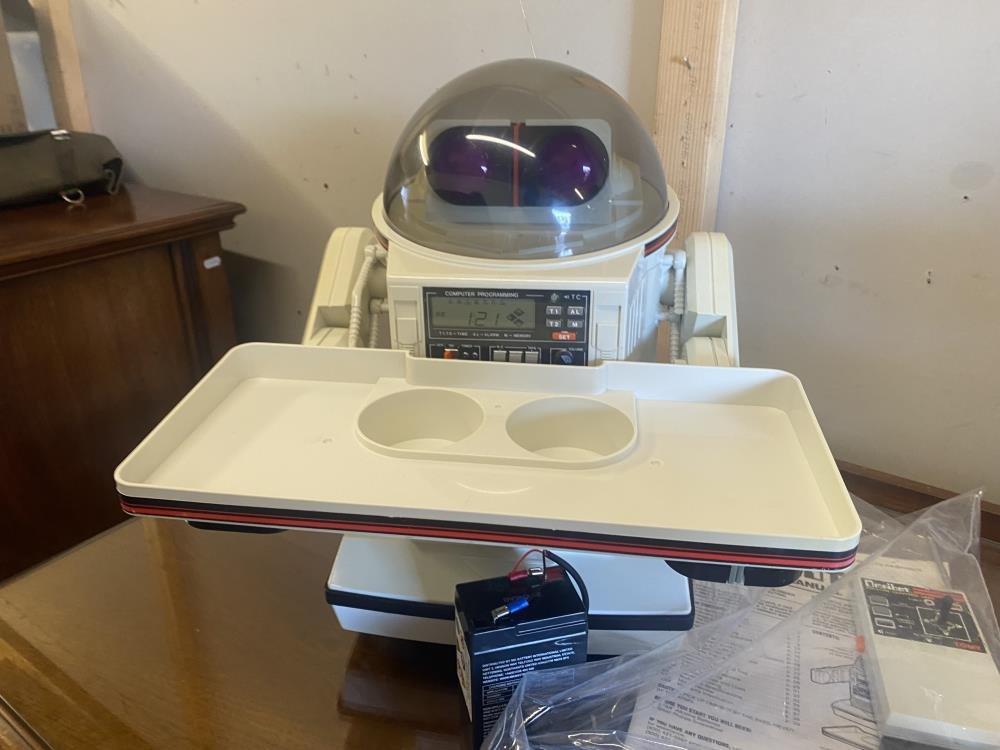
The Tomy Omnibot 5402 is a home robot toy, released in 1984 as the flagship of Tomy’s Omnibot line. It is a wheeled, roughly knee-high robot with a clear domed head, two glowing eyes, a pair of arms ending in claws, and — its signature trick — a detachable serving tray it can carry across a room. A panel on its chest, labelled in so many words “COMPUTER PROGRAMMING,” houses an LCD clock and a row of timer and memory buttons, and behind that chest sits a cassette tape deck. It sold for around $250 and became one of the defining images of the 1980s consumer-robot craze (Wikipedia, “Omnibot”; theoldrobots.com; everything80spodcast.com).
It is important to be clear, at the outset, about what kind of machine this is — because it shares a hub with the Heathkit HERO robots and the KIM-1-controlled Loofbourrow robot, and it is a fundamentally different animal. The HEROs were genuine computers on wheels, programmed in machine code or BASIC. The Omnibot is a teleoperated toy. Its primary control is a hand-held radio remote; its “programming” is not code but a tape recording of remote commands played back on cue. There is no documented general-purpose processor inside it. What makes it interesting is not computational power — it has essentially none — but the clever, low-cost way it turns a cassette deck and an alarm clock into something that behaves, to a 1984 living room, like a robot servant.
1.2 The two things that make it work
Strip the Omnibot to its essentials and it is two consumer-electronics ideas in a robot shell, joined to a radio-controlled car.
The remote is the robot’s lifeline. Movement, the arms, the voice — all of it is commanded from the hand-held TX remote. The remote drives the Omnibot forward, back, left, and right, and it carries a microphone: speak into the remote and the words come out of the robot’s speaker, as though the Omnibot were talking (Wikipedia; theoldrobots.com). The dependence is near-total — as the record bluntly puts it, losing the remote left the robot “virtually useless” beyond its clock and cassette functions (Wikipedia). Vol. 5 covers the remote and the voice.
The cassette deck is the “memory.” The deck in the Omnibot’s chest does double duty: it plays ordinary music cassettes, and it records and replays sequences of commands. An owner drives the robot around with the remote — and narrates, if they like — while the deck records the whole performance to tape; played back, the robot re-enacts the recorded routine (Wikipedia; theoldrobots.com). Paired with the built-in LCD clock and timer, that recording can be triggered at a set time, so the Omnibot can be set to roll into the bedroom in the morning and announce the hour. This record-and-replay scheme is the closest the machine comes to “programming,” and it is the subject of Vol. 2. There is no microprocessor documented in the consulted sources; the “computer” on the chest is, in substance, a clock and a tape recorder.
1.3 Headline facts
Table 1 — Headline facts
| Attribute | Value | Source |
|---|---|---|
| Name / model | Tomy Omnibot, model 5402 | Wikipedia; theoldrobots |
| Year | 1984 | Wikipedia; everything80s |
| Retail price | ~$250 | everything80s; collector listings |
| Class | Consumer toy — home “robot butler” | Wikipedia |
| Control | RC remote (the TX unit); robot is the RX | theoldrobots; Wikipedia |
| Autonomy | None — teleoperated; “virtually useless” without the remote | Wikipedia |
| ”Programming” | Cassette record/replay of command sequences, clock-triggered | Wikipedia; theoldrobots |
| Processor | None documented (clock/timer + cassette sequencer) | (unclaimed; see Vol 2) |
| Cassette deck | 2-track monaural; normal bias; ±3% speed; wow & flutter <0.3% | theoldrobots |
| Clock | LCD, ±2 sec/day; on a 1.5 V AA (~5000 h) | theoldrobots |
| Drive | Wheeled; remote-steered | Wikipedia; theoldrobots |
| Arm / tray | Claws hold a detachable serving tray, ≤2.2 lb | theoldrobots; Wikipedia |
| Remote frequencies | 49.860 MHz (US) / 27.145 MHz (Europe) / 40.680 MHz (TAL) | theoldrobots |
| Voice | Remote mic (300–600 Hz) → robot speaker (8 Ω); robot sounds | theoldrobots; Wikipedia |
| Eye-lights | 2.8 V, 200 mA | theoldrobots |
| Main battery | 6 V 4.0 Ah sealed lead-acid; ~4 h; charge 12–16 h | theoldrobots |
| Other cells | 2 × AA (clock/computer), 4 × AA (remote) | collector sources |
| Height | Approximate (~a foot to ~17 in); spec sheet omits exact dimensions | (approximate; cite the manual) |
1.4 The Omnibot family
The 5402 was the first and the baseline, and Tomy built a small family around it. The same machine appears as the “Omnibot MK II” and, in a gold-finished edition, the 5402X “Goldbot”; the robot-and-remote pair carry RX (robot) and TX (remote) designations, and a TR5000 label appears on the documentation (theoldrobots.com). The more capable Omnibot 2000 (model 5405) followed as an upgrade — it added a motorized tray and arm and a two-gear drive that the 5402 does not have, so those features should not be attributed to the 5402 (Wikipedia; theoldrobots.com). Tomy also made a smaller sibling, the Omnibot Jr (“Charmmy”), about 10.5 inches tall and, unusually for the line, fitted with ultrasonic navigation (Wikipedia). This deep dive is about the original 5402; where a feature belongs to the 2000 or to Junior, it is flagged as such.
1.5 Where it sits in this hub
The Omnibot is the consumer-toy bookend of a hub that otherwise documents genuine computer-robots, and that contrast is the reason it is worth a deep dive. Set beside the Heathkit machines, the gap is stark:
Table 2 — the Heathkit machines, the gap is stark
| Omnibot 5402 | HERO Jr (RT-1) | HERO 1 / HERO 2000 | |
|---|---|---|---|
| Maker / year | Tomy, 1984 | Heathkit, 1984 | Heathkit, 1982 / 1986 |
| Class | Consumer toy | Consumer robot | Educational computer-robot |
| Processor | None documented | Motorola 6808 | 6808 / Intel 8088 + slaves |
| Control | RC remote (teleoperated) | One-touch keys; HJPL/BASIC | Keypad / BASIC / assembly |
| ”Programming” | Cassette record/replay | A real language | A real language |
| Autonomy | None | Some (personality programs) | Yes |
Even the HERO Jr — itself a consumer machine — had a true microprocessor and a
programming language; the Omnibot has neither. What it has instead is showmanship: a
talking, tray-carrying, alarm-clock robot that a child could operate with a remote and
a cassette, at a fraction of a HERO’s price. A fuller cross-robot matrix sits in
_shared/comparison.md.
The volumes that follow take the machine apart on its own terms. Vol. 2 covers the cassette-and-clock “brain” and what “programming” really means here; Vol. 3 the wheeled, remote-steered drive; Vol. 4 the arms, claws, and the serving tray; Vol. 5 the remote and the voice; and Vol. 6 the power system and acquiring or restoring one today. Vol. 7 is the cheatsheet.
Comments (0)