Omnibot 5402 · Volume 5
The Remote & the Voice
5.1 The remote is the robot’s lifeline
Most of the machines in this hub can, in some measure, stand on their own. The Heathkit HERO 1 and HERO 2000 are computers on wheels that execute a stored program; even the consumer HERO Jr runs personality routines out of a 32 KB behaviour ROM with no operator in the loop. The Omnibot 5402 is the outlier. Take away its hand-held TX remote and what is left is, in the words of the record, “virtually useless” beyond its clock and cassette functions (Wikipedia, “Omnibot”). The remote is not an accessory to this robot; it is the robot’s nervous system, held at arm’s length.
This is the sharpest expression of the teleoperation point that runs through the whole deep dive. The Omnibot does not sense its world and decide what to do. It waits for a radio command and obeys it. Drive — forward, back, left, right — comes from the remote (Wikipedia; theoldrobots.com). The arms and the serving-tray act are worked from the remote (cross-ref Vol. 4). The voice comes from the remote. Even the “programming” the chest panel advertises is, at bottom, a tape recording of remote commands played back on cue (cross-ref Vol. 2): the cassette captures what the operator did with the TX unit and re-issues it later, so that the remote’s authority is merely time-shifted, never removed. The one thing the robot will do with no remote present is keep time and, if a routine was pre-recorded, replay it when the alarm fires — and that, too, is just the remote’s commands coming back off tape.
The contrast with the HEROs is worth stating plainly, because it is the reason the Omnibot earns a place beside them rather than being dismissed as a toy. A HERO is autonomous-capable: it can be left to run a program, watch its sonar, and act on what it finds. The Omnibot is autonomous of nothing. Its intelligence lives in the child’s hand and travels to the robot over a radio link. Lose the link — lose the remote, or its batteries, or radio line-of-sight — and the robot reverts to a clock with a tape deck in its chest. That dependence is the single most important fact about how the Omnibot is operated, and it is the subject of this volume.
5.2 Three frequencies, three regions
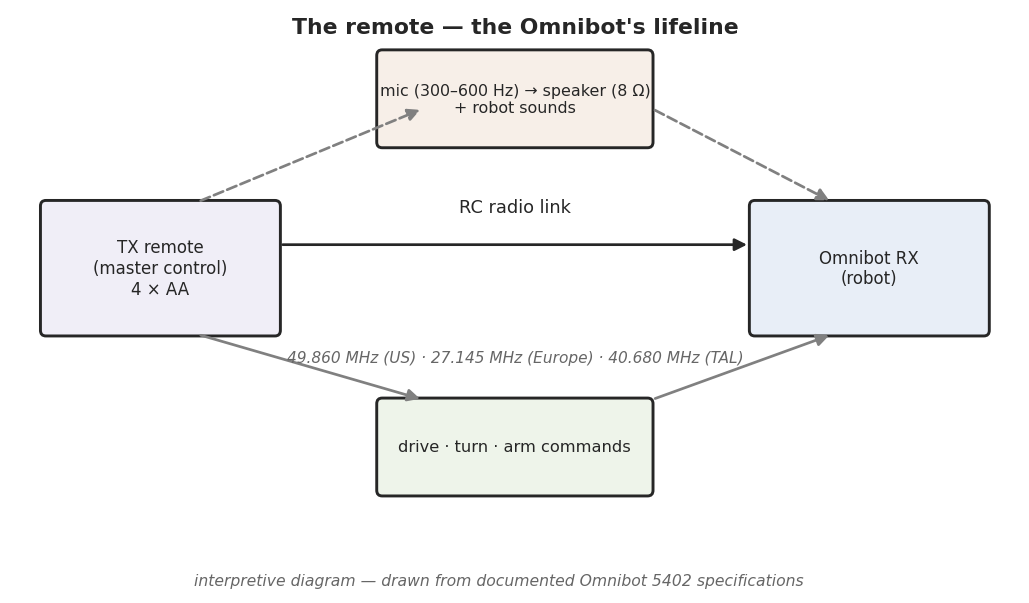
The remote and the robot are an RX / TX pair — the robot is the receiver (RX), the hand-held unit the transmitter (TX) — and the pairing is tied to a radio channel. The consulted spec sheet records three frequency options for the link (theoldrobots.com):
Table 1 — (theoldrobots.com)
| Region | Frequency | Source |
|---|---|---|
| United States | 49.860 MHz | theoldrobots |
| Europe | 27.145 MHz | theoldrobots |
| TAL | 40.680 MHz | theoldrobots |
These are not arbitrary numbers; they sit on the bands that national regulators set aside for low-power radio-control and consumer remote devices, which differ by region. The 49 MHz band was the common home for unlicensed consumer RC and cordless gadgets in the United States; 27 MHz is the classic European hobby-RC / CB neighbourhood; and 40 MHz is another RC allocation. A toy sold into all three markets therefore needed three versions of the same radio so that an Omnibot bought in one region would not jam — or be jammed by — the neighbour’s garage-door opener or model car. The practical implication for a collector is that a remote and a robot must share a frequency to talk at all: a US-band TX will not command a European-band RX, regardless of how alike the two units look (theoldrobots; inference from the regional band split).
The “TAL” label on the 40.680 MHz option is reproduced from the spec sheet as written; the documentation does not spell out the territory it abbreviates, so the designation is left as found rather than guessed at (theoldrobots.com).
The remote carries its own power: four AA cells drive the transmitter (theoldrobots.com). This is independent of the robot’s own supply — the 6 V sealed-lead-acid main battery and the AA cells that keep the clock alive (cross-ref Vol. 6) — so the lifeline has its own failure mode. A robot with a full charge is still inert if the four AA cells in the operator’s hand are flat. Two battery compartments, two ways to lose the robot.
What the record does not give is just as important to state. It does not document the modulation scheme (AM, FM, or otherwise), any channel coding or addressing that would let two Omnibots run side by side on the same band, or a specified control range in metres. None of those figures appears in the consulted sources, so none is asserted here; the link is described only to the depth the record supports. What can be said is structural: it is a one-way command link from a battery-powered handset to a receiver in the robot, on one of three regional channels.
5.3 The talk-through voice path
The second job the remote does is give the robot a voice — and the mechanism is charmingly literal. The remote is not only a transmitter of motion commands; it is also a microphone. The spec sheet records a dynamic microphone in the remote with a quoted response of 300–600 Hz, feeding the radio link so that sound picked up at the handset is reproduced through the robot’s 8 Ω speaker (theoldrobots.com). The child speaks into the remote across the room and the words come out of the Omnibot, as though the robot were talking (Wikipedia; theoldrobots).
This is a deliberately telephone-grade, even sub-telephone-grade, audio path, and the 300–600 Hz figure explains why. A 300-to-600 Hz window is a narrow slice of the voice band — it captures the fundamental pitch and lower formants of speech but rolls off the higher frequencies that carry crispness and sibilance. The effect is a thin, “robot-on-the-intercom” timbre, which for a 1984 toy is a feature rather than a defect: it makes a human voice sound machine-mediated, reinforcing the illusion that the sound is the robot’s own. Paired with an 8 Ω speaker — the ordinary impedance of a small dynamic loudspeaker — the path is exactly what a period AM-radio-grade voice channel would be: low-fidelity, robust, and cheap. The narrow band is also kind to the radio link, since less audio bandwidth is easier to carry over a simple consumer RC channel.
Crucially, the operator is the robot’s voice. There is no documented
speech synthesiser in the Omnibot — nothing like the Votrax SC-01 that gives the
Heathkit HERO 1 and HERO Jr their canned phoneme speech, and nothing like the
HERO 2000’s direct text-to-speech (cross-ref _shared/comparison.md). The Omnibot
makes a child “be” the robot: every sentence it utters is a sentence a person spoke
into the remote a moment earlier, or recorded to tape earlier still.
Alongside the talk-through path, the remote also triggers a set of built-in robot sounds — the canned beeps and noises that let the robot “speak” in its own idiom without a live voice behind it (Wikipedia; theoldrobots.com). These are stored in the robot and called up by the remote, the audible counterpart to the drive and arm commands. The record names them only as built-in sounds; it does not enumerate them or specify how they are generated, so they are described here no further than that.
The voice is not only live. Because the chest cassette deck records the command stream and audio, a spoken line sent through the talk-through path can be captured to tape and replayed later as part of a timed routine (cross-ref Vol. 2): the Omnibot can be set to roll into a room at a fixed hour and deliver a line the owner recorded days before. The remote supplies the voice; the cassette gives it a memory.
5.4 The eye-lights
The last thing the remote-and-voice system answers for is the robot’s face. The Omnibot’s two domed eyes are lit, and the spec sheet records their electrical rating: the eye-lights run at 2.8 V and 200 mA, with a stated maximum of 3 V and 250 mA (theoldrobots.com). At 2.8 V and 200 mA the pair draws about 0.56 W — a load consistent with small incandescent lamps of the period rather than the LEDs that would dominate a later design, though the record states only the voltage and current and the lamp type is not specified here. The headroom to the 3 V / 250 mA maximum is the usual margin a designer leaves so that a fresh battery, sitting a little above nominal, will not immediately over-drive the lamps.
The eyes are part of the show, not part of the sensing: they make the robot read as
alive and awake, the visual companion to the voice coming out of its speaker. They
are not, on the documented record, sensors — the Omnibot does not see with them.
That distinction matters in a hub that also holds machines whose “eyes” are real
sonar and light detectors (cross-ref _shared/comparison.md); on the Omnibot, the
glowing eyes are stagecraft, lit to a modest 2.8 V so a child across the room sees a
robot looking back.
5.5 Where this leaves the machine
The remote-and-voice system is the clearest window onto what the Omnibot really is. A radio handset on four AA cells, tuned to one of three regional channels, carries every meaningful command to a receiver in the robot — and the same handset doubles as a microphone so the operator can lend the robot a voice through its 8 Ω speaker, with a tray of built-in sounds and a pair of lit eyes to complete the act. Nothing in that chain is autonomous; every part of it traces back to a person holding the remote. Set against the genuinely autonomous-capable HEROs, the Omnibot’s lifeline is the whole point: it is a wonderful piece of teleoperated showmanship, and it lives or dies by the link in the operator’s hand. Vol. 6 turns to the power that feeds both ends of that link, and to acquiring and restoring one of these machines today.
Comments (0)