Omnibot 5402 · Volume 3
Drive & Mobility
3.1 How the Omnibot moves
The Omnibot 5402 is a wheeled robot, and everything about how it gets around follows from one fact: it is driven entirely from the hand-held TX remote. The remote sends four movement commands — forward, back, left, and right — and the robot’s base translates those commands into motion (Wikipedia, “Omnibot”; theoldrobots.com). There is no joystick to nudge the robot along a wall and no internal map of the room; the operator watches the robot and steers it the way one steers a radio-controlled car. The drive is, in a word, teleoperated.
This is the single most important thing to understand about the Omnibot’s mobility, and it is worth stating plainly because the chest panel labelled “COMPUTER PROGRAMMING” invites the opposite assumption. The robot does not decide where to go. It goes where the remote tells it, when the remote tells it — or, on playback, where a previously recorded tape tells it (see Vol. 2 on the cassette-and-clock “brain”). Either way the source of the motion commands is human: live from the operator’s thumb, or recorded earlier from the operator’s thumb. The machine itself originates nothing.
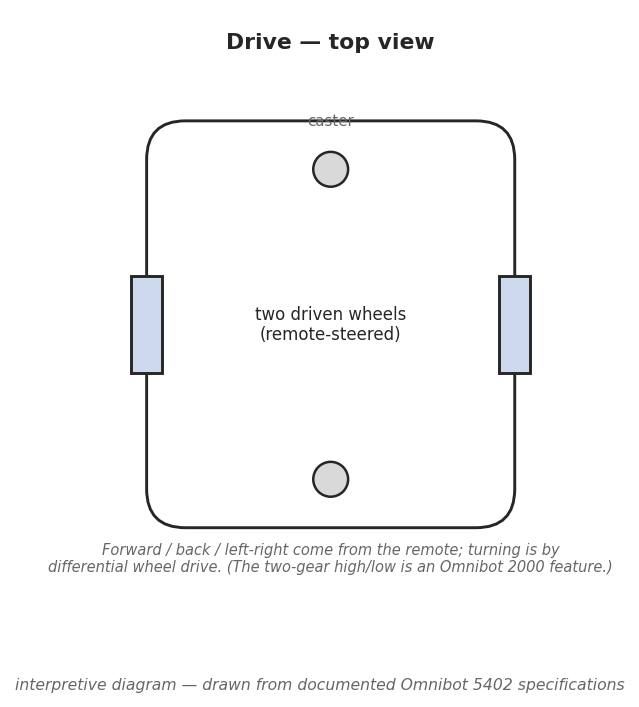
3.2 Turning: differential drive
The Omnibot steers the way most small two-wheeled robots and tracked toys do — by differential wheel drive. Rather than swivel a steering axle, the base turns by driving its two sides at different rates: run both sides together and the robot goes straight; drive one side and slow or reverse the other and the robot pivots toward the slower side (theoldrobots.com; Wikipedia). The four remote commands map onto this directly — “forward” and “back” drive both sides the same way, while “left” and “right” introduce the side-to-side difference that swings the nose around.
What the consulted record does not give is the geometry of that turn. The sources establish that the Omnibot is wheeled and that it is steered from the remote, but they do not specify the wheel diameter, the track width, the turning radius, or whether a “left”/“right” command produces a gentle arc or a turn in place. None of that is asserted here, because the manual — not this volume — is the authority on the machine’s dimensions and behaviour, and the consulted spec sheet omits it. A reader who needs the exact turn geometry should measure a unit or consult the instruction manual.
3.3 What is deliberately left unclaimed
It is easy, writing about a drive train, to reach for numbers that sound right. This volume does not, because the documented record does not supply them. The following are explicitly unclaimed for the 5402:
- Motor type and part numbers. That the wheels are motor-driven is implicit in a powered wheeled robot, but no motor specification, count, or part number appears in the consulted sources. The figure of two independently driven sides is the differential-drive principle, not a documented motor count.
- Wheel diameter, track width, and ground clearance. Not in the consulted spec sheet; defer to the manual.
- Speed. No traverse speed or RPM is documented. The Omnibot is understood to move at a sedate walking-pace-or-slower amble suited to carrying a tray across a living-room floor, but no figure is on record and none is invented here.
- Turning radius / turn geometry. As above — undocumented.
The power that feeds the drive is on record — a 6 V, 4.0 Ah sealed lead-acid main battery good for roughly four hours of continuous running, with a low-battery warning at 5.77 V (theoldrobots.com). That battery, the charge cycle, and the home-base charger are the subject of Vol. 6; what matters here is simply that the drive draws on a modest sealed-lead-acid pack, which is consistent with the unhurried, short-range mobility the toy was built for.
3.4 No sensing, no autonomous navigation
The Omnibot 5402 has no sensors feeding its drive and no autonomous navigation. It cannot detect a wall, a stair, a table leg, or a person; it will drive into an obstacle if commanded to, because nothing in the base is watching the room. The “feedback loop” that keeps an Omnibot from driving off a step is entirely external — it is the operator’s eyes and the operator’s thumb on the remote (Wikipedia; theoldrobots.com). Strip away the remote and, as the record bluntly puts it, the robot is “virtually useless” beyond its clock and cassette functions; that verdict applies as much to mobility as to anything else (Wikipedia).
This is the cleanest line between the Omnibot and the genuine computer-robots it
shares a hub with. The Heathkit HERO Jr (RT-1) — itself a 1984 consumer
home robot at a comparable place in the market — carried a real microprocessor and
a Polaroid ultrasonic sonar with which it could sense its surroundings and run
self-directed “personality” behaviours; the full HERO 1 went further still
(_shared/comparison.md). The Omnibot has nothing of the kind. Its motion is
authored by a person and merely executed by the machine.
The contrast even reaches inside Tomy’s own line. The smaller sibling, the Omnibot Jr (“Charmmy”, about 10.5 inches tall), was fitted with ultrasonic navigation — a sensing capability the flagship 5402 never had (Wikipedia). That is a useful thing to know precisely because it is so easy to assume the bigger, pricier robot must be the more capable one. On the question of sensing and self-navigation, the little one had the feature and the big one did not. Junior’s ultrasonics belong to Junior; they are noted here only as a sibling contrast and are not a 5402 capability.
3.5 What belongs to the Omnibot 2000, not the 5402
One drive feature is frequently — and wrongly — attributed to the 5402: a two-gear high/low drive. That selectable gearing is a feature of the later, upgraded Omnibot 2000 (model 5405), not of the 5402 (Wikipedia; theoldrobots.com). The 5402’s drive is the simpler arrangement described above: remote-commanded, differentially steered, with no documented gear selection. When comparing units or reading collector descriptions, the two-speed drive is a reliable tell that the machine in question is a 2000, not the original 5402. This volume keeps that feature off the 5402 deliberately, in line with the same care that keeps the 2000’s motorized tray and arm out of the 5402’s repertoire (Vol. 4).
3.6 Summary
The Omnibot 5402 rolls on a wheeled base, steered from the TX remote by four commands — forward, back, left, right — and turns by differential wheel drive. It moves only when a person drives it live or when a taped routine replays a person’s earlier driving (Vol. 2). It has no sensors in its drive and no autonomous navigation; the smaller Omnibot Jr had ultrasonic sensing, but the flagship did not, and the two-gear high/low drive belongs to the Omnibot 2000. Motor, wheel, speed, and turn-geometry specifics are not in the consulted record and are left to the manual. The drive is, start to finish, a teleoperated one — a radio-controlled car wearing the body of a robot butler.
Comments (0)