Conte Lethal Injection Attack Droid · Volume 1
Overview — The Lethal Injection Attack Droid Prototype
1.1 What it is
The Lethal Injection Attack Droid Prototype is a small tracked robotic sculpture made in 2004 by the New York-based artist Christopher Conte. It is a single, one-of-a-kind object roughly the size of a shoebox — 10.5 × 6.5 × 8 in (26.5 × 16.5 × 20 cm) — built from recycled stainless steel, titanium, and machined aluminum, and crowned by a vintage glass syringe carried forward on an articulated arm. A genuine Parallax microcontroller board sits on the deck between two tracked treads built from bicycle chain. The museum that displayed it called it a “programmable robotic sculpture.”

Unlike every other machine queued in this hub — the Heathkit HERO line, the Tomy Omnibot, the Loofbourrow / KIM-1 build — the Attack Droid was never a product, a kit, or a hobbyist platform. It is a work of fine art that quotes the vocabulary of robotics: tracks, a control board, a manipulator, an end effector. It is documented here as a robot-as-art-object, and the deep dive treats it as one would treat any machine in the collection — form, structure, drive train, electronics, and payload — while keeping sight of the fact that its true function is to make an argument, not to move.

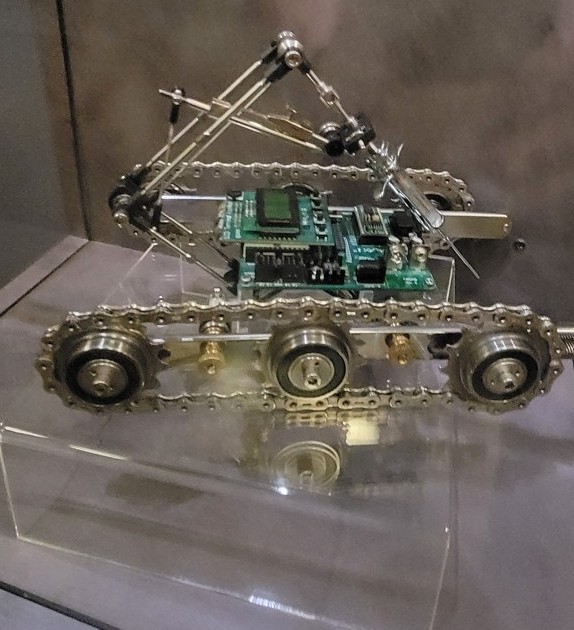
1.2 The headline facts
Table 1 — The headline facts
| Attribute | Value | Source |
|---|---|---|
| Title | Lethal Injection Attack Droid Prototype | Artist’s catalogue (microbotic.org) |
| Artist | Christopher Conte | Artist’s catalogue |
| Year | 2004 | Artist’s catalogue |
| Dimensions | 10.5 × 6.5 × 8 in (26.5 × 16.5 × 20 cm) | Artist’s catalogue |
| Materials | Recycled stainless steel, titanium, machined aluminum, vintage glass syringe | Artist’s catalogue |
| Locomotion | Two tracked treads of bicycle chain over machined sprockets | Observation (this hub’s photographs) |
| Control | Parallax microcontroller board (BASIC Stamp-class) | Observation; placard (“programmable robotic sculpture”) |
| Status | On loan to the National Museum of Crime & Punishment, Washington, DC | Artist’s catalogue; museum placard |
The artist’s own catalogue entry reads, verbatim:
Lethal Injection Attack Droid Prototype by Christopher Conte, 2004. Recycled stainless steel, titanium, and machined aluminum with vintage glass syringe. 10.5”x 6.5”x 8” (26.5cm x 16.5cm x 20cm). Photos: Christopher Conte. Currently on loan to the National Museum of Crime and Punishment in Washington, DC.
1.3 Where it sat: the capital-punishment gallery
The prototype was exhibited at the National Museum of Crime & Punishment, a privately-owned attraction in the Penn Quarter of Washington, DC (open May 2008, closed September 2015). The sculpture was shown inside a clear acrylic vitrine in the museum’s capital-punishment gallery — the same room that displayed an authentic lethal-injection machine from the Delaware state prison and an electric chair from the Tennessee State Prison. The wall panels visible behind the case in this hub’s photographs are labelled HANGING and ELECTRIC CHAIR: the piece was deliberately placed in a survey of execution methods, as the most recent and most “technological” entry in that lineage.

The museum’s interpretive placard summarised the work’s argument:
Created by New York-based artist Christopher Conte, this programmable robotic sculpture is interpreted as a commentary on the evolution of technology in capital punishment and the seemingly impossible goal of eliminating human involvement in the process. Before becoming a full-time artist, Conte made prosthetics and many of his works have human elements. This piece is made of recycled stainless steel, titanium, and machined aluminum with a vintage glass syringe. Courtesy of Christopher Conte.
1.4 How to read this deep dive
The volumes move from idea to object to mechanism — concept, then design, then construction — and close with a reference sheet:
Table 2 — construction — and close with a reference sheet
| Vol | Focus |
|---|---|
| 1 | Overview — what it is, the headline facts, gallery context (this volume) |
| 2 | Concept & commentary — automating the executioner; the title; the lethal-injection backdrop |
| 3 | The maker & the method — Conte’s path from prosthetics to “cybermechanical” sculpture |
| 4 | Form & design language — silhouette, the predator/tank reading, composition, scale |
| 5 | Construction I — chassis & tracked drive train — the bicycle-chain treads, sprockets, frame, materials |
| 6 | Construction II — control electronics & programmability — the Parallax board, PBASIC, power |
| 7 | Construction III — the manipulator & the vintage glass syringe — the arm, the end effector, the human element |
| 8 | Cheatsheet — dimensions, materials, electronics, timeline, sources, quick reference |
1.5 A note on sourcing and certainty
Two classes of fact appear in these volumes, and they are kept distinct:
- Documented fact — title, year, dimensions, materials, artist biography, exhibition venue. These come from the artist’s own catalogue, the museum’s placard, and public records, and are cited as such.
- Visual observation and inference — everything about the mechanism (the chain tracks, the sprocket count, the identity of the control board, the manipulator linkage). Conte never published a build log, a bill of materials, or a wiring diagram for this piece. Where this deep dive describes the mechanism it is reading the object itself from photographs, and it says so. It does not invent part numbers, motor types, or a control program. Claims that go beyond what the catalogue states are flagged with language such as “the photographs show,” “appears consistent with,” or “not documented.”
That discipline matters more here than for a mass-produced robot: there is no service manual to gate against, only the artwork and the artist’s words.
Comments (0)