Conte Lethal Injection Attack Droid · Volume 7
Construction III — The Manipulator & the Vintage Glass Syringe
Sourcing note. The catalogue confirms the end effector is a vintage glass syringe. The arm that carries it is described here from the photographs; its exact joint count, degrees of freedom, and whether it actuates under power are not documented and are flagged as observation/inference.
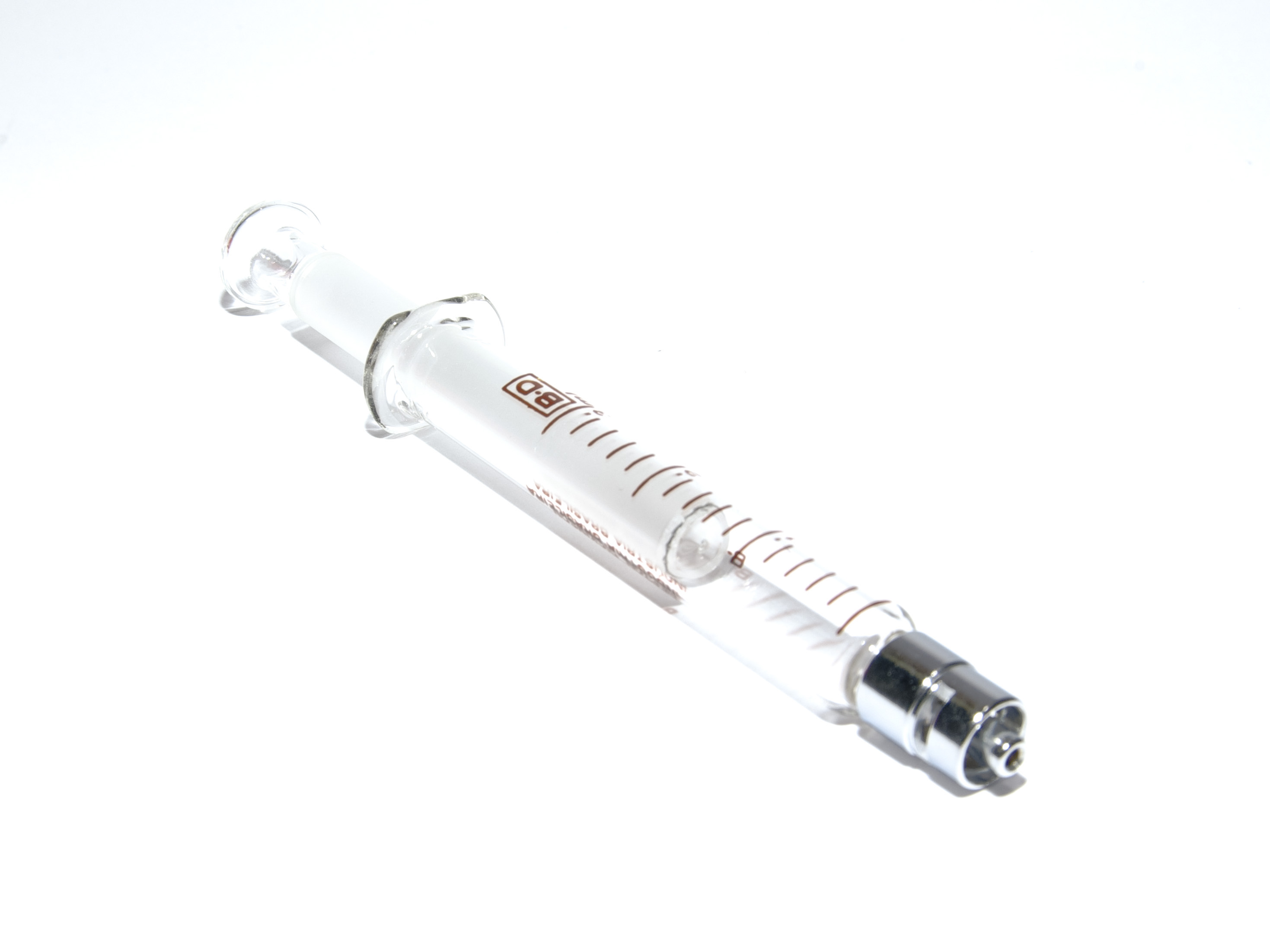
7.1 The end effector: a vintage glass syringe
The focal point of the entire sculpture is a single vintage glass syringe, carried forward at the tip of the arm. The catalogue lists it explicitly among the materials (“…with vintage glass syringe”), and it is the only non-metal, only transparent, only fragile, and only overtly medical component in an object otherwise built entirely of steel, titanium, aluminum, and brass (Vol 4).
The choice of an antique glass-and-metal syringe rather than a modern disposable plastic one is deliberate and does several things at once:
- It supplies the medical / clinical half of the work’s central collision (Vol 2): the syringe is the literal instrument of lethal injection.
- As an antique object, it adds time depth and craft — it reads as a real, used, historical medical tool, not a prop, reinforcing the salvage-and-recycle method (Vol 3).
- Its glass barrel is transparent and breakable, making it the one vulnerable, human-scaled element amid the armored mechanism — the part the eye fixes on.
- Pointed forward on the arm, it becomes the machine’s “stinger”: the aimed point toward which the whole front-weighted, diagonal composition drives the viewer’s eye (Vol 4).

7.2 The arm: a triangular cantilever
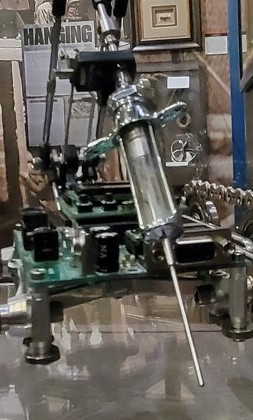
The arm that carries the syringe is, in the photographs, a truss of thin polished rods arranged as a triangle — a braced, cantilevered structure that rises from the front of the chassis and reaches forward and upward to hold the syringe out ahead of the machine. The triangulated form is both structurally sound (a triangle is rigid) and visually purposeful (it aims).
What the photographs show of the arm:
Table 1 — What the photographs show of the arm
| Feature | Observation | Reading |
|---|---|---|
| Members | Multiple thin, bright, polished rods (stainless / titanium per catalogue) | A lightweight, braced linkage rather than a solid arm |
| Geometry | Triangulated / truss-like, forming an apex at the front | Rigid cantilever that holds the syringe out and up |
| Joints | Dark (anodised) clevis-type pivots and rod ends at the rod junctions | Articulated connections — the joints of a built linkage, not a welded frame |
| Mounting | Anchored to the front of the chassis frame | Cantilevers the load forward of the tracks |
| End fitting | Grips the glass syringe with its needle aimed forward | The “injection” gesture |
The use of rod ends / clevis joints is notable: these are the same kinds of articulating hardware used in precision linkages and, tellingly, in prosthetic and orthotic mechanisms — Conte’s home territory (Vol 3). The arm is built like something meant to move and position, not merely to hold a static pose.
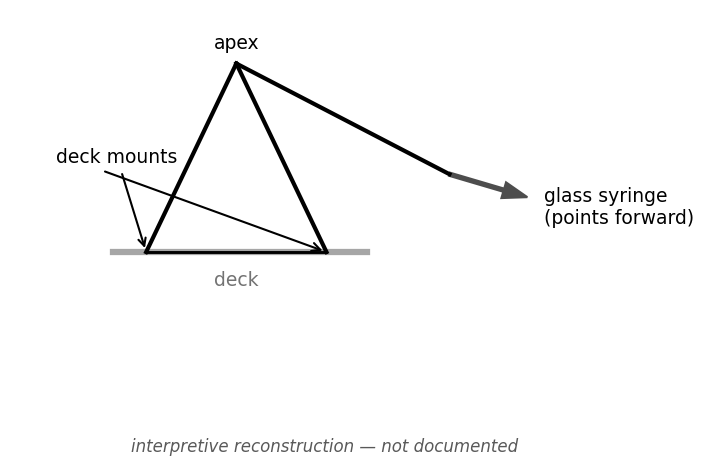
Not documented — does the arm actuate? Whether the manipulator is a powered, articulating mechanism (driven from the control electronics in Vol 6) or a fixed sculptural pose cannot be determined from the photographs alone. The presence of clevis-jointed linkages and a live controller with a motor-driver daughterboard makes powered articulation plausible, but no source confirms it, and this deep dive does not assert that the arm moves.
7.3 The “injection” gesture
Whether or not it actually moves, the arm is composed to depict a single action: advancing the needle. The machine’s stable tracked base, its forward lean, and its outstretched arm all stage the moment just before contact. There is no target in the vitrine, which makes the gesture more disquieting — the viewer’s own position, leaning in to inspect the case, completes the scene. The object is caught mid-procedure, the executioner’s hand replaced by a truss of steel rods.

7.4 The human element, removed and implied
The placard notes that Conte “made prosthetics and many of his works have human elements.” Here the human element is present by its absence: there is no body on the gurney, no executioner at the controls, no patient for the syringe. The manipulator stands in for the hand that would push the plunger; the empty space in front of the needle stands in for the condemned. By building the instrument and the agent with great care and leaving the human out, the sculpture makes the viewer supply the missing person — and confront how little machinery it would take to remove the human from the act entirely (Vol 2).
This completes the tour of the object: idea (Vols 1–2), maker (Vol 3), form (Vol 4), and the three construction systems — chassis and drive (Vol 5), control electronics (Vol 6), and the manipulator and syringe (this volume). Volume 8 condenses all of it into a single reference sheet.
Comments (0)