Conte Lethal Injection Attack Droid · Volume 4
Form & Design Language
4.1 The silhouette
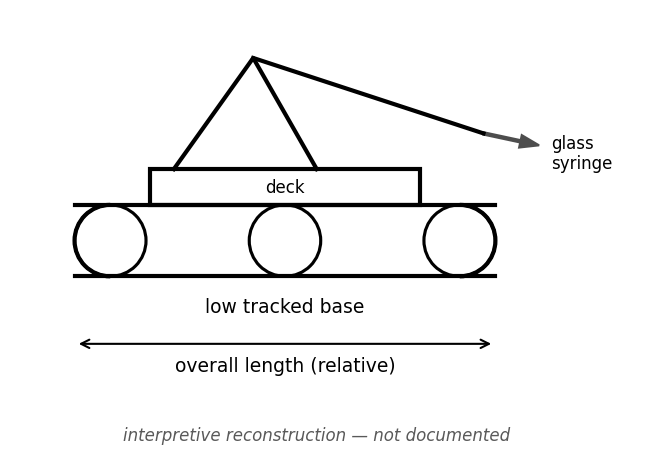
Seen in profile, the Attack Droid resolves into three stacked bands, and the design reads almost entirely from that stack:
- A low, wide tracked base — two long bicycle-chain treads on machined running gear, hugging the ground. This is the “tank,” the aggressive, military-vehicle register.
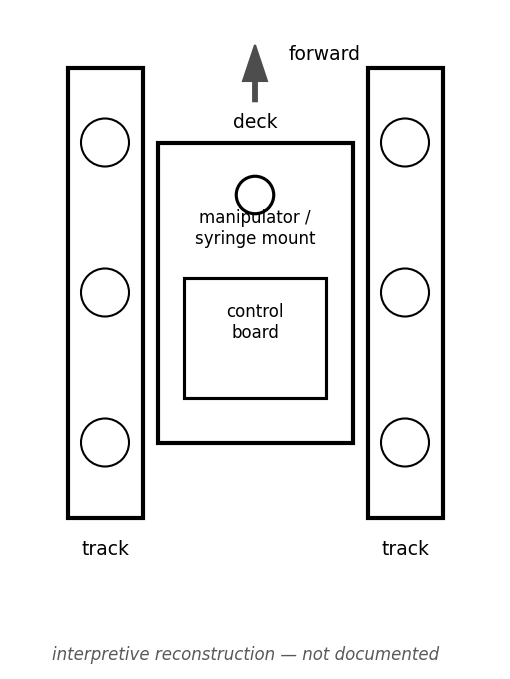
- A control deck — the green Parallax board mounted flat and longitudinally across the centre of the chassis, between the treads. This is the “brain,” exposed rather than housed.
- An articulated arm rising forward and up — a triangular truss of polished rods that cantilevers off the front of the chassis and presents the syringe at its tip, angled forward like a stinger or a lance.
The composition is deliberately front-weighted and diagonal: mass and tracks low and level, then a single rising gesture toward the syringe. The eye is led from the broad stable base, up the diagonal of the arm, to the needle. Everything in the form points at the end effector.

4.2 Two visual registers in collision
The power of the object comes from forcing two incompatible visual languages to share one body:
- The predator / weapon register — tracks, a low stance, a forward-reaching arm, an aimed point. These cues say attack vehicle. The proportions echo a small UGV (unmanned ground vehicle) or a bomb-disposal robot.
- The clinical / medical register — the glass syringe, the surgical-looking polished stainless linkages, the precise small fasteners. These cues say instrument, procedure, care.
A bomb-disposal robot reaches out to make a dangerous thing safe; this machine reaches out to make a safe-looking thing (a medical injection) lethal. The form deliberately confuses the two, which is the same collision the title performs in language (Vol 2).
4.3 Scale and address
At 10.5 × 6.5 × 8 in, the droid is intimate — tabletop scale, not monument scale. That is a design decision with consequences:
- It invites close, eye-level inspection rather than awe. The viewer leans in to a vitrine and reads the object like a specimen or a scientific model.
- It reads as a “prototype” in the literal, engineering sense — a bench model, a proof of concept, something you could imagine sitting on a workbench. The modest scale reinforces the unsettling implication of the word “prototype” in the title: this is the small first one, before the full-size production units.
- It makes the craft legible. Every chain link, sprocket tooth, brass nut, and linkage joint is visible and resolvable at this size; the construction is the surface (Vol 3).

4.4 Symmetry, asymmetry, and “aim”
The chassis is bilaterally symmetric — two matched tracks, a centred deck — which gives the object the stable, deliberate, purpose-built look of a real vehicle. The arm breaks that symmetry: it rises and reaches to one forward point, introducing direction and intent. A purely symmetric object sits; this one aims. That single asymmetric gesture is what converts a static model of a tracked robot into a depiction of a machine in the act of doing something.
4.5 Finish and material storytelling
The Attack Droid wears its materials as part of the message (see Vols 3 and 5 for the materials themselves):
- Polished metal — bright stainless and machined aluminum throughout, giving a cold, clinical, instrument-grade sheen consistent with the medical reading.
- Salvage left legible — the bicycle chain is unmistakably bicycle chain; it is not disguised as purpose-made track. The viewer is meant to recognise the everyday object re-tasked into a weapon, which keeps the piece grounded and slightly uncanny.
- Warm accents — knurled brass thumb-nuts and fittings punctuate the cool steel, drawing the eye to the joints and fasteners and emphasising that this is assembled, hand-built hardware.
- Glass as the one fragile thing — amid all the metal, the single glass syringe is the lone breakable, transparent, human-scaled element. It is the focal point precisely because it is the exception (Vol 7).
4.6 Design summary
The Attack Droid’s design solves one problem: how to make an object that is simultaneously a credible, aggressive little robot and an instrument of clinical killing, so that the viewer cannot hold the two apart. It does this with a front-weighted, aiming silhouette; a deliberate collision of military and medical cues; an intimate “prototype” scale that rewards close reading; and a finish that keeps both the salvage and the surgical craft fully visible. The following volumes take the same object apart mechanically — the drive train (Vol 5), the electronics (Vol 6), and the manipulator and syringe (Vol 7).
Comments (0)