Conte Lethal Injection Attack Droid · Volume 2
Concept & Commentary — Automating the Executioner
2.1 The argument the object makes
The museum framed the Lethal Injection Attack Droid Prototype as “a commentary on the evolution of technology in capital punishment and the seemingly impossible goal of eliminating human involvement in the process.” That sentence is the key to the whole object. The sculpture is not a proposal for a real execution machine; it is a thought experiment cast in steel, asking what it would mean to finish a long historical project — the gradual removal of the human hand from state killing — by handing the task to a machine that decides and acts on its own.
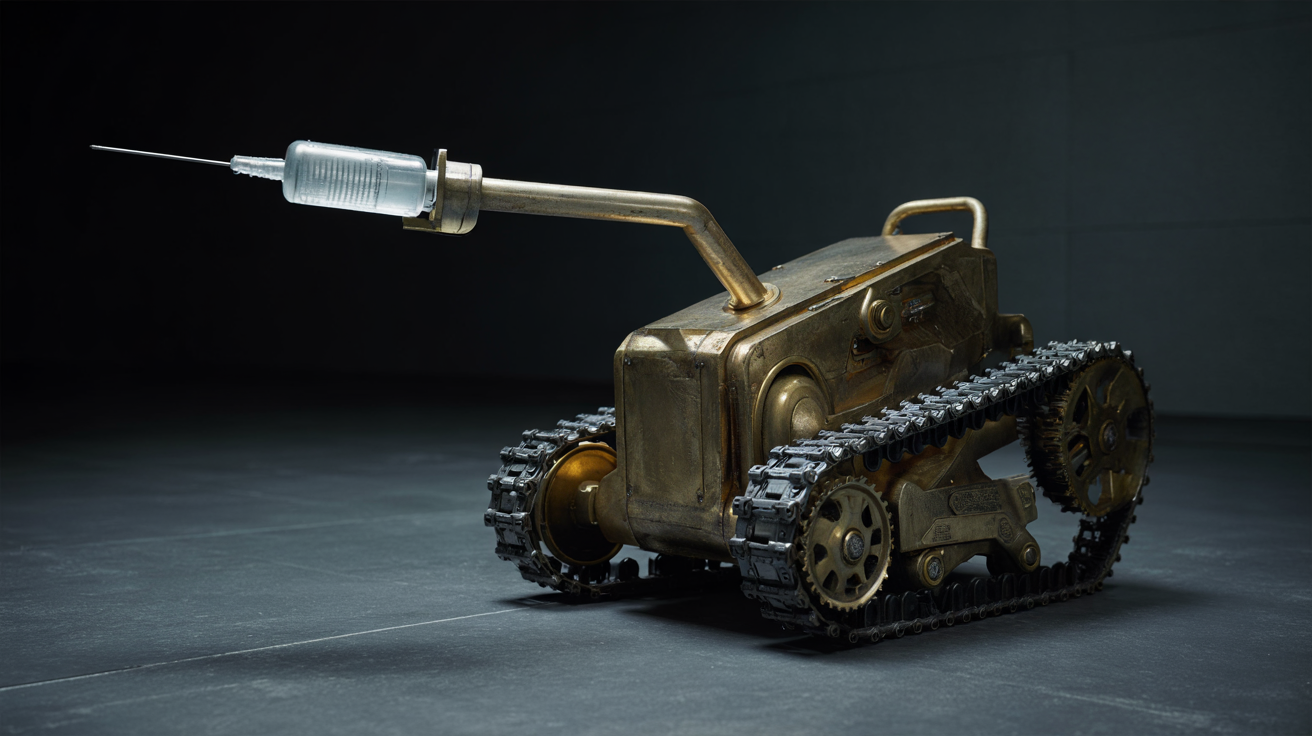
The placard’s phrase “seemingly impossible goal” is doing deliberate work. It signals that the idea is meant to fail, or at least to disturb: the closer the state comes to a clean, automated, human-free execution, the more clearly the moral weight of the act is exposed rather than dissolved. A robot that injects a lethal dose does not remove human responsibility; it only relocates it to the people who designed, programmed, and deployed the robot — which is to say, to the viewer’s own society.

2.2 Reading the title
The title is assembled from four loaded words, and each contributes:
- Lethal Injection — the specific, contemporary method. Of all execution methods, lethal injection is the one explicitly engineered to look clinical, medical, and humane: a gurney, an IV line, a sequence of drugs borrowed from the operating room. It is the method that most wants to resemble care. Mounting its instrument — a glass syringe — on a weaponised robot strips that disguise away.
- Attack — the word that breaks the clinical frame. An “attack droid” is military, predatory, offensive. Pairing “attack” with “lethal injection” collapses the distance the modern death penalty tries to maintain between treatment and killing, between the hospital and the battlefield.
- Droid — science-fiction shorthand for an autonomous machine agent. It moves the scene into a speculative future where the executioner is not a masked warden or an anonymous technician but a programmed device.
- Prototype — perhaps the most unsettling word. A prototype is the first of a series, an object that implies production to follow. Calling it a prototype asks the viewer to imagine the second unit, the tenth, the fleet.
2.3 The historical backdrop the gallery supplied
The piece was shown as the final entry in a survey of execution methods — literally down the wall from panels reading HANGING and ELECTRIC CHAIR (Vol 1, Fig 4). That curation reinforces the artwork’s own theme: each historical method was, in its day, promoted as more humane and more technologically advanced than the one before it.
Table 1 — The historical backdrop the gallery supplied
| Era (US context) | Method | The promise made for it |
|---|---|---|
| Pre-modern | Hanging | Familiar; “instant” with the long drop |
| Late 19th c. | Electric chair | The clean efficiency of electricity |
| Early-mid 20th c. | Gas chamber | Painless sleep (it was neither) |
| Late 20th c.–present | Lethal injection | Medicalised, clinical, humane |
| The sculpture’s premise | Autonomous “attack droid” | The human removed from the act entirely |
Lethal injection entered this lineage in the late 1970s and became the dominant US method through the 1980s and 1990s, marketed throughout as the most humane option yet. The Attack Droid extrapolates the trend one step past the present: if each method’s selling point was more technology, less visible human agency, then the logical endpoint is a machine that needs no executioner at all. The sculpture makes that endpoint concrete so the viewer can recoil from it.

2.4 The prosthetist’s inversion
The placard makes a point of the artist’s background: “Before becoming a full-time artist, Conte made prosthetics and many of his works have human elements.” For sixteen years Conte built devices that restored function and returned capability to human bodies — artificial limbs for amputees. The Attack Droid is the exact inversion of that work: the same fluency in mechanism, articulation, and the marriage of metal to the body, turned to building a device whose end effector is designed to end a life.
That biographical irony is not incidental decoration; it is part of why the object is convincing. The manipulator that presents the syringe is built with the care of someone who has spent a career making things that interface gently and precisely with human anatomy. The craftsmanship that would make a good prosthesis is here in service of the opposite purpose, and the tension between the two is the emotional core of the piece (the manipulator and its glass syringe are examined in detail in Vol 7).
2.5 Why “programmable” matters to the meaning
The single most important technical choice, for the meaning of the work, is that it is programmable — that it carries a real microcontroller rather than being a static assemblage. A programmable agent is one that could, in principle, decide when to act. That is precisely the faculty a society tries to withhold from any single human in an execution: the protocols, the multiple anonymous participants, the divided responsibility all exist so that no one person “decides” the death. Giving that faculty to a machine is the “seemingly impossible goal” made literal. The control board is therefore not a gimmick; it is the part of the sculpture that carries the central idea. Its hardware is examined in Vol 6.
2.6 Where it sits among Conte’s work
The Attack Droid is unusual within Conte’s catalogue. Most of his pieces are biomechanical organisms — insects, arachnids, skulls, hearts, “widows” — hybrids of cast bronze and machined metal that explore the fusion of the living and the mechanical (see Vol 3). The Attack Droid is one of his few overtly machine subjects and one of his most explicitly political works: rather than a speculative organism, it is a speculative device with a specific social argument. Made in 2004, it is also among his earlier surviving catalogued works — predating his 2008 move to full-time art — which makes its ambition and finish notable. It reads as the work of a maker testing how far the language of robotics could be pushed toward statement rather than spectacle.
Comments (0)