Conte Lethal Injection Attack Droid · Volume 3
The Maker & the Method — Conte's Cybermechanical Practice
3.1 Who Christopher Conte is
Christopher Conte was born in Bergen, Norway, and raised in New York, where he still lives and works. He earned a Bachelor of Fine Art (BFA) from Pratt Institute in Brooklyn, then spent sixteen years as a Certified Prosthetist, making artificial limbs for amputees. Throughout that career he worked privately on biomechanical sculpture — pieces that, in his own words, reflected “his love for biomechanics, anatomy and robotics.” In June 2008 he left prosthetics to become a full-time artist.
That two-track history is the foundation for understanding any of his objects, and the Attack Droid in particular. A prosthetist is a person who designs and fabricates mechanical devices that must mate precisely, comfortably, and reliably with a living human body. The trade demands fluency in materials science, machining, articulation, anatomy, and tolerances measured against flesh. Conte carried all of that directly into his art.
3.2 “Cybermechanical sculpture”
Conte describes his work as “cybermechanical sculpture” — biomechanical objects “centered on future technologies and cybernetic organisms.” The catalogue describes his method as combining “modern exotic materials ranging from bronze to carbon fiber” with “ancient techniques of construction.” Two technical pillars recur:
- Original cast components — often via lost-wax bronze casting, an ancient process he treats as integral rather than incidental.
- Found, recycled, and salvaged parts — fused with the cast and machined elements. The Attack Droid’s catalogue line (“recycled stainless steel, titanium, and machined aluminum”) and its bicycle-chain tracks are textbook examples of this salvage-and-machine approach.
His material palette is unusually rich for a sculptor: cast bronze paired with stainless steel, brass, sterling silver (925), garnet, titanium, and carbon fiber, with “many of the exotic materials used in both the aerospace industry and the medical field” finding their way into the work. He has noted that a single piece can take weeks or months to complete.


3.3 The salvage aesthetic, applied here
Reading the Attack Droid against Conte’s stated method, several of its choices stop looking arbitrary and start looking like signature moves:
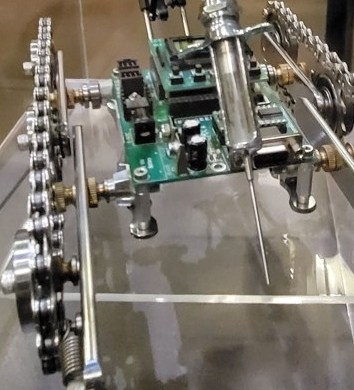
- Bicycle chain as tank tread. A mundane, instantly-recognisable salvaged object is re-tasked into the most recognisable robotic-vehicle form — a tracked drive. The viewer reads “tank” and “bicycle” simultaneously (see Vol 5).
- A vintage glass syringe, not a modern plastic one. The medical-field material is chosen for its age and its craft: glass and metal, an antique object, not a disposable. It anchors the “medical” reading while reinforcing that this is a constructed artwork, not a clinical instrument (see Vol 7).
- Brass and stainless hardware left visible. Conte does not hide his fasteners; the knurled brass thumb-nuts and polished bar frames are part of the finish. The construction is the surface.
3.4 Where the 2004 droid sits in the timeline
The Attack Droid (2004) predates Conte’s full-time art career by four years, placing it among his earlier catalogued works. A condensed timeline:
Table 1 — placing it among his earlier catalogued works. A condensed timeline
| Date | Event |
|---|---|
| — | Born Bergen, Norway; raised in New York |
| — | BFA, Pratt Institute, Brooklyn |
| 16 yrs | Certified Prosthetist, making artificial limbs |
| 2004 | Lethal Injection Attack Droid Prototype built |
| 2007 | Begins offering work for sale through galleries |
| May 2008 | Two-person show at Last Rites Gallery (Paul Booth’s gallery) |
| June 2008 | Leaves prosthetics for full-time art |
| 2008 | Begins working with former Northrop Grumman engineers/model makers; interest from the FBI and Lockheed Martin reported |
| Mar 2009 | Speaks at the Material Fusion technology/design conference, Sweden |
| Jun 2009 | Loans several sculptures to the Peabody Essex Museum, Salem, MA, for a one-year exhibition |
| 2008–2015 | Attack Droid on loan to the National Museum of Crime & Punishment, DC |
That the piece was built in 2004 — before the gallery career, while Conte was still a working prosthetist — is part of its interest. The fluency of its articulated arm and the integration of a live microcontroller show a maker already operating at a high level well before he was a “full-time artist.”
3.5 The broader catalogue, for context
The Attack Droid is one machine subject among a body of work dominated by biomechanical organisms. Conte’s catalogue includes pieces such as Scarlett (a six-legged bronze arachnid with stainless steel, silver, and garnet inlay), Steam Insect / Steam II Insect, the Steel Widow and Black/Red/Blue Widow series, biomechanical skulls and hearts (the Cardiac and Cynthetic pieces), the Articulated Antique SINGER Insect (built around salvaged sewing-machine parts), and the Biomic Stand, a working mechanical microphone stand made for the rock band Three Days Grace. His work has appeared on the Discovery Channel and in Wired, Discover, Popular Science, and MTV media, and has reportedly drawn interest from defense and homeland-security organisations.
Seen against that catalogue, the Attack Droid is the rare piece where Conte turns his organism-building fluency toward an explicit machine and an explicit social argument — the prosthetist’s craft inverted into a study of automated death (Vol 2). The rest of this deep dive turns from the maker to the made object: its form (Vol 4) and its construction (Vols 5–7).
Comments (0)