Conte Lethal Injection Attack Droid · Volume 5
Construction I — Chassis & Tracked Drive Train
Sourcing note. Conte published no build log or bill of materials for this piece. Everything in this volume is read from the object itself in this hub’s photographs and is described as observation. Counts and dimensions are photographic estimates; material names beyond the catalogue line (“recycled stainless steel, titanium, and machined aluminum”) are inferences from appearance, flagged as such.
5.1 The drive train at a glance
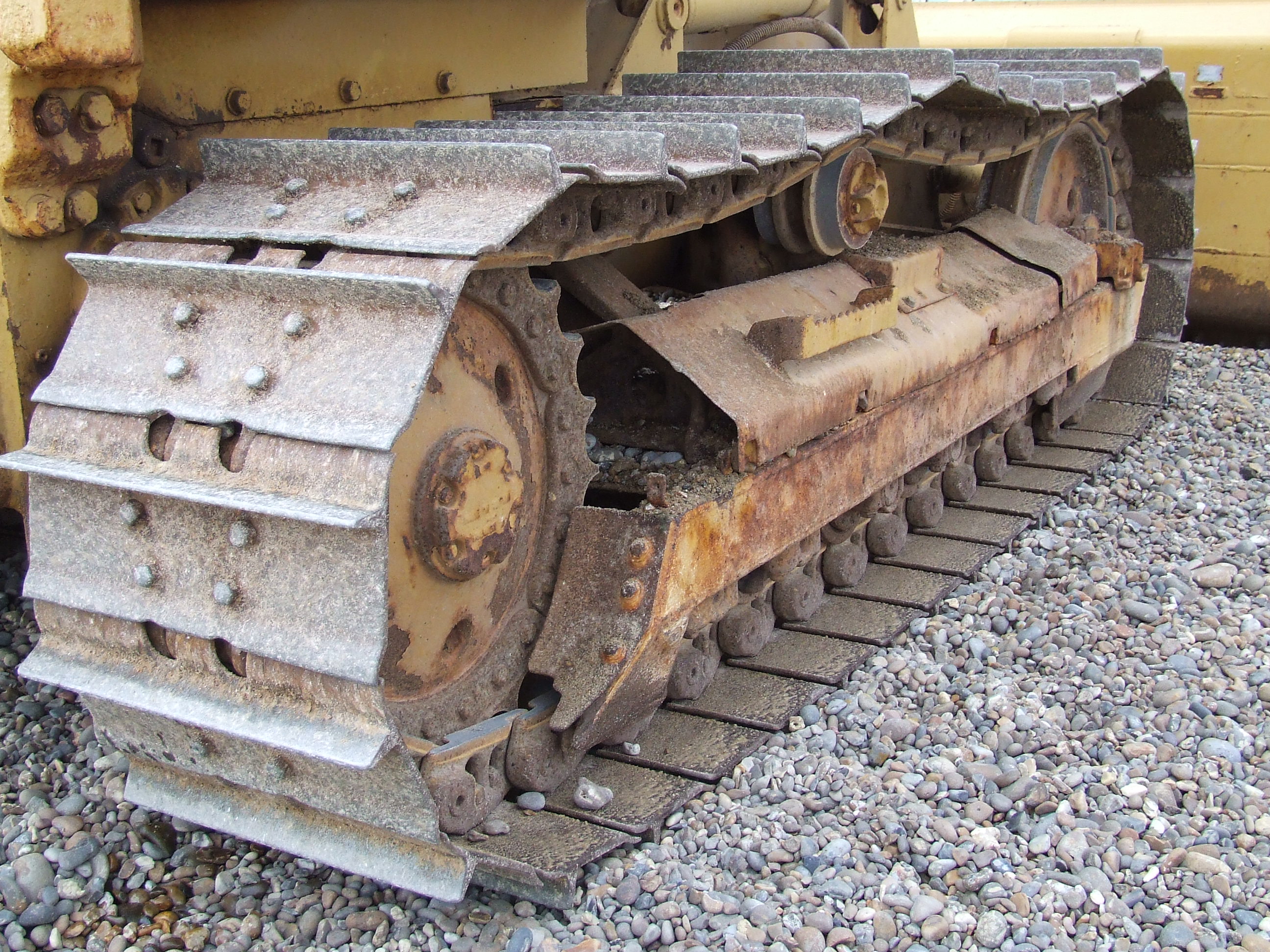
The droid moves — or depicts moving — on two tracked treads, one per side, in the manner of a tank or a tracked unmanned ground vehicle. Each tread is a closed loop of roller chain of the bicycle type, run around a line of machined wheels carried on a polished side-frame. The two side assemblies are joined across the centre by transverse axles and the control deck, giving the classic low-and-wide tracked stance discussed in Vol 4.

5.2 The treads: bicycle chain
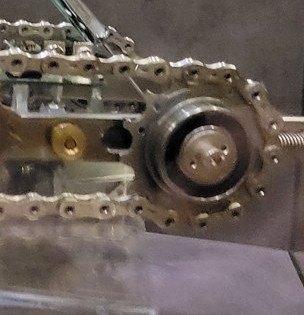
The single most identifiable salvage choice in the piece is the use of bicycle chain as track. The catalogue confirms the chain-as-tread reading, and the photographs show standard roller-chain construction — outer plates, inner plates, rollers, and pins — wrapped as a continuous loop around the running gear on each side.
Re-tasking bicycle chain as a tank tread is both a practical and a rhetorical choice:
- Practically, roller chain already engages toothed sprockets cleanly, so it provides a ready-made, museum-durable “track” that meshes positively with machined sprocket teeth — no need to fabricate custom track links and guide horns.
- Rhetorically, it is exactly the kind of recognisable found object Conte’s method favours (Vol 3): the viewer reads “tank tread” and “bicycle” at once, keeping the object grounded in the everyday even as it depicts a weapon.
5.3 The running gear: sprockets and bearing wheels
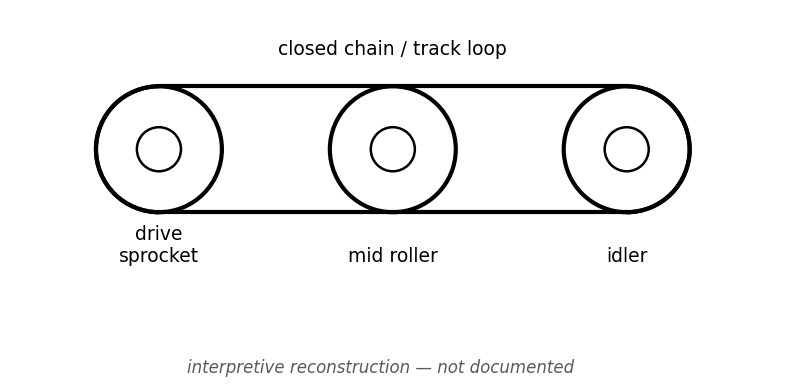
Each side carries a line of machined wheels that the chain runs over. The photographs show what reads as a multi-wheel arrangement per side — toothed sprockets where the chain must be driven or guided positively, and ball-bearing road wheels between them where the chain rides. Several wheels clearly show the concentric outer-race / inner-race signature of sealed ball bearings pressed into service as rollers — a typical Conte move, using a finished mechanical component (a bearing) as a sculptural wheel.
A reasonable reading of one side, from the photographs:
Table 1 — A reasonable reading of one side, from the photographs
| Element (per side) | What the photos show | Likely role |
|---|---|---|
| End wheels (front & rear) | Larger, toothed | Drive / tensioning sprockets that the chain wraps and meshes |
| Intermediate wheel(s) | Sealed ball bearing(s) | Road wheel(s) supporting the chain run |
| Brass fittings between wheels | Knurled brass nuts / standoffs | Axle hardware, spacers, and frame fasteners |
Not documented: whether the running gear was ever actually driven (i.e. whether a motor turned a sprocket and the tracks really moved), or whether the drive train is a static depiction. The presence of a live control board and a stacked driver daughterboard (Vol 6) makes some powered function plausible, but no source confirms the chassis ever locomoted, and this deep dive does not claim it did.

5.4 The frame and hardware
The two track assemblies are carried on polished bar side-frames — flat, bright metal members (consistent with the catalogue’s stainless steel / machined aluminum) that hold the wheel axles in line and tie the running gear together. Between and across the frames, knurled brass thumb-nuts and fittings appear repeatedly. Brass against bright steel is both a structural choice (easy hand assembly and adjustment) and an aesthetic one (warm accents on cool metal, Vol 4). Transverse members and the control deck span the two sides to make the chassis a single rigid unit.
5.5 Materials, as catalogued and as observed
The catalogue lists the piece as recycled stainless steel, titanium, and machined aluminum (plus the glass syringe). Mapping those to what the chassis shows:
Table 2 — shows
| Material (catalogue) | Where it plausibly appears | Basis |
|---|---|---|
| Stainless steel | Bright side-frames, fasteners, chain, linkage rods | Appearance; corrosion-bright finish |
| Titanium | Selected polished structural members / linkage | Catalogue lists it; not visually separable from stainless in photos |
| Machined aluminum | Frame plates / brackets / wheel bodies | Catalogue; machined-bright surfaces |
| Brass (not in catalogue line) | Thumb-nuts, standoffs, axle hardware | Clearly visible gold-coloured knurled hardware |
Note the small discrepancy: the catalogue’s material line does not mention brass, yet brass hardware is plainly visible throughout the running gear. This deep dive records the brass as observed rather than forcing it to fit the catalogue list — the catalogue line is a summary, not an exhaustive BOM.
5.6 Fabrication inferences
Nothing about the build process is documented, but the object is consistent with a maker who machines and assembles finished mechanical components rather than casting the chassis. The chassis appears fabricated and assembled — cut and machined bar stock, pressed bearings, salvaged chain, threaded brass hardware — rather than cast (Conte’s lost-wax bronze casting, central to his organism pieces, is not in evidence here; this is a machined-and-assembled object). That fits the 2004 prototype’s character: a bench-built mechanism, demonstrating the form, assembled from stock and salvage with a prosthetist’s machining fluency.
The drive train carries the object physically; the next volume turns to the part that carries its meaning — the Parallax control electronics that make it a “programmable robotic sculpture.”
Comments (0)