Petoi Bittle Nybble · Volume 1
Overview — A Quadruped You Can Actually Open
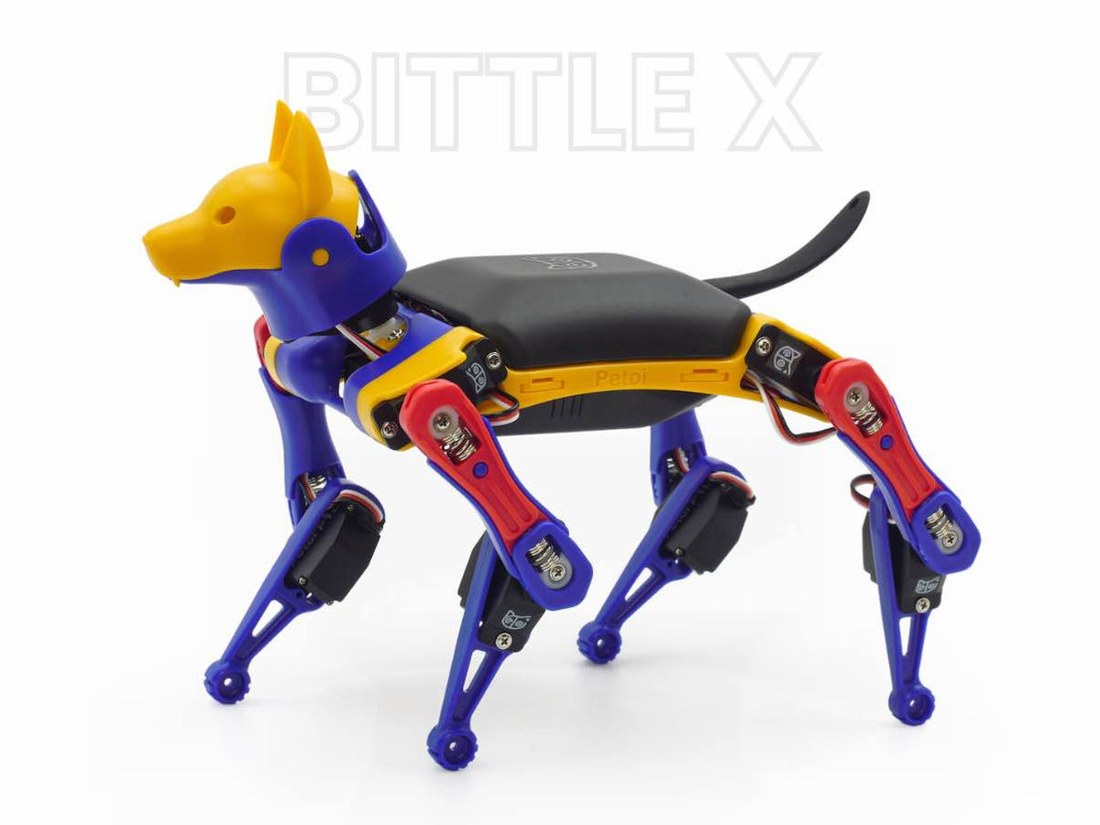
1.1 What they are
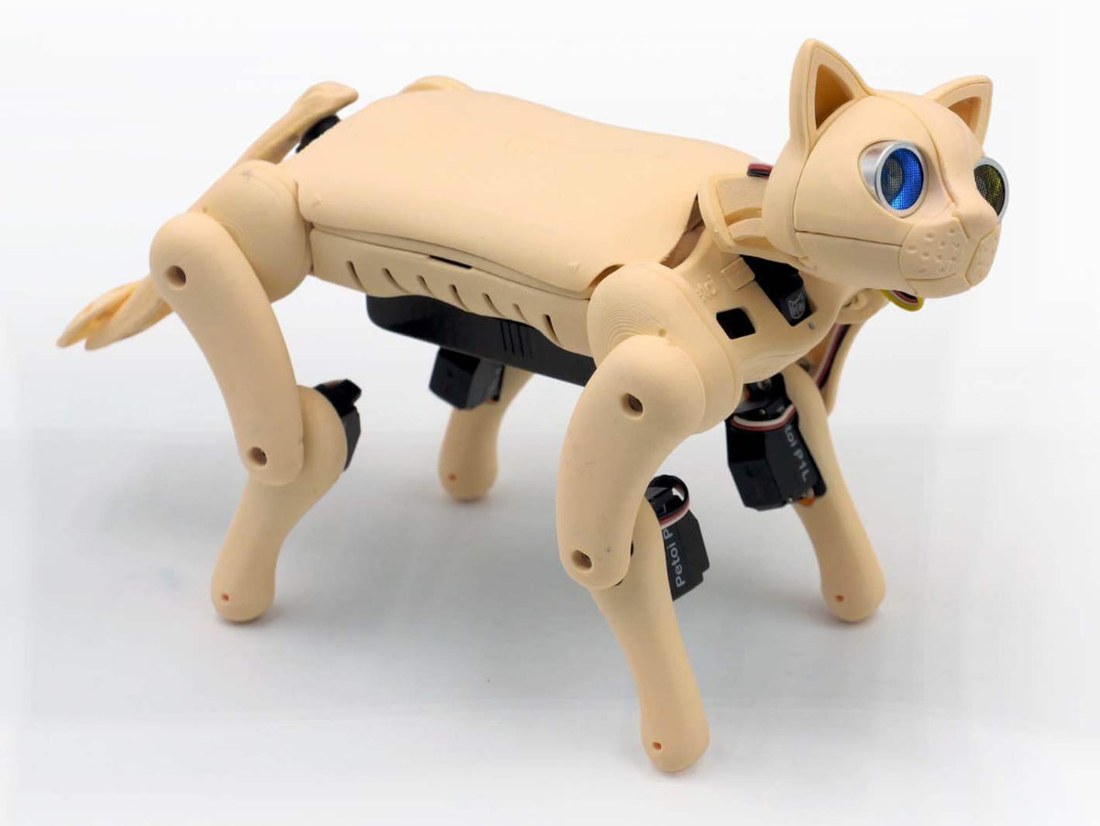
Petoi makes two palm-sized four-legged robots. Bittle is a dog with nine servo-driven joints. Nybble is a cat with eleven. Both walk, trot, balance on uneven ground, sit, stretch and perform a library of scripted skills; the dog can also run and backflip. Both are sold either as a kit to be assembled at the kitchen table or pre-built, and both are small enough to stand on a sheet of A4 paper.
They matter to this hub for one reason: they are genuinely open, and the openness is load-bearing rather than decorative.
The firmware that runs them — a framework called OpenCat — is published under the MIT licence, was still receiving commits in September 2026, and carries the whole interesting part of the machine: the inverse kinematics, the gait tables, the balance loop that reads the inertial sensor and corrects the legs, and the skill library. It is not a thin API over a sealed binary. It is the actual control software, readable and recompilable, for a robot that costs roughly three hundred dollars.
That is rare enough to be worth stating precisely, because “open-source robot” is a heavily marketed phrase that usually means something much weaker.
1.2 Where they sit in this hub
This collection now documents quadrupeds at three very different scales, and the comparison is instructive.
Table 1 — Where they sit in this hub
| Petoi Bittle / Nybble | RoboDog (this hub) | Commercial platforms | |
|---|---|---|---|
| Scale | palm-sized, 270 to 430 g | Labrador-sized, from scratch | knee-height and up |
| Cost | around USD 300 to 435 | USD 540 to 21,030 across three build tiers | USD 13,000 and up |
| Frame | printed or moulded plastic | printed, then machined aluminium | machined |
| Actuators | hobby-class coreless servos | serial-bus servos, then quasi-direct-drive | proprietary QDD |
| Control software | OpenCat, MIT, published | ROS 2, assembled by the builder | vendor SDK, variant-gated |
| Time to a walking robot | under two hours | a multi-year programme | walks out of the box |
| What it teaches | gaits, kinematics, embedded control | everything, expensively | integration |
Bittle and Nybble are the entry point to that ladder. They are the cheapest way to have a real quadruped — one with a genuine balance loop and real gait generation, not a wind-up toy — walking on a desk the same week it arrives.
They are also the deliberate counterweight to the other companion robots in this hub. The Anki machines documented alongside them are closed products from a dead company; the Petoi machines are open products from a company that is still shipping. Vol 8 draws that comparison out.
1.3 Headline facts
Table 2 — Headline facts
| Attribute | Bittle X V2 (current) | Nybble Q (current) |
|---|---|---|
| Form | dog | cat |
| Joints | 9 — 2 per leg, 1 neck | 11 — 2 per leg, 2 head, 1 tail |
| Standing size | 190 x 153 x 107 mm | 240 x 115 x 150 mm |
| Mass | 269 to 353 g | 403 to 433 g |
| Controller | BiBoard V1, ESP32-WROOM-32D | BiBoard V1, ESP32-WROOM-32D |
| Inertial sensor | 6-axis MPU6050 or ICM42670 | 6-axis MPU6050 or ICM42670 |
| Servos | P1S alloy or P1L plastic, coreless | P1S alloy or P1L plastic, coreless |
| Battery | 7.4 V 1000 mAh Li-ion | 7.4 V 1000 mAh Li-ion |
| Runtime | about 1 hour walking | about 1 hour walking |
| Frame | plastic | 3D-printed |
| Voice | 35+ built-in commands, 10 user-defined | 35+ built-in commands, 10 user-defined |
| Price | USD 319 | USD 435 |
The inertial sensor entry is worth noticing: Petoi’s own specification says “MPU6050 or ICM42670 depending on chip availability.” A vendor that tells buyers its bill of materials varies with the supply chain is being unusually straight with them, and it is a useful signal about the rest of the documentation.
1.4 The generational split that matters
Four animals have shipped, and the important division between them is not dog versus cat. It is which control board they carry, because that determines which firmware repository applies, which features exist, and what a second-hand purchase can do.
The earlier Bittle and Nybble run the NyBoard V1, built on an ATmega328P — Arduino Uno class, 8-bit, no radio on board. The current Bittle X V2 and Nybble Q run the BiBoard V1, built on an ESP32-WROOM-32D — 32-bit, dual-core at 240 MHz, with Wi-Fi and Bluetooth integrated. The ESP32 generation is what makes offline voice recognition, position-feedback servos and Raspberry Pi co-processing possible at all.
Both generations are alive in the source tree. The legacy pair is discontinued as a product but still supported as software, which is a distinction Vol 3 treats in detail because it governs whether a cheap used Bittle is a bargain or a dead end.
1.5 Openness, rated honestly
The scaffolding note for this subproject called these machines “fully open.” That is nearly right and worth sharpening, because one component is not.
Open. The firmware, under MIT, in two public repositories that are actively committed to. The serial command protocol. Published mechanical files. The Python API, which ships inside the firmware repository rather than as a separate product. Free curricula.
Not open. The companion mobile app is proprietary. It is the one closed door in an otherwise open building.
The critical question is how much that matters, and the answer is: far less than the equivalent closure would matter on a Cozmo. The Anki machines documented in this hub put the intelligence in the app — without it there is no personality and no vision. Petoi’s app is a convenience remote. Everything it does can be done from Coding Blocks, from the Arduino IDE, or from Python over a serial link, and the robot’s actual behaviour lives in firmware on the robot. Losing the app would cost a Petoi owner a control surface. Losing the app would cost a Cozmo owner the robot.
That is the difference between a closed component and a closed core, and it is the distinction this hub cares about most.
1.6 A note on sourcing
Petoi publishes detailed specification tables, and this dive gates against them. Where the vendor’s own pages disagree with each other — and in at least one case they do, over the flash capacity of the same control board — the conflict is recorded rather than silently resolved. See Vol 4.
Independent hands-on testing is thinner than the volume of online coverage suggests. One review consulted for this dive states plainly that it had not received a review unit and had not measured battery runtime, servo durability, gait stability or software reliability. Claims about long-term durability in this dive are therefore identified as untested rather than presented as findings.
1.7 What the volumes cover
Vol 2 covers Petoi’s origin — a graduate student, a viral video, two crowdfunding campaigns and the framework that came out of them. Vol 3 compares the four machines in detail and explains the board generations. Vol 4 is the electronics: boards, servos, power and the specification conflict noted above. Vol 5 covers how the robots actually move — gaits, the balance loop, the skill library and offline voice. Vol 6 is the programming surface, from block coding to the serial token protocol. Vol 7 covers extending the machine with a Raspberry Pi for vision and autonomy, and its use in published research. Vol 8 is building and buying one. Vol 9 is the cheatsheet.
Sources
- petoi.com technical specification pages for Bittle, Bittle X, Nybble and Nybble Q — dimensions, mass, joint counts, boards, servos, batteries and sensors.
- petoi.com store listings — current products, prices and availability.
github.com/PetoiCamp/OpenCatandgithub.com/PetoiCamp/OpenCatEsp32-Quadruped-Robot— the MIT licence, supported hardware, and repository activity.- guide.petoi.com — the current-generation product documentation.
- tvgreport.com, “Review Preview: Petoi Bittle X” — the specification summary, and its explicit statement that no review unit was received.
Comments (0)