Petoi Bittle Nybble · Volume 7
Extending It — Co-processors, Vision and Research Use
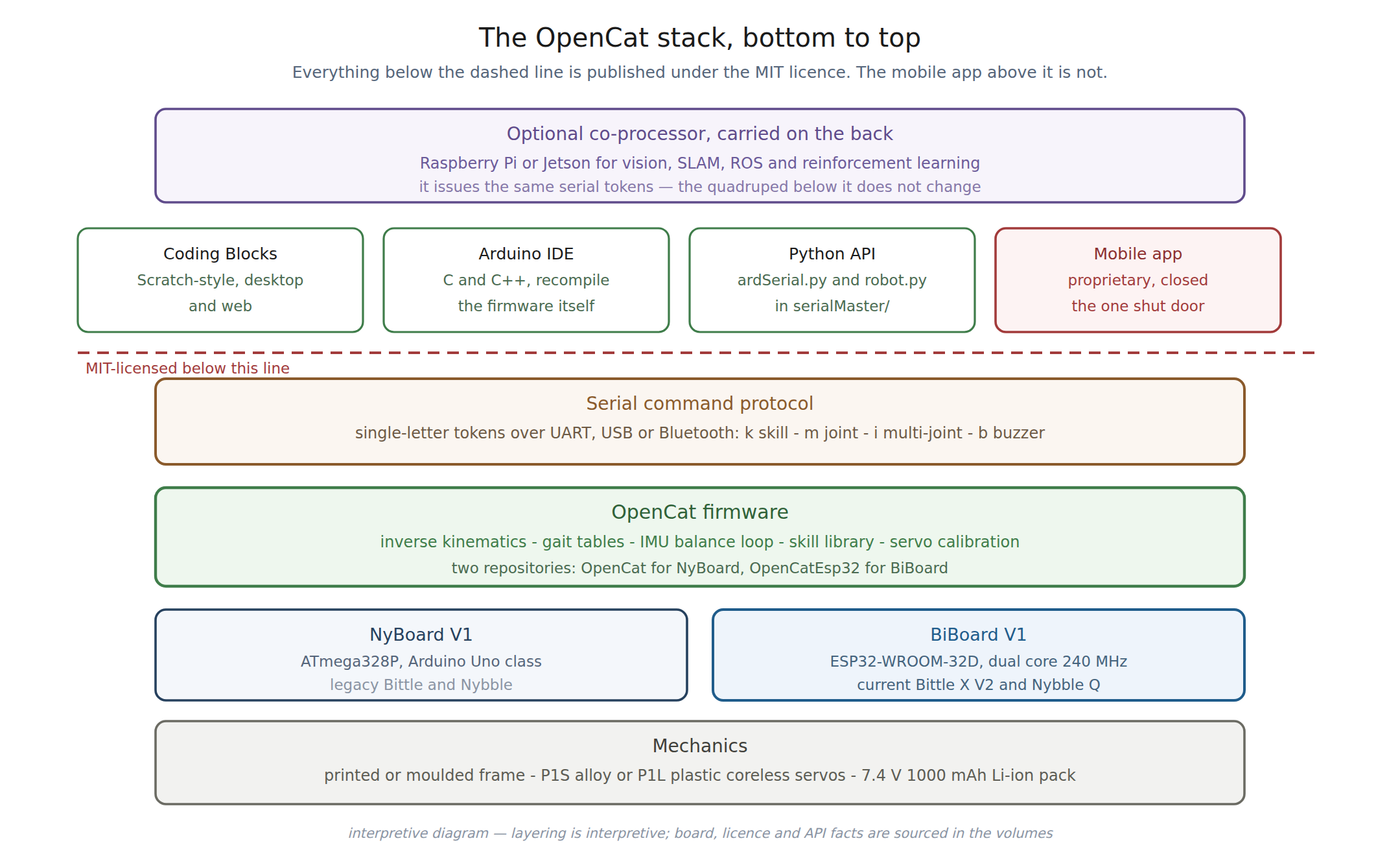
7.1 The architecture that makes extension cheap
The single most important thing to understand about adding intelligence to a Petoi quadruped is that the robot does not change.
A Raspberry Pi or Jetson riding on the robot’s back is not a replacement brain, and it
does not take over the legs. It runs vision, mapping or planning, decides what the robot
should do, and then issues exactly the same serial tokens documented in Vol 6 — the
same k, m and i commands a human could type into a terminal. The BiBoard continues
to run the gait tables and the balance loop underneath, unaware of what is generating
the commands.
This is a genuinely good separation and it has three practical consequences worth drawing out:
The hard part stays solved. Walking is difficult and is already working. A vision project never has to touch gait code, which is where a from-scratch legged robot spends most of its effort.
The interface is trivial. The boundary between the co-processor and the robot is a serial link carrying short ASCII strings. Anything that can open a serial port can drive the robot, in any language.
Failure is partitioned. A crashed vision process leaves a robot that is still standing and still balancing, rather than one that collapses.
The contrast with the RoboDog programme documented elsewhere in this hub is instructive. There, the builder is responsible for the entire stack — actuator selection, leg kinematics, gait generation, balance, and then autonomy on top. Here the bottom four layers are bought for three hundred dollars and the builder starts at the interesting part.
7.2 What the vendor supports
Raspberry Pi support is listed by independent coverage as one of the three headline additions in the current BiBoard generation, alongside the updated board and the feedback servos. The legacy NyBoard machines also accept a Pi — the original Nybble specification lists Raspberry Pi support explicitly — but the current generation has the documented interface.
The framework’s own README names the extension territory directly: ROS compatibility, sim-to-real experimentation for reinforcement learning, and support for multiple programming languages. Camera and sensor add-ons are sold as accessories, and the legacy NyBoard carries four Grove connectors for attaching sensors without soldering.
A limit on what this dive establishes: the specific camera module part numbers, the
mounting arrangement for a co-processor, and the wiring between a Pi and the BiBoard
were not verified during this research. Anyone planning a build should work from the
current documentation at guide.petoi.com rather than from this paragraph.
7.3 Research use, honestly bounded
Petoi maintains a “research spotlight” page positioning Bittle and Nybble as a quadruped research platform, and the framework’s README makes reinforcement-learning and sim-to-real claims directly.
The claim is plausible on its face. A quadruped with published firmware, a documented command interface, an inertial sensor, position-feedback servos and a three-hundred-dollar price is an obvious candidate for laboratory work where buying twenty of something is more useful than buying one good one — exactly the niche that made cheap wheeled platforms ubiquitous in robotics teaching.
However. The note that scaffolded this subproject cited specific published work — a SLAM-with-ROS write-up and a visual-SLAM study on Bittle attributed to Carnegie Mellon. Those specific sources were not retrieved or read during this research pass, and this dive therefore does not cite, summarise or vouch for them. They may well be exactly as described. They are recorded here as unverified leads for a future pass rather than presented as evidence.
What can be said without overreach: the vendor positions these machines for research, the technical preconditions for that use are genuinely present, and the specific body of published work was not surveyed here.
7.4 The realistic ceiling
It is worth being blunt about what a palm-sized quadruped with hobby servos can and cannot support, because enthusiasm in this category tends to outrun physics.
Well within reach. Gait experimentation. Kinematics teaching. Behaviour scripting. Vision projects where the robot is a camera platform that walks. Reinforcement learning in simulation transferred to hardware for demonstration. Multi-robot work where cost matters more than capability.
Marginal. Serious SLAM. Mapping requires carrying a sensor with enough range and stability to be useful, and a 300-gram robot with roughly a one-pound unverified payload and an hour of runtime is working close to its limits with a Pi, a camera and a battery on its back. It can be done; it is not comfortable.
Out of reach. Outdoor operation over rough ground. Payload-carrying of any consequence. Long-duration autonomy. Anything requiring the torque-to-mass ratio that Vol 5 identified as the binding constraint — the same reason the cat cannot backflip bounds everything else.
A reader wanting those capabilities is looking at the RoboDog tier or the commercial tier, and the honest framing is that Bittle and Nybble are where a person learns whether they want to go there, at one per cent of the cost of finding out the expensive way.
7.5 Figure slots for the unit documented here
Sources
github.com/PetoiCamp/OpenCatREADME — ROS compatibility, sim-to-real reinforcement-learning positioning, multi-language support, and the framework’s scope.github.com/PetoiCamp/OpenCatEsp32-Quadruped-RobotREADME — the current-generation firmware and its module support.- learnwitharobot.com, “Petoi’s new products” — Raspberry Pi support as one of the three additions in the current generation.
- petoi.com, “Research Spotlight” page — the vendor’s positioning of Bittle and Nybble as a research platform.
- petoi.com technical specification pages — the four Grove connectors on NyBoard and the Raspberry Pi support entry on the Nybble specification.
- The RoboDog volumes in this hub — for the from-scratch comparison drawn above.
- Unverified leads, not used as sources: the Hackster SLAM-with-ROS write-up and the Carnegie Mellon visual-SLAM study named in this subproject’s scaffolding note, neither of which was retrieved during this research.
Comments (0)