Petoi Bittle Nybble · Volume 2
Petoi and OpenCat — Where These Machines Came From
2.1 A framework before a company
OpenCat began in 2016, started by Dr. Rongzhong Li while at Wake Forest University, and it began as a personal project rather than a product. The stated inspiration was Boston Dynamics’ Spot — the question being whether the gait coordination and balance behaviour that made those machines compelling could be reproduced at hobby scale, on hobby servos, for hobby money.
The prototype was a cat. A video of it circulated widely, and the response to that video is what turned a research side-project into a company: Petoi was founded in 2017, with the explicit aim of making the robot something anyone could build and program rather than something only its author could run.
The order of events matters. The framework predates the product. OpenCat was not written to support a robot Petoi had already designed and needed software for; the robots were designed to embody a framework that already existed and already worked. That is the opposite of the usual sequence in consumer robotics, and it explains a great deal about how the products are shaped — why the firmware is the interesting artefact, why two quite different animals run the same codebase, and why the software survived a complete change of processor architecture.
2.2 Two crowdfunding campaigns
Petoi’s products reached the public through crowdfunding, twice.
Nybble, the cat, launched on Indiegogo in 2018 and raised USD 136,536 from 580 backers. It shipped on a wooden frame — laser-cut plywood assembled as a screw-free three-dimensional puzzle, a choice that gave the robot a distinctive look and a notoriously long build.
Bittle, the dog, launched on Kickstarter in October 2020 and raised USD 567,000 from 2,052 backers, more than eleven times its goal. Bittle moved to a moulded plastic frame, assembled far faster, and became the company’s mainstream product.
Petoi reports having shipped more than 30,000 robots to customers in over 60 countries, with more than USD 1 million raised across its campaigns.
A third campaign is in progress: Quaddle, described as a four-servo quadruped with position-feedback servos and a “puppet mode”, went live on Kickstarter on 2 September 2026. It is mentioned here for completeness and is outside this dive’s scope — no shipped hardware existed to document at the time of writing.
2.3 Why the crowdfunding history is relevant
It is tempting to treat funding history as corporate trivia. In this hub it is not, because the adjacent Anki dives make the comparison unavoidable.
Anki raised approximately USD 182.5 million in venture capital, shipped Cozmo to “hundreds of thousands” of buyers, and ceased to exist in 2019. Petoi raised roughly USD 1 million from backers, has shipped some 30,000 robots, and was still committing code in September 2026.
The lesson is not that crowdfunding is safer than venture capital — the graveyard of unfulfilled crowdfunding campaigns is enormous, and the Digital Dream Labs action described in the Cozmo dive concerned exactly that failure mode. The lesson is narrower and more useful: a company scaled to its actual revenue can survive at a size that a company scaled to a venture return cannot. Anki needed to be enormous or die. Petoi did not.
For a buyer, the relevant question is not which company is more impressive but which is more likely to still answer an email. And beneath even that sits the question this hub keeps returning to: what happens to the robot if the answer turns out to be neither? For a Petoi machine the answer is comparatively benign, because the firmware is MIT licensed and already on the buyer’s disk.
2.4 The framework’s two lives
OpenCat has survived a complete change of processor architecture, which is the clearest evidence that it is a real framework rather than a product’s firmware.
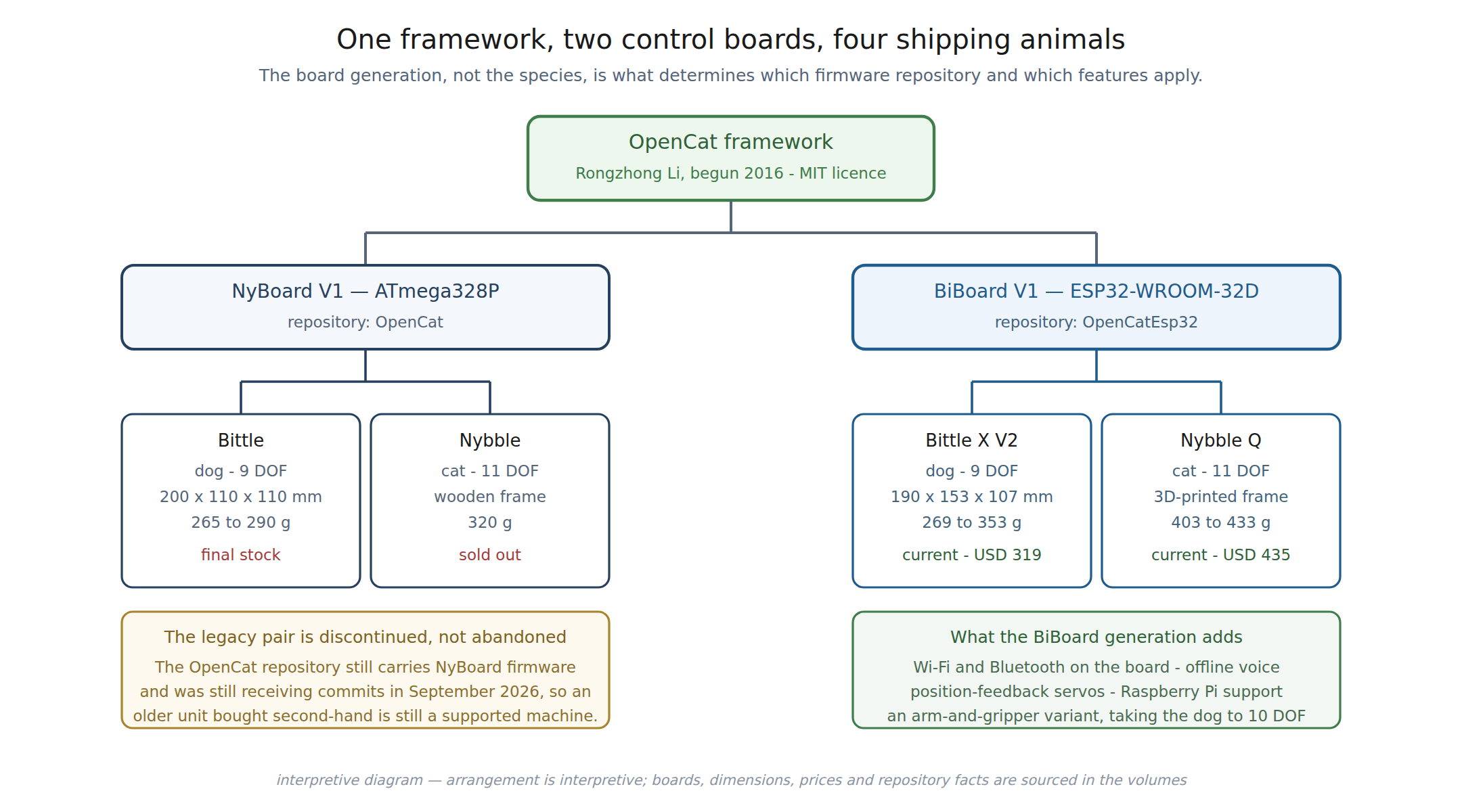
The original implementation targets the NyBoard, built on an ATmega328P — the same 8-bit microcontroller as an Arduino Uno, running gait generation and an inertial balance loop for up to twelve servos. That it works at all on that part is a genuine engineering result; there is very little headroom on an ATmega328P once inverse kinematics and a sensor loop are running.
The second implementation targets the BiBoard, built on an ESP32 dual-core part at 240 MHz with integrated Wi-Fi and Bluetooth. The extra capability is what enables offline voice recognition, richer skills and a co-processor interface.
These live in two separate repositories, and knowing which one applies is the first thing an owner needs to establish:
Table 1 — thing an owner needs to establish
| Repository | Board | Robots |
|---|---|---|
PetoiCamp/OpenCat | NyBoard V1, ATmega328P | Bittle, Nybble — legacy |
PetoiCamp/OpenCatEsp32-Quadruped-Robot | BiBoard V1, ESP32 | Bittle X V2, Nybble Q — current |
Both are MIT licensed. Both were still receiving commits in September 2026. The NyBoard repository carries roughly 5,300 stars and the ESP32 repository roughly 400, reflecting the age of each rather than their relative importance.
That the legacy repository is still being committed to is the single most reassuring fact in this dive for anyone considering a second-hand purchase. The hardware is discontinued; the software is not abandoned.
2.5 The education strand
Petoi’s public material puts substantial weight on teaching. Free curricula are published for both the block-based and the C++ routes, and the company’s framing of its products as STEM tools rather than toys is consistent across its documentation.
This is worth taking more seriously than marketing copy usually deserves, for a structural reason: a robot whose firmware is published and whose command protocol is documented is teachable in a way a sealed product is not. A student can be shown the gait table, change a number in it, recompile, and watch the robot walk differently. That loop is the whole pedagogical value, and it requires exactly the openness Petoi provides.
The comparison to the Cozmo dive is direct. Code Lab, Anki’s block-coding environment, is genuinely well made and more polished than Petoi’s equivalent — and it stops at the API boundary. There is no layer beneath it a student can reach.
2.6 What is not established
- Petoi’s size, revenue and staffing are not published and are not estimated here.
- Long-term component supply — how long spare servos and boards will be available for current models, let alone discontinued ones — is not stated by the vendor.
- The Quaddle campaign’s outcome and delivery were outside the window of this research.
Sources
github.com/PetoiCamp/OpenCatREADME — OpenCat’s 2016 origin, Rongzhong Li, Wake Forest University, the Spot inspiration, the MIT licence, the 30,000-robot and 60-country figures, and the NyBoard hardware scope.github.com/PetoiCamp/OpenCatEsp32-Quadruped-RobotREADME — the BiBoard, the ESP32 dual-core specification, current robot support, and the Quaddle campaign date.- Repository metadata for both projects — licences, star counts and September 2026 activity.
- petoi.com “About” page and petoi.camp — the 2017 founding, the Indiegogo and Kickstarter figures, and the shipping totals.
- The Anki Cozmo dive in this hub — for the funding and survival comparison drawn above.
Comments (0)