Petoi Bittle Nybble · Volume 5
Motion — Gaits, Balance, Skills and Offline Voice
5.1 What OpenCat actually does
The framework’s own description of its purpose is the clearest summary available: it handles “the hard parts — gait coordination, servo control, IMU integration” so that a developer can work on an application instead.
Unpacking that into the four things running on the board:
Inverse kinematics. Converting a desired foot position into the shoulder and knee angles that achieve it. This is the arithmetic that lets a gait be described in terms of where feet should go rather than what each servo should do.
Gait tables. Precomputed sequences of joint positions over a cycle, one per gait. Because they are precomputed, the runtime cost is interpolation, which is what allows the whole thing to run on an ATmega328P. This is the key architectural decision underneath the legacy generation’s existence.
The balance loop. The inertial sensor is read continuously and leg positions are corrected against it. This is what separates these machines from a servo toy playing back a fixed animation: push a Bittle and it resists, and set it on a slope and it adjusts.
The skill library. Named, callable motions — sit, stretch, greet, push-up — invoked by a short token over the serial link.
5.2 The gaits
The published figure is more than 35 lifelike movements and skills, spanning locomotion gaits and expressive postures. Documented examples include walking, trotting, running, crawling, balancing, sitting, stretching, sleeping, greeting, push-ups and, on Bittle, a backflip.
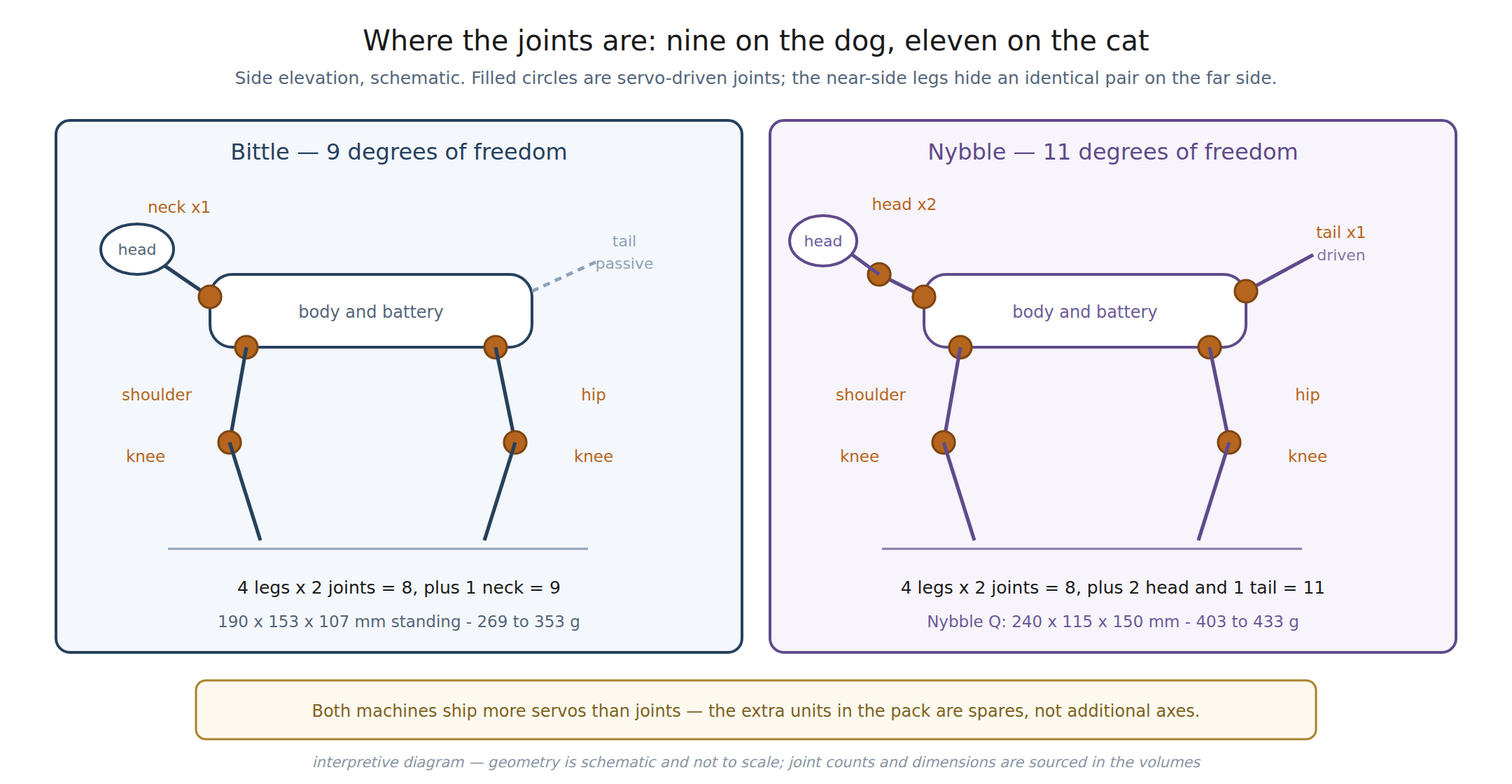
The important asymmetry was introduced in Vol 3 and belongs here in its mechanical form: Bittle backflips and Nybble does not. The framework supports the manoeuvre on both. The cat cannot execute it because, at 403 to 433 grams against the dog’s 269 to 353, the same coreless servos cannot generate the acceleration required.
This is worth stating as a principle rather than a product quirk, because it recurs at every scale of legged robotics and it is one of the through-lines of this hub: what a legged robot can do dynamically is set by the ratio of actuator torque to mass, and no amount of control sophistication substitutes for it. The RoboDog volumes in this collection reach the same conclusion at forty times the size, working torque budgets across three build tiers. Here it is visible for three hundred dollars, in the difference between a dog that flips and a cat that cannot.
5.3 Teaching by demonstration
The position-feedback servos in the current generation change how motions are authored, and this is the most practically significant capability in the BiBoard machines.
Because a servo reports its actual angle, an operator can pose the robot by hand and have the firmware record the resulting joint angles. A sequence of such poses becomes a skill. The alternative — deriving joint angles analytically, writing them into a table, compiling, uploading and watching the robot fall over — is how the legacy generation required custom motions to be built.
A second consequence is mirroring: a servo can track a paired servo, so moving one leg by hand makes another follow. Independent coverage describes this as the headline demonstration of the feature.
For anyone whose actual interest is authoring motion rather than consuming it, this alone is a strong argument for the current generation over a cheap used legacy unit.
5.4 Offline voice
The current machines respond to spoken commands, and the significant word is offline.
Table 1 — Offline voice
| Attribute | Value |
|---|---|
| Built-in commands | more than 35 |
| User-defined commands | 10 |
| Languages | English and Chinese, switchable by voice command |
| Trigger | any sound, not restricted to speech |
| Processing | on the robot |
That last row is the one that matters in this hub. Voice recognition here runs on the ESP32 on the robot’s own back. There is no server, no account, no network dependency and no company that can withdraw the capability.
Set that against the Anki dives documented alongside this one. Vector’s voice interaction — wake phrase, speech recognition, knowledge answers — ran in a vendor cloud, and when that cloud went dark the robot stopped answering until the community built a local replacement server. Cozmo sidestepped the problem by having no microphone at all.
Petoi’s approach is the third option and, from a durability standpoint, plainly the best of the three: a small, fixed vocabulary processed locally. It is far less capable than what Vector attempted — thirty-five commands is not a conversation — but it cannot be switched off by anyone, and it still works with the router unplugged.
The trade is explicit and worth stating plainly rather than glossing: Petoi chose a capability ceiling in exchange for independence. Anki chose the reverse and its customers lost the feature. Which is the better engineering decision depends on the time horizon being optimised for, and this hub’s bias toward machines that still work is not neutral on the question.
That user-defined commands can be triggered by any sound rather than only speech is a small, nice piece of design — it makes a clap or a whistle a valid trigger.
5.5 Stability in practice
Petoi’s own claim is stability “even on uneven terrain,” supported by the six-axis inertial sensor and the balance loop.
This dive has not verified that claim, and the qualification matters. The most substantial independent review located during this research states explicitly that it did not receive a review unit and had not measured gait stability, servo durability or battery runtime. The volume of enthusiastic coverage of these robots online is not matched by a corresponding volume of measurement.
What can be said with confidence is structural rather than empirical: the machine has the right sensor, runs a documented balance loop, and its firmware is published so the loop can be read. Whether it stays stable after a term of classroom handling is an open question that the sources do not answer.
5.6 Figure slots for the unit documented here
Sources
github.com/PetoiCamp/OpenCatREADME — the framework’s handling of gait coordination, servo control and IMU integration; walking, running, jumping and balancing gaits; and its sim-to-real and reinforcement-learning positioning.github.com/PetoiCamp/OpenCatEsp32-Quadruped-RobotREADME — the skill library and voice-control integration on the current generation.- guide.petoi.com, Bittle X V2 and Nybble Q product pages — the 35-plus built-in voice commands, the 10 user-defined commands, English and Chinese switching, the any-sound trigger, the gyroscope and touch sensors, and the feedback servos.
- petoi.com product pages — the skill lists (sit, stretch, sleep, balance, greet, push-up) and the “35+ lifelike movements” figure.
- learnwitharobot.com, “Petoi’s new products” — the independent description of servo feedback and mirroring.
- petoi.com technical specification pages — the masses underlying the backflip argument.
- tvgreport.com, “Review Preview: Petoi Bittle X” — the explicit statement that gait stability, servo durability and runtime were not measured.
Comments (0)