Petoi Bittle Nybble · Volume 3
The Machines — Dog, Cat, and Which Generation
3.1 Two animals, one skeleton
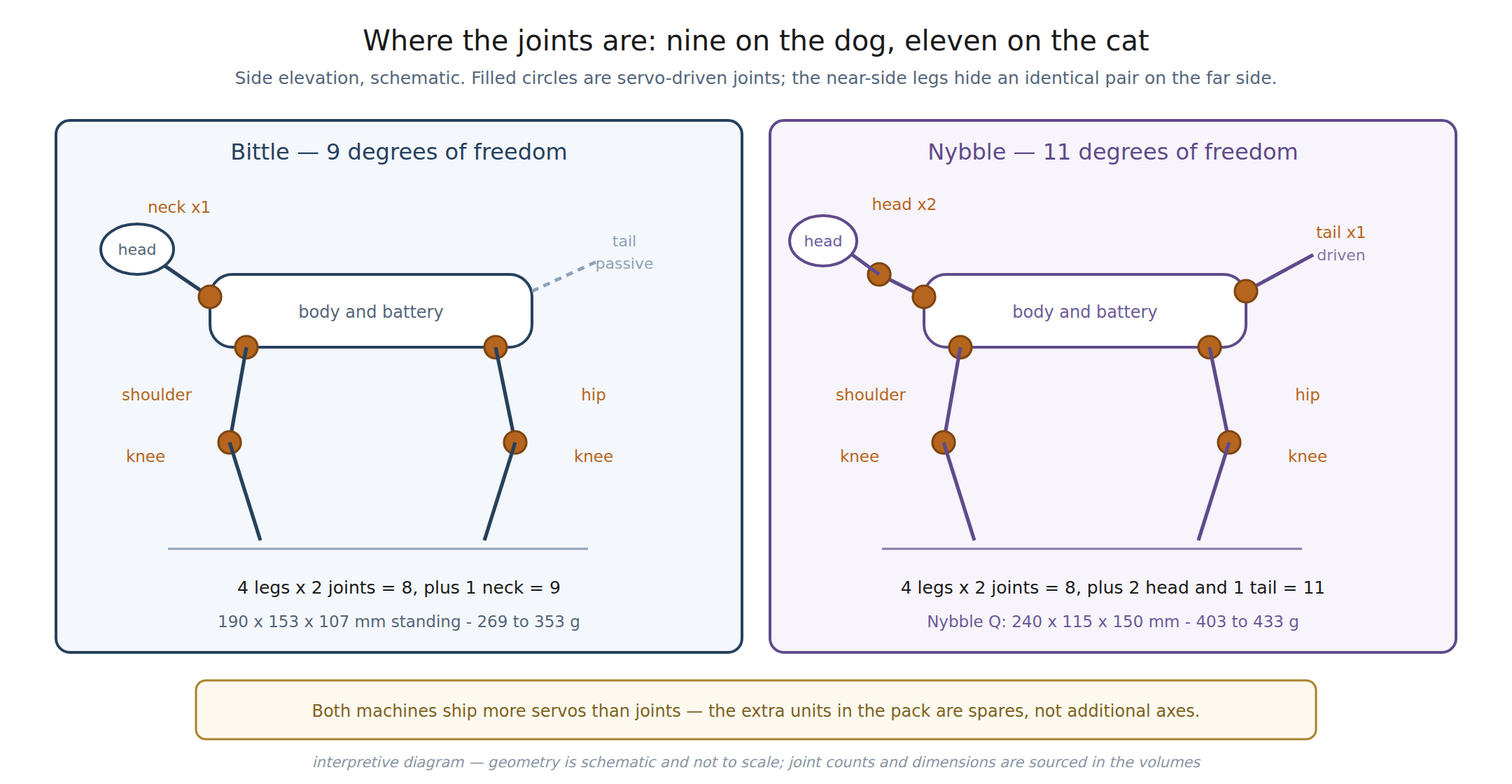
Strip the shells away and Bittle and Nybble are the same machine. Both use two servo-driven joints per leg — a shoulder or hip, and a knee — giving eight joints of locomotion. Both balance using a six-axis inertial sensor. Both run the same framework, the same gait tables and the same command protocol.
The difference is entirely in what is attached to the body above those eight joints:
Table 1 — The difference is entirely in what is attached to the body above those eight joints
| Bittle (dog) | Nybble (cat) | |
|---|---|---|
| Leg joints | 8 (4 legs x 2) | 8 (4 legs x 2) |
| Neck or head | 1 neck joint | 2 head joints |
| Tail | passive | 1 driven joint |
| Total | 9 | 11 |
Two extra degrees of freedom sound minor and are not. The cat’s second head joint gives it a genuinely feline gaze — it can tilt as well as pan — and the driven tail is used for expression rather than balance. Nybble is the more expressive machine; Bittle is the more athletic one.
3.2 The athletic difference
Bittle can run and backflip. Nybble cannot backflip, and the reason is mass rather than software: the framework supports the manoeuvre, but the heavier cat cannot generate the necessary acceleration with the same servos. Nybble Q weighs 403 to 433 grams against Bittle X V2’s 269 to 353 grams — roughly 40 per cent more robot on comparable actuators.
This is a clean illustration of a principle that governs the entire legged-robot field and recurs at every scale in this hub: dynamic capability is set by the ratio of actuator torque to mass, not by the sophistication of the controller. The same software on a heavier chassis simply cannot do the same things. The RoboDog volumes in this hub work the same trade at forty times the scale, with the same conclusion.
3.3 The four shipping machines
Table 2 — The four shipping machines
| Bittle | Nybble | Bittle X V2 | Nybble Q | |
|---|---|---|---|---|
| Animal | dog | cat | dog | cat |
| Joints | 9 | 11 | 9 | 11 |
| Board | NyBoard V1 | NyBoard V1 | BiBoard V1 | BiBoard V1 |
| Processor | ATmega328P | ATmega328PA | ESP32-WROOM-32D | ESP32-WROOM-32D |
| Size (mm) | 200 x 110 x 110 | 250 x 107 x 140 | 190 x 153 x 107 | 240 x 115 x 150 |
| Mass | 265–290 g | 320 g | 269–353 g | 403–433 g |
| Frame | plastic | wood | plastic | 3D-printed |
| Servos | P1S / P1L | DS031 metal x11 | P1S / P1L, feedback | P1S / P1L, feedback |
| On-board radio | none | none | Wi-Fi + Bluetooth | Wi-Fi + Bluetooth |
| Offline voice | no | no | yes | yes |
| Status | final stock | sold out | current, USD 319 | current, USD 435 |
3.3.1 A price discrepancy
Petoi’s own pages disagree about the legacy Bittle. The store collection lists it at USD 289 while the product page lists USD 309. Both were observed during this research. The discrepancy is recorded rather than resolved; since the model is on final stock, it is of limited practical consequence.
3.4 What the BiBoard generation added
Three changes separate the current machines from the legacy pair, and together they are substantial enough that the generations should be thought of as different products rather than revisions.
An ESP32 in place of an ATmega328P. Thirty-two bits and two cores at 240 MHz against eight bits at 16. The practical gain is not faster walking — the legacy machines walk perfectly well — but headroom for everything that runs alongside the gait loop.
Wi-Fi and Bluetooth on the board. The legacy machines needed optional dongles for wireless. The current ones have radios integrated, which is what makes the web-based block-coding environment and wireless firmware upload practical.
Position-feedback servos. This is the most interesting change and the least obvious. The current servos report their actual position back to the controller rather than merely accepting a commanded one. Two consequences follow. First, the robot can be taught by demonstration — an operator moves a limb by hand and the robot records the pose, which is how custom skills are now built without writing joint angles by hand. Second, a servo can mirror another: move one leg and a paired leg follows.
A fourth change is listed by independent review: Raspberry Pi support, meaning a documented interface for a co-processor riding on the robot’s back. Vol 7 covers what that enables.
3.5 The arm variant
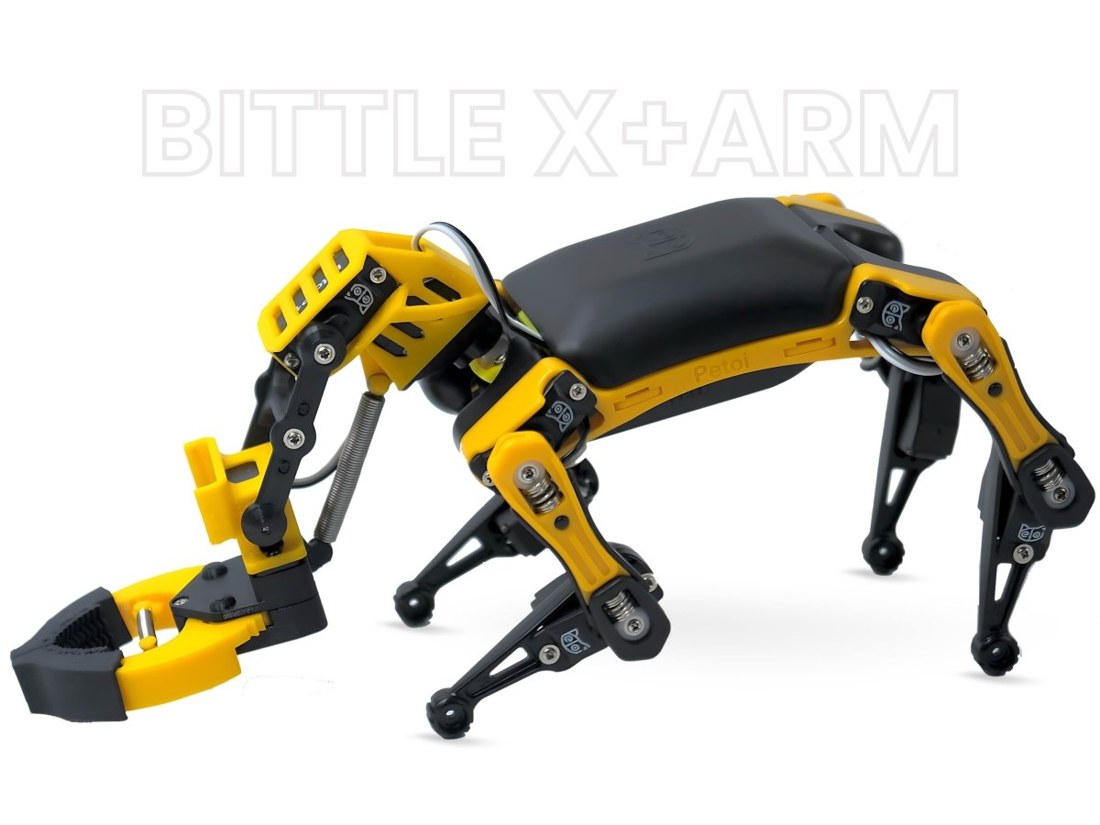
Bittle X V2+Arm replaces the dog’s head with a two-degree-of-freedom arm, taking the machine to ten joints. One servo swings the arm laterally; the other operates a gripper. Independent coverage draws the comparison directly to Anki Vector’s lift — a neat cross-reference within this hub, since Vector’s forklift arm is documented in its own dive.
The trade is explicit: the arm replaces the head. A Bittle with an arm has no neck joint and cannot look around. It is a manipulation machine rather than an expressive one.
3.6 Frames: wood, plastic, printed
The frame material has changed with every generation and is the most visible difference between the machines.
The original Nybble’s laser-cut plywood frame assembled as a screw-free three-dimensional puzzle. It looks superb and takes roughly three hours to build. Wood is also the least forgiving material here — it does not tolerate repeated disassembly or a fall onto a hard floor as well as plastic.
Bittle’s moulded plastic frame assembles in 40 to 90 minutes and is the more practical choice for anything that will be taken apart.
Nybble Q’s 3D-printed frame is the current approach, and it comes with a caveat worth knowing before ordering: at the time of writing Nybble Q is available pre-assembled only. Petoi describes the build as complex and states that a kit version is still in development. A buyer specifically wanting the assembly experience — which for many is the point — should verify availability before ordering, because the cat and the dog currently differ on this.
3.7 Buying a legacy machine
Since both legacy models are discontinued, second-hand units will circulate, and the question is whether they are worth having.
They are, with clear eyes. The decisive fact is that PetoiCamp/OpenCat, the
NyBoard firmware repository, was still receiving commits in September 2026. A used
Bittle or Nybble is a discontinued product running maintained software — the inverse of
the situation documented in this hub’s Anki dives, where current-looking software sits
on a platform nobody supports.
What is given up is concrete: no on-board Wi-Fi or Bluetooth without dongles, no offline voice, no position-feedback servos and therefore no teaching by demonstration, and no documented Raspberry Pi path. For learning gait programming and kinematics — arguably the main reason to own one of these — none of that is required.
What should be checked is the same list as for any servo robot: that all servos drive and hold position, that the frame is uncracked, that the battery holds charge, and, for a wooden Nybble, that the plywood is intact at the joints.
Sources
- petoi.com technical specification pages for Bittle, Bittle X, Nybble and Nybble Q — all dimensions, masses, joint counts, boards, processors, servo models and frame materials tabulated above.
- petoi.com store collection and product pages — prices, stock status, and the pre-assembled-only note for Nybble Q; also the source of the recorded price discrepancy.
- guide.petoi.com — Bittle X V2 feature description, feedback servos, and the voice command counts.
- learnwitharobot.com, “Petoi’s new products” — the independent statement of the three changes in the V2 generation, and the description of the arm variant and its comparison to Vector’s lift.
github.com/PetoiCamp/OpenCatrepository metadata — September 2026 activity on the legacy firmware.
Comments (0)