Heathkit HERO 1 (ET-18) · Volume 1
Overview — HERO 1, the Heathkit Educational Robot
1.1 What it is
The HERO 1 is a self-contained, mobile educational robot introduced by the Heath
Company in 1982. Its name is an acronym — Heathkit Educational RObot —
and that name states its purpose plainly: the machine was built to teach robotics,
not to perform useful work. An onboard Motorola 6808 microprocessor drives the
whole platform, which carries a sonar ranging sensor, light, sound, and motion
detectors, an optional manipulator arm, and an optional speech synthesizer, all
programmed from a hexadecimal keypad set into the top of its head (Wikipedia,
“HERO (robot)”; hero.dsavage.net HERO FAQ).
Heathkit sold the HERO 1 in the two forms that defined the company: as a solder-it-yourself kit (ETW-18) and as a factory-assembled unit (ET-18). Building the kit was itself part of the education — the buyer assembled the drive train, the sensor boards, and the microprocessor system, then learned to program the result (HERO FAQ; ET-18 Assembly Manual, in the factory manual set).
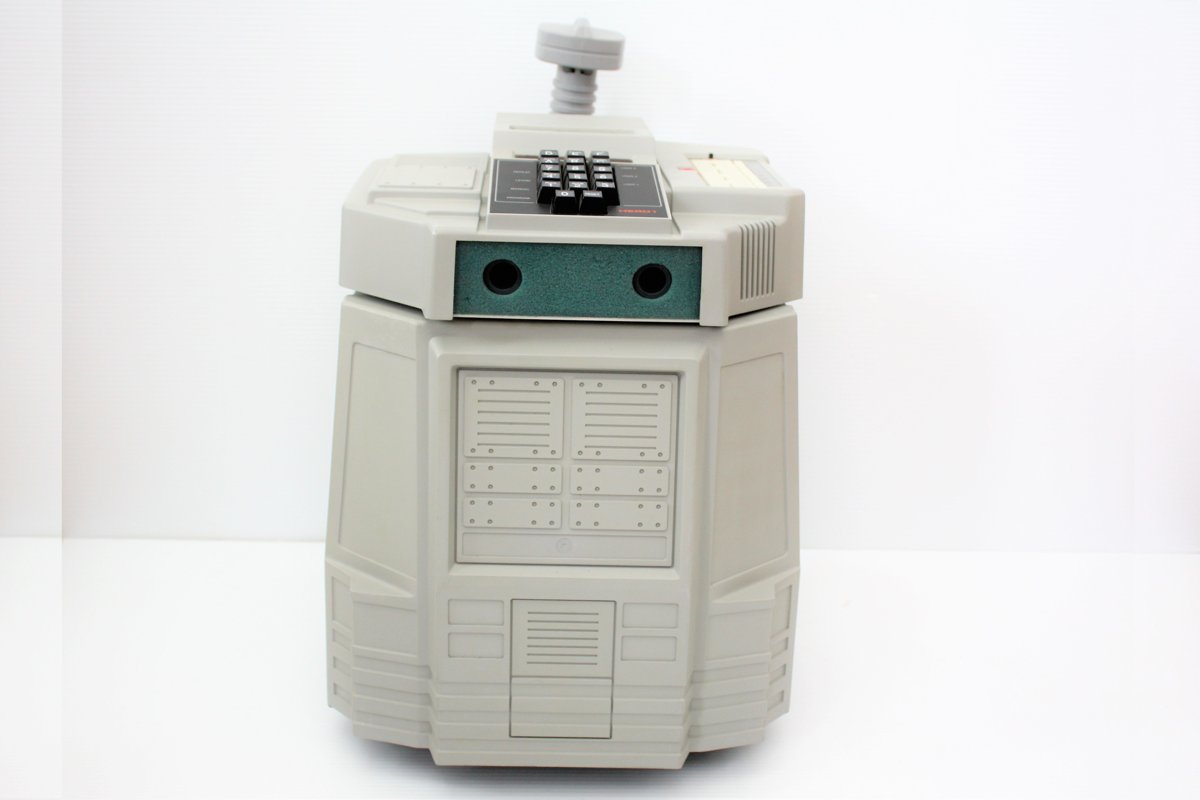
The robot stands 20 inches tall, measures 18 inches in diameter, and weighs about 39 pounds with its accessories fitted (HERO FAQ; theoldrobots.com). It rolls on three wheels — two fixed at the rear and one steerable drive wheel at the front — and runs from an internal pack of four gel-cell rechargeable batteries replenished by an included 120/240 VAC charger (HERO FAQ). A head that rotates through 350° aims the sensor cluster and the arm, giving a stationary HERO 1 a near-complete view of its surroundings without moving its base (HERO FAQ; Wikipedia).
1.2 Headline facts
Table 1 — Headline facts
| Attribute | Value | Source |
|---|---|---|
| Full name | HERO 1 — Heathkit Educational RObot | HERO FAQ; Wikipedia |
| Model numbers | ET-18 (assembled), ETW-18 (kit) | HERO FAQ |
| Project start / first release | October 1979 / 1982 | Wikipedia; historyofinformation.com |
| Price | $1,500 kit / $2,500 assembled | Wikipedia |
| Units sold | ~14,000 over ~8 years | Wikipedia |
| Line supported until | 1995 | Wikipedia |
| CPU | Motorola 6808, 8-bit, 1 MHz | Wikipedia; HERO FAQ; makezine.com |
| RAM | 4 KB (two 6116 static-RAM chips) | HERO FAQ |
| ROM | Robot monitor — reported as 2 KB; the ROM space spans E000–FFFF | Wikipedia; HERO FAQ |
| Drive | Three wheels; two fixed rear, one steerable front drive wheel (DC motors) | HERO FAQ |
| Motion control | Seven stepper motors plus the DC drive | HERO FAQ |
| Head | Rotates 350° | HERO FAQ; Wikipedia |
| Sonar | 4 inches to 8 feet | Wikipedia; HERO FAQ |
| Light detector | Visible spectrum into the infrared | Wikipedia; HERO FAQ |
| Sound detector | 200–5000 Hz | Wikipedia; HERO FAQ |
| Motion detector | Up to 15 feet | Wikipedia; HERO FAQ |
| Arm (optional, ET-18-1) | 5 axes + gripper, ≈16 oz lift | HERO FAQ |
| Speech (optional, ET-18-2) | Votrax SC-01 phoneme synthesizer | Wikipedia; HERO FAQ |
| Power | Four gel-cell batteries; 120/240 VAC charger | HERO FAQ; theoldrobots.com |
| Dimensions / weight | 20” high × 18” dia, ~39 lb with accessories | HERO FAQ; theoldrobots.com |
A note on the ROM. Wikipedia describes the HERO 1’s firmware as a 2 KB monitor ROM, while the HERO FAQ’s memory map shows the ROM occupying the E000–FFFF range — an address window of up to 8 KB. These are not necessarily in conflict: a roughly 2 KB robot monitor can live within a larger ROM address space. Throughout this deep dive the firmware is described as “the robot monitor,” and the exhaustive memory map is left to the ET-18 Technical Manual rather than asserted here (see Vol. 2).
1.3 The machine in use
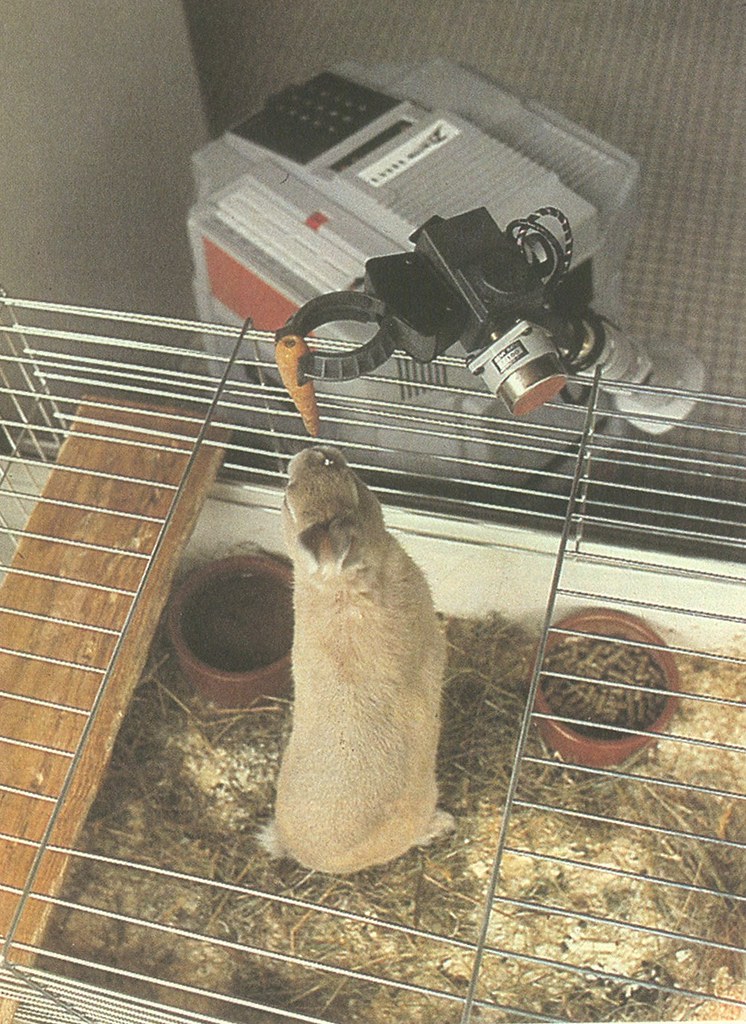
What the HERO 1 actually did — when a program ran — was sense, decide, and act on its small world. The sonar found the range to an obstacle; the light, sound, and motion detectors registered a changing environment; the head turned to aim; the arm, if fitted, reached and gripped; and the Votrax voice, if fitted, announced the result. None of it amounted to practical work, and Heathkit did not pretend otherwise — the robot was marketed to the education and entertainment markets as a platform for learning robotics, circuitry, and the rudiments of artificial intelligence (Wikipedia).
1.4 Where it sat
The HERO 1 arrived at the right moment. By 1982 the 8-bit microprocessor was cheap and well understood, the home-computer boom was underway, and Heathkit — a company whose whole identity was the educational kit — had both the manufacturing base and the instructional-writing tradition to turn a robot into a course of study. The result sold on a scale that few hobby robots ever reached: roughly 14,000 units over its production life (Wikipedia). The price was not trivial — $1,500 as a kit, $2,500 assembled — but it bought a complete, documented, expandable robotics laboratory.
The HERO 1 also anchored a family. Heathkit followed it with the HERO Jr, a
smaller and simpler home-oriented robot with half the RAM (2 KB), and later the
HERO 2000, a far more powerful machine built around an Intel 8088 main
processor with multiple microprocessors and RAM expandable to 576 KB (Wikipedia).
The HERO 1 was the first and, by units sold, the most popular of the line, and
Heathkit supported HERO robots until 1995 (Wikipedia; HERO FAQ). A detailed
comparison of the three sits in _shared/comparison.md.
What makes the HERO 1 worth a deep dive is not that it was capable — it was not, by any practical standard — but that it was complete and completely documented. Every subsystem shipped with a manual: assembly, technical reference, the arm, the voice, remote operation, BASIC, and the accessory ROMs (the ET-18 manual set, freely available today). That documentation makes it possible to take the machine apart, layer by layer, with confidence.
The volumes that follow do exactly that. Vol. 2 examines the 6808 hardware architecture and memory; Vol. 3 the three-wheel drive and the seven stepper motors; Vol. 4 the rotating head and the five-axis arm; Vol. 5 the sonar, light, sound, and motion sensing; Vol. 6 the Votrax SC-01 speech; Vol. 7 the four ways to program and command the robot; and Vol. 8 acquiring, restoring, and interfacing a HERO 1 today. Vol. 9 is the cheatsheet — every hard number in one place.
Comments (0)