Loofbourrow · Volume 8
Legacy, Acquisition & Building One Today
8.1 The book and its reach
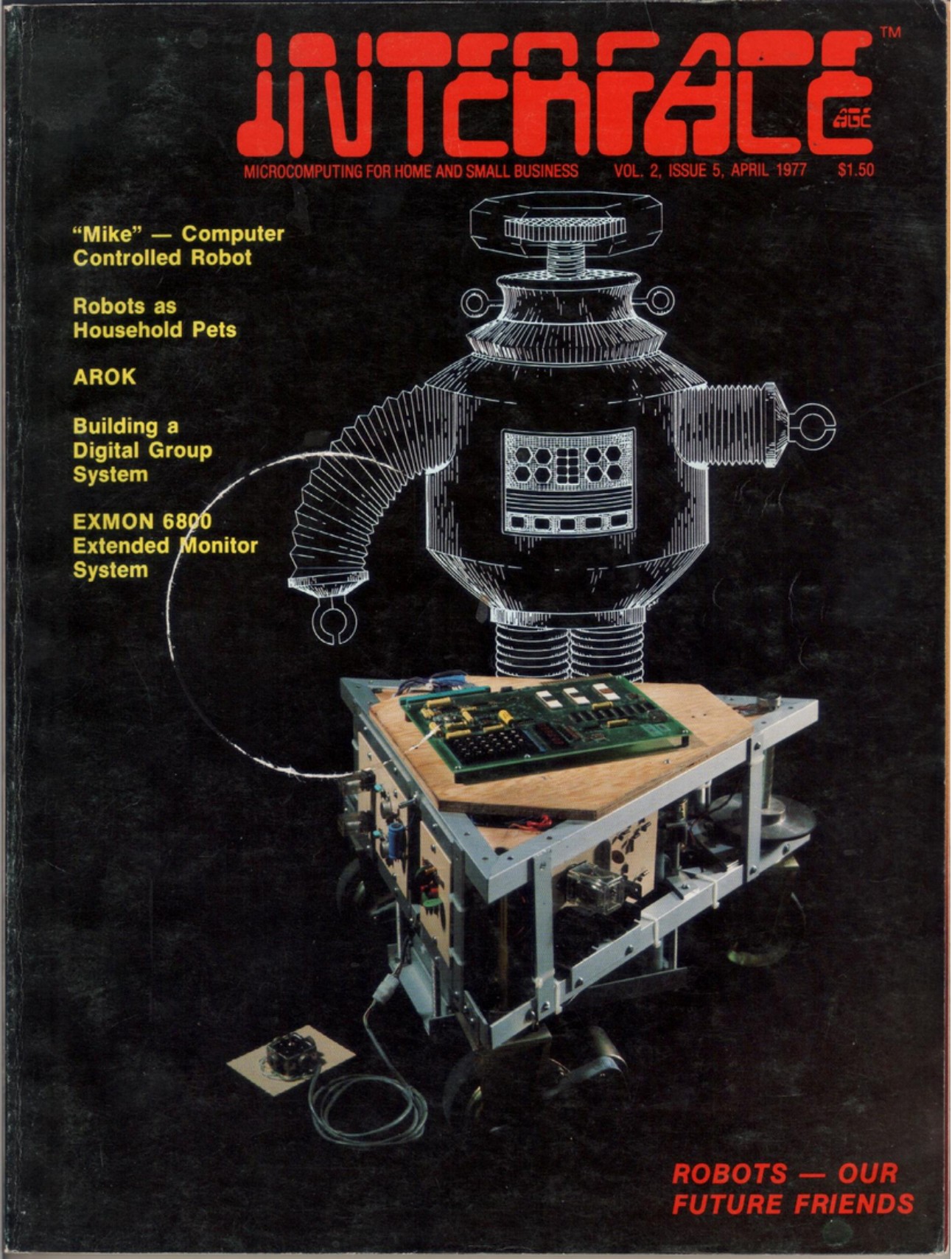
The Interface Age article of April 1977 was the first public documentation of the robot — eleven pages of build narrative, circuit diagrams, and complete 6502 assembly listings, written by Loofbourrow himself when he was fourteen. That documentation circulated within the hobbyist computing community at a moment when the KIM-1 was still a new platform, and it evidently attracted the attention of Hayden Publishing, which approached Loofbourrow to expand the material into a full-length book.
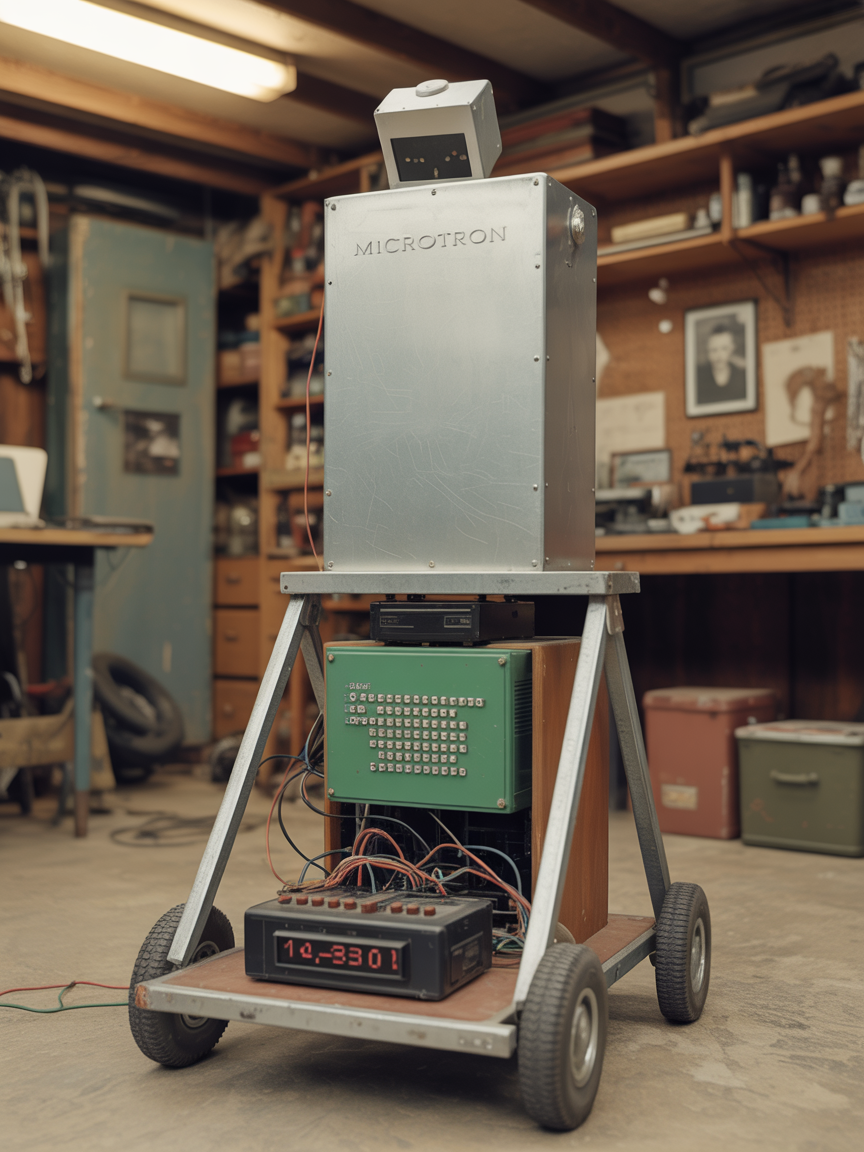
The circumstances of the book’s creation underscore Loofbourrow’s age at the time. Bagnall’s “Tim and Kim” chapter records that Loofbourrow wrote the manuscript on yellow-lined paper, and that his mother transcribed it (Bagnall, “Tim and Kim”). The result was published in 1978 by Hayden — one of the major technical publishers of the era, with a catalogue oriented toward electronics, computing, and engineering — under the title How to Build a Computer-Controlled Robot. The book sold approximately 20,000 copies (daughterofkrypton). For a specialized technical title on microcomputer robotics in the late 1970s, that figure represents a substantial audience: the KIM-1 community alone numbered in the thousands by mid-1977 (Bagnall, “Tim and Kim”), and the book’s premise — a computer-controlled robot built and documented by a teenager — carried appeal well beyond dedicated KIM-1 owners.
The book is the single deepest primary source on the robot’s construction and
programming, covering the rolling base, the KIM-1 interface, and the assembly-language
routines in greater depth than the Interface Age article. At this writing, the book is
held by the Internet Archive under the identifier howtobuildcomput0000loof but is
restricted to the borrow-only, DRM-controlled lending model (inlibrary,
printdisabled); it cannot be freely downloaded or read without an Archive.org lending
session. As a result, the book’s full content has not been directly incorporated into
this volume series. The volumes here are gated against the Interface Age article, the
Bagnall “Tim and Kim” chapter, and other open sources, with the book designated as a
planned enrichment: a future accuracy pass, enabled by an Archive.org lending session,
would be the appropriate way to fold the book’s additional detail into these volumes
without invention.
The fact that a fourteen-year-old’s build notebook, typed up by his mother, became a Hayden technical title that sold roughly twenty thousand copies is itself a datum about the era. The mid-1970s hobbyist computing moment was driven partly by exactly this kind of peer-to-peer documentation: practitioners writing directly about what they had built, for an audience that wanted to replicate or extend it. Loofbourrow’s book stood at the intersection of the KIM-1’s hobbyist reach and the nascent amateur-robotics movement, and it did so before either field had established journals or professional venues for this kind of work.
8.2 The builder after Mike
Loofbourrow’s subsequent career after How to Build a Computer-Controlled Robot is documented only in passing in the sources available to this series. Bagnall’s “Tim and Kim” chapter includes a footnote that reads in full: “Loofbourrow used the revenues from his book to found a Fortune 500 company called Foundation Technologies” (Bagnall, “Tim and Kim,” fn. 3).
This claim is Bagnall’s characterization, presented without elaboration or supporting citation in the source. Two elements of the footnote warrant explicit attention. First, the causal claim — that the company was founded using the book’s revenues — is recorded here as Bagnall’s statement, not as an independently verified fact. Second, the “Fortune 500” designation is a specific and significant characterization: the Fortune 500 is the annual ranking of the five hundred largest U.S. companies by revenue, and the label implies a scale of enterprise considerably beyond a small technology firm. Whether Foundation Technologies met that threshold, and in what period, is not established by the available sources, and the characterization is noted here as potentially overstated. It is cited strictly as what Bagnall writes rather than as an established fact about the company’s size or standing.
The precise nature, founding date, scope, and subsequent history of Foundation Technologies are not documented in any source used for this series. Those details are left explicitly unclaimed.
8.3 Building one today
Recreating the Loofbourrow robot in the present requires addressing a resource constraint that Bagnall’s chapter describes directly. After noting the widespread enthusiasm for the KIM-1 during its peak years, Bagnall writes: “there are not many KIM-1’s left in the world” (Bagnall, “Tim and Kim”). The observation reflects a familiar pattern in retrocomputing: as more capable computers arrived through the late 1970s and early 1980s, hobbyists set aside or repurposed their KIM-1 boards, and many were discarded rather than preserved. A working, unmodified KIM-1 today is a collectible item with a collector’s price and provenance considerations, not a commodity component available from a distributor.
A modern hobbyist approaching a KIM-1 robot build has three broad paths available, each with different tradeoffs. These are presented as general context rather than as recommendations derived from the period sources.
8.3.1 Acquiring an original board
Original KIM-1 boards do appear in collector markets — estate sales, retrocomputing auctions, and online communities organized around vintage computing. Condition and completeness vary widely. For a robot reconstruction following the Loofbourrow design, a board intended for use would require functional I/O ports: the PA pins of the 6530 RRIOTs carry the analog comparator signals from the speed and steering potentiometers (documented in Vol. 5), and any failure in that I/O path undermines the motor interface directly. A working keypad and six-digit LED display, a verified 1 MHz clock rate, and a functional cassette interface would round out the baseline requirements, though a working keypad alone is sufficient to enter programs if the cassette interface is non-functional. Buyers should establish provenance, confirm working condition on the bench before integration, and note any modifications to the board that might affect I/O timing or pin behavior.
8.3.2 Modern replica and clone boards
The KIM-1’s open schematics have enabled a small community of hobbyists to produce modern replica boards that faithfully reproduce the original circuit using contemporary components. These replicas implement the same 6502 processor and 6530 RRIOT architecture, expose the same I/O pin assignments, and run the original TIM monitor ROM. That compatibility means the 6502 assembly listings from the Interface Age article — the initialization routine, the speed-control loop, the manual joystick-control table, and the steering table (documented in Vol. 7) — can be entered and executed on a replica without modification. A replica board also eliminates the risk of damaging an original. The tradeoff is that a modern replica’s physical dimensions and mounting-hole layout may differ from the original KIM-1’s form factor, requiring adaptation of the mounting board Loofbourrow fabricated from plywood and attached to the aluminum chassis frame (documented in Vol. 3).
8.3.3 Software emulation
Software emulators for the 6502 architecture, and for the KIM-1 specifically, are available as a third option. Emulation allows the assembly listings from the Interface Age article to be loaded, stepped through, and debugged without any physical hardware. This path is useful for understanding the control logic — the joystick-direction decoding table, the speed-step transitions, the steering-angle selection — before committing to a hardware build. It does not substitute for the physical interface between the KIM-1’s I/O pins and the robot’s motor-control circuitry: the op-amp comparators, the relay H-bridge, and the steering-motor relay chain (Vols. 4 and 5) are hardware elements that emulation cannot exercise.
8.3.4 Safety considerations for the power system
The Loofbourrow robot runs on a 12 V car battery — a sealed lead-acid source that
can deliver very high short-circuit currents. Any build or restoration work involving
this power system carries real hazards. The pack must be fused before connection to the
drive circuitry; the terminals must never be shorted, as a direct short can weld tools
and start fires; and charging must take place on a non-flammable surface in a ventilated
space. The mains-side charger for a lead-acid pack should be inspected for cracked line
cords and failed strain reliefs and verified with a meter before use. Full guidance
applicable to this class of vintage robot build — covering sealed lead-acid packs,
mains-powered chargers, and mechanical hazards from drive motors — is in
_shared/safety.md (§ Batteries and § Electrical). Any restoration or rebuild content
derived from this series should carry those warnings.
8.4 Where Mike is now
The present location, condition, and ownership of the actual robot are not documented in any source available to this series. The Interface Age article describes the rolling Stage I chassis as of early 1977; secondary reporting cited by cyberneticzoo places the robot at roughly six feet tall and seventy pounds by 1996 (Inc., 1996, via cyberneticzoo). Nothing in the primary or secondary material establishes what became of the machine after that point — whether it was preserved, transferred to a collection, modified further, or otherwise disposed of is unknown.
That gap is stated plainly here. The robot’s current whereabouts and condition are not claimed, not inferred, and not speculated upon.
Comments (0)